
GMLRS Guided Rocket Specs, Range, Variants and Operators
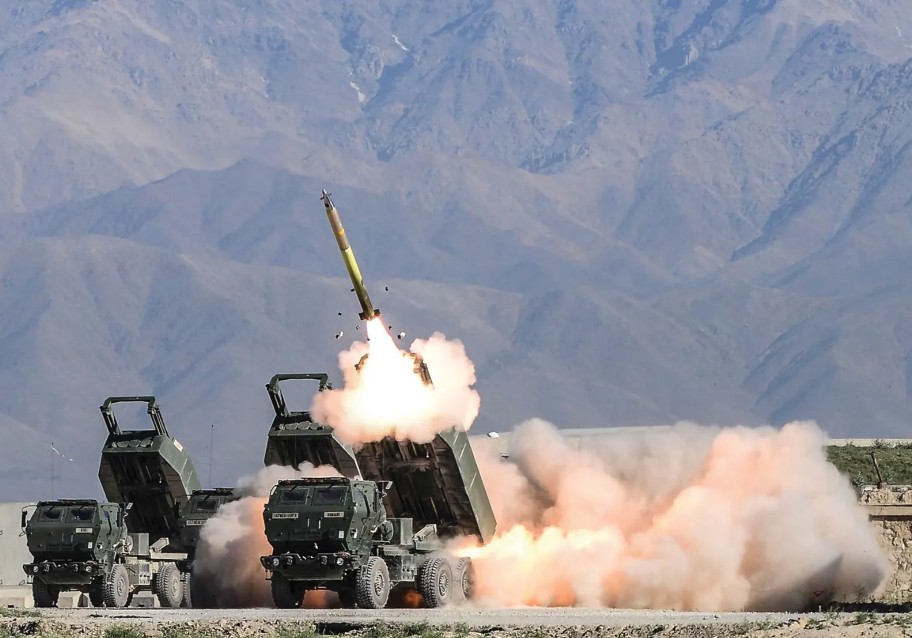
GMLRS is the guided 227mm rocket that made HIMARS famous, a GPS-steered round with roughly 70 to 84 kilometers of range that Lockheed Martin now builds at a rate climbing toward 14,000 a year. More than 60,000 have been produced, and in Ukraine it turned rocket artillery from an area weapon into a precision sniper of bridges, depots and command posts.
What is GMLRS
The Guided Multiple Launch Rocket System grew from a simple observation, unguided MLRS rockets in Desert Storm saturated grid squares, but commanders increasingly needed to hit buildings. Adding a GPS-aided inertial guidance package and canards to the 227mm rocket family produced a weapon accurate to a few meters at any range, which changed the economics of rocket artillery entirely, one rocket per target instead of a pod per grid square.
Lockheed Martin builds GMLRS at Camden, Arkansas, and the round flies from both launchers in the family, six per pod on the M142 HIMARS and twelve across two pods on the tracked M270.
GMLRS specifications and range
| Item | Detail |
|---|---|
| Designation | M30 / M31 family, 227mm guided rocket |
| Manufacturer | Lockheed Martin Missiles and Fire Control |
| Length | About 3.9 m |
| Weight | Roughly 300 kg per rocket |
| Guidance | GPS-aided inertial with canard control |
| Range | Approximately 15 to 70+ km; often cited to 84 km |
| Warhead | 200-lb class unitary (M31) or Alternative Warhead (M30A1/A2) |
| Accuracy | Within a few meters, GPS-dependent |
| Launchers | M142 HIMARS (6), M270/M270A2 (12), MARS II and allied variants |
GMLRS variants, M30, M31 and ER
| Variant | Warhead | Notes |
|---|---|---|
| M30 | DPICM submunitions | Original version; retired as cluster policy changed |
| M30A1/A2 AW | Alternative Warhead, ~182,000 tungsten fragments | Area effects without unexploded submunitions |
| M31/M31A1/A2 | 200-lb unitary blast-fragmentation | The workhorse point-target round |
| GMLRS-ER | Unitary or AW, new motor and tail-driven control | Roughly 150 km; in production and fielding |
The Alternative Warhead matters more than it sounds, it delivers cluster-like area effects against personnel and soft vehicles while leaving no unexploded bomblets behind, keeping the round usable under cluster-munitions policies. GMLRS-ER roughly doubles reach by fitting a larger motor in the same pod footprint, closing part of the gap to ballistic missiles at rocket prices.
GMLRS combat record
GMLRS debuted in Iraq in 2005 and spent two decades as the precision backbone of US and British fires in Iraq and Afghanistan, where troops called it the 70-kilometer sniper. Ukraine made it a household name, HIMARS-launched GMLRS strikes from mid-2022 hit ammunition depots, headquarters and the Antonivsky bridge, effects that Ukrainian commanders credit, in operator-reported accounts, with forcing Russian logistics back beyond rocket range. The same campaign exposed the round’s dependency, dense Russian GPS jamming has, per operator-reported and US official acknowledgments, degraded accuracy at times and pushed upgrades to jam-resistant guidance.
The bridge strikes deserve their own line in the record. Dropping a span requires hitting the same aim point repeatedly, something area rockets could never do; Ukrainian crews walked successive GMLRS rounds into the Antonivsky bridge’s deck until it was unusable, a mission profile previously reserved for aircraft-delivered bombs. That repeatable precision, more than any single spectacular strike, is what changed how planners value the round.
Who operates GMLRS and production
Operators include the United States and more than a dozen allies, the United Kingdom, Germany, France, Italy, Finland, Poland, Romania, the Baltic states, Australia, and other HIMARS and M270 users across Europe, the Gulf and the Pacific. Poland and Australia have signed for local involvement, with Australia standing up domestic GMLRS assembly under a 2024 agreement. Lockheed has pushed annual production from around 10,000 toward a stated 14,000 rockets, the fastest ramp of any Western precision munition, though tube artillery like the K9 Thunder still fires far cheaper shells for closer work.
GMLRS frequently asked questions
What is the range of GMLRS?
Standard rockets reach roughly 70 kilometers, with figures to 84 km cited; the extended-range GMLRS-ER roughly doubles that to about 150 kilometers.
How accurate is GMLRS?
Within a few meters under normal GPS conditions; heavy jamming can degrade accuracy, which newer guidance updates address.
How much does a GMLRS rocket cost?
Roughly $160,000 per round in recent US budget documents, against about $1.3 million or more for an ATACMS missile.
What is the GMLRS Alternative Warhead?
A warhead containing about 182,000 tungsten fragments that delivers area effects without leaving unexploded submunitions on the battlefield.
Which launchers fire GMLRS?
M142 HIMARS carries six rockets and the M270 family carries twelve; European MARS II and allied M270 variants fire it as well.
- US Army budget justification documents
- Lockheed Martin product literature and production statements
- Wikipedia – M270 and GMLRS articles (accessed October 2026)
- Operator-reported accounts of GMLRS employment in Ukraine
- Defence & Tech reporting on precision fires production