Egypt Seeks 24 More Rafale F4 Jets, Eyeing a 78-Aircraft Fleet
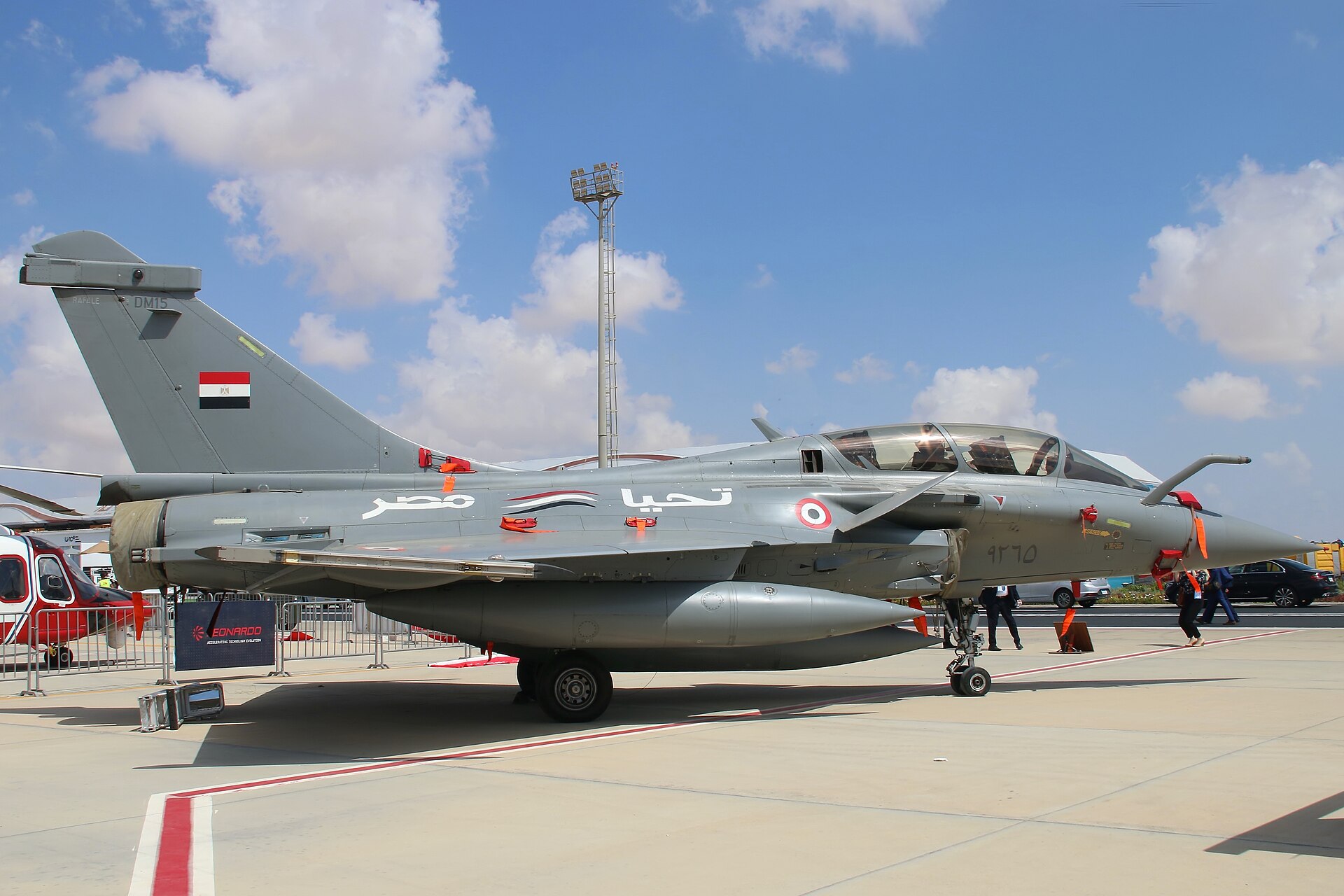
Cairo has asked Dassault Aviation for 24 more Rafale fighters, according to French newspaper La Tribune, a request that would make Egypt the largest Rafale export operator in the world with 78 aircraft. Neither the Egyptian government nor Dassault has confirmed the report, and no contract has been signed.
What Happened
La Tribune reported in early September that Egypt submitted a request for proposal (RFP) to Dassault Aviation covering 24 additional Rafale fighters, which the report said would likely be built to the F4 standard. The outlet EDR Magazine, which covered the request after Dassault appeared at the Egyptian International Airshow (EIAS) 2026, said Dassault chairman and chief executive Eric Trappier did not confirm or deny the new order when asked, telling reporters only that “Egypt recognises the Rafale as a unique ‘game changer’ ensuring its role in defending the country’s sovereignty.” Dassault declined to comment directly on the RFP, and the Egyptian Ministry of Defence has made no public statement on it.
The Defense Post, which separately confirmed the La Tribune report through its own sourcing, cautioned that the story rests on a single media account rather than an official announcement, and that unnamed analysts it spoke with flagged financing as the main open question. As of late October, more than a month and a half after the report first surfaced, no outlet has reported a signed contract, and this remains an unconfirmed request rather than an established fact.
The Aircraft: Rafale F4
The Rafale is a twin-engine, delta-wing multirole fighter built by Dassault Aviation of France. The F4 standard, the newest production configuration, adds upgrades over the F3R version Egypt currently flies, including improved connectivity between aircraft, enhanced sensor fusion, and support for newer precision munitions. Egypt’s existing F3R jets carry the Thales RBE2 active electronically scanned array (AESA) radar, MBDA’s Meteor beyond-visual-range air-to-air missile, the MICA air-to-air missile, the AASM Hammer precision-guided bomb, and the SCALP-EG cruise missile — the last of which was held up for Egypt’s second order under US ITAR export-control rules because of American-origin components, delaying that contract until the issue was resolved.
France has offered Egypt financing on favorable terms for its two previous Rafale purchases: ten-year loans underwritten by French state-backed banks. Dassault’s production line is currently also working through orders from India, Indonesia, and Serbia, so a third Egyptian order would have to be slotted into an already crowded delivery schedule.
Egypt’s Rafale Fleet: Confirmed Numbers
Egypt became Dassault’s first export customer for the Rafale in 2015, signing for 24 jets — 16 two-seat DM variants and 8 single-seat EM variants — in a contract valued at roughly $5 billion. A second contract followed in 2021 for 30 more aircraft in the newer F3R configuration (12 two-seat, 18 single-seat), valued at about $3.75 billion. As of the September reporting, 8 of those 30 F3R jets had been delivered, with the remainder scheduled to leave Dassault’s Bordeaux-Mérignac line over the following two years. The Egyptian Air Force expects to have 54 Rafales in operational service by the end of 2026, flown by the 203rd Tactical Fighter Wing out of Gebel El-Basur Air Base. A 2017 option attached to the original 2015 contract for 12 extra jets was cancelled after France’s Ministry of Economy and Finance raised concerns, a reminder that financing questions have derailed Egyptian Rafale add-ons before.
If the new 24-jet request is confirmed and converted into a signed contract, Egypt’s total would reach 78 Rafales — more than France’s own air force currently operates of the type, and more than any other export customer, surpassing Qatar (36), India (36), Indonesia (42 on order), Greece (24), Croatia (12), and the United Arab Emirates (80 on order but not yet delivered in full).
Why Egypt Wants More Rafales
The driver, according to multiple outlets citing Egyptian and French defense sources, is the age of Egypt’s F-16 fleet. The Egyptian Air Force operates more than 200 American-built F-16s — Block 15, 32, 40 and 52 variants delivered between 1982 and 2013 — the oldest of which are approaching the end of their structural service lives. Egypt has also chafed at US restrictions on weapons integration for the F-16, including the lack of approval for long-range air-to-air missiles, a limitation that reportedly pushed Cairo toward European and other suppliers for its newer combat aircraft. The Rafale, flying with the Meteor missile, gives Egypt a beyond-visual-range capability its F-16 fleet lacks.
Dassault has also moved to deepen its industrial footprint in Egypt. At EIAS 2026, the company signed a training agreement with Egypt’s state-owned Arab Organisation for Industrialisation (AOI), which separately signed a memorandum of understanding with Safran to support maintenance of the Rafale’s M88 engine inside Egypt — a step that, if it proceeds, would reduce Egypt’s reliance on sending engines back to France for overhaul.
Global Competitors
Egypt’s air force has diversified its fighter inventory more than most in the region, also operating Russian MiG-29M/M2s and, per earlier reporting, continuing to weigh other options. The Defense Post noted that Egypt retains alternatives to the Rafale, including Chinese-made fighters, though no source has specified a model or confirmed active Egyptian interest in a Chinese jet to date. Regionally, Egypt’s F-16 replacement decision contrasts with Gulf states that have leaned toward the F-15EX and F-35 (where the US permits sales) or, as with the UAE, large Rafale orders of their own.
Why It Matters
A confirmed order for 24 more Rafales would be one of the largest fighter contracts negotiated by any African or Middle Eastern air force in 2026, and it would mark the first time any Rafale customer has flown more of the jet than the French Air and Space Force itself. For Dassault, a third Egyptian order — on top of India’s, Indonesia’s and Serbia’s — would further stretch a production line already near capacity, with implications for delivery timelines across all of its customers. For Egypt, locking in a third decade of Rafale purchases would cement a shift away from reliance on US-origin combat aircraft that began with the 2015 contract, continuing even as Cairo’s defense budget has contracted in recent years.
What Happens Next
The request is still at the proposal stage. Egypt would need to secure financing — most likely another French state-backed loan package — and Dassault would need to find room in a production schedule already committed to India, Indonesia and Serbia before any contract could be signed. Given that a similar Egyptian option was cancelled in 2017 over financing concerns, and that Cairo’s current reporting is based on a single, unconfirmed French newspaper account, Defense & Tech will treat this as an open request until Cairo or Dassault issues an official confirmation.
FAQ
Has Egypt signed a contract for 24 more Rafale jets?
No. As of late October 2026, the only public reporting is a request for proposal described by French newspaper La Tribune and relayed by specialist outlets including EDR Magazine and The Defense Post. Neither the Egyptian government nor Dassault Aviation has confirmed a signed deal.
How many Rafales does Egypt already have?
Egypt has ordered 54 Rafales across two contracts: 24 in 2015 and 30 more in 2021. The Egyptian Air Force expects all 54 to be in operational service by the end of 2026.
Why is Egypt buying Rafales instead of more F-16s?
Egypt’s F-16 fleet, delivered between 1982 and 2013, is aging, and the US has restricted some weapons integration on those jets, including long-range air-to-air missiles. The Rafale, paired with the Meteor missile, gives Egypt a beyond-visual-range capability its F-16s do not have.
What is the Rafale F4 standard?
F4 is Dassault’s newest production configuration of the Rafale, adding improved networking between aircraft, upgraded sensor fusion, and compatibility with newer precision-guided munitions compared with the F3R jets Egypt currently operates.
Would 78 Rafales make Egypt the largest Rafale operator?
If the new request is confirmed and fulfilled, Egypt’s 78 Rafales would exceed the number currently in French Air and Space Force service and would be more than any other export customer has taken delivery of to date, though the United Arab Emirates has a larger order (80 jets) still being delivered.
Sources
- La Tribune, “Égypte: la demande qui pourrait faire de Dassault Aviation le premier fournisseur…” (September 2026) — original report of the 24-jet RFP, cited by all outlets below.
- EDR Magazine (Alan Warnes), “EIAS 2026 – Egypt’s Rafale numbers set to increase,” September 14, 2026, edrmagazine.eu — fleet history, Trappier quote, AOI/Safran M88 agreement.
- The Defense Post, “Egypt Seeks More Rafale Jets From France,” September 3, 2026, thedefensepost.com — F-16 replacement context, financing analysis, production-queue details.
- Migflug Afterburner, “Egypt Asks Dassault for 24 More Rafales, Taking Its Fleet to 78,” migflug.com — fleet-total arithmetic and comparison to other export customers.
- Janes, “Egypt activates Rafale contract” — historical confirmation of the 2015 and 2021 contract terms.