ZALA Lancet Specs, Range, Warhead and Combat Record
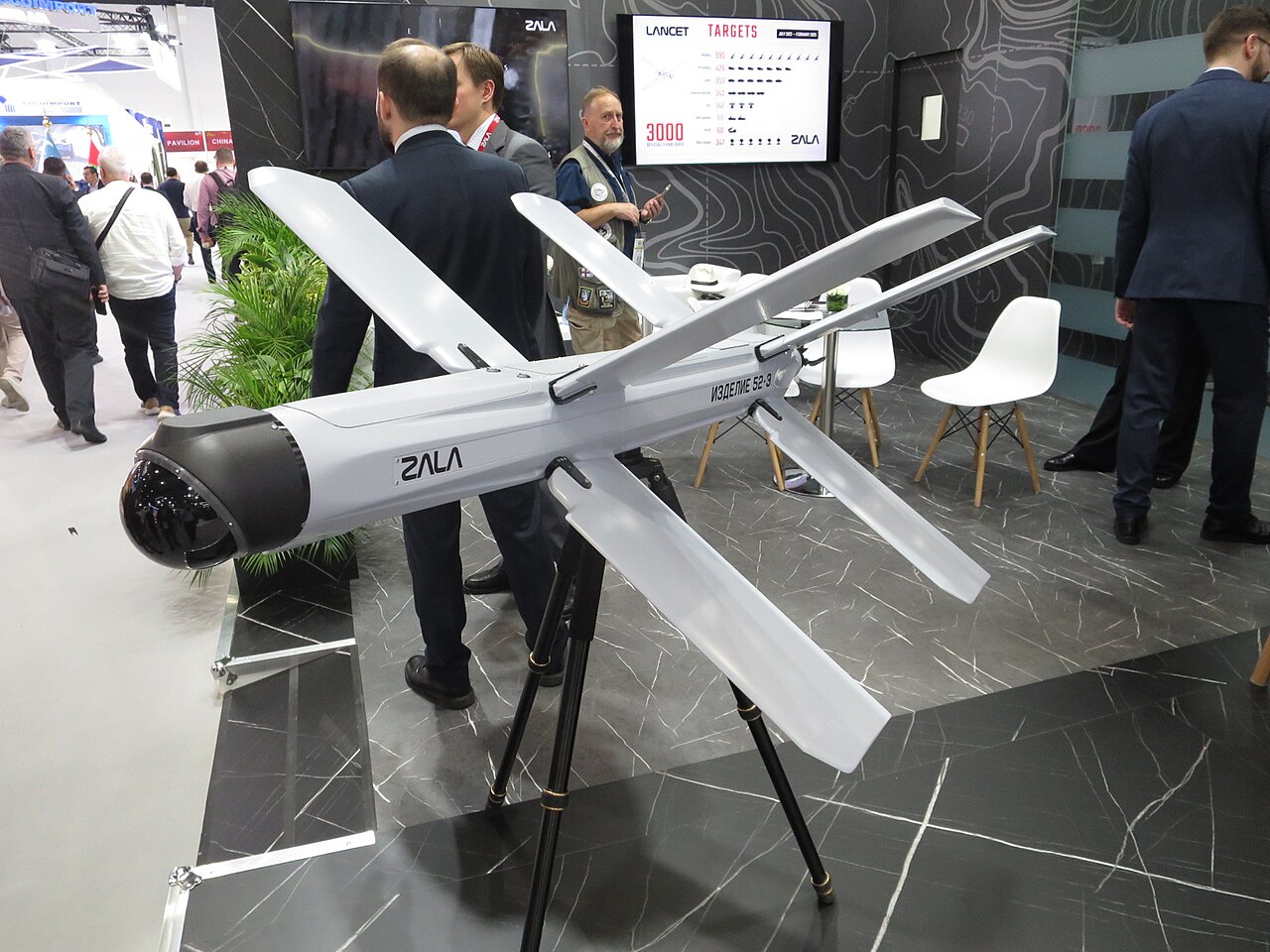
The ZALA Lancet is a Russian loitering munition with a claimed range of about 40 km and a warhead of up to roughly 3 kg, and it has become one of the most recognizable strike drones of the war in Ukraine. It is produced by ZALA Aero, part of the Kalashnikov Concern, and is aimed mainly at artillery, air defenses and armor.
What is the ZALA Lancet
The Lancet is a small, fixed-wing loitering munition with an X-shaped wing and tail layout. It is launched from a rail, flies to a target area under operator control and dives onto a chosen target, using an electro-optical seeker and a data link. It is often called a kamikaze drone, and our explainer on loitering munitions describes the category.
ZALA Aero was founded by Alexander Zakharov in Izhevsk, and the Kalashnikov Concern took control of it in the mid-2010s. The Lancet was first shown publicly in 2019, and Russian sources reported its use in Syria before it became widespread in Ukraine from 2022. The design appears in our top 10 loitering munitions ranking with notes on its reliability.
Lancet specifications
| Parameter | Lancet-1 | Lancet-3 | Status |
|---|---|---|---|
| Launch weight | About 5 kg | About 12 kg | Manufacturer claims |
| Warhead | About 1 kg | Up to about 3 kg | Manufacturer claims |
| Range | About 40 km | Up to about 40 km (later variants claimed higher) | Manufacturer claims |
| Endurance | About 30 min | About 40 min | Manufacturer claims |
| Speed | About 80 to 110 km/h, dive faster | About 80 to 110 km/h, dive faster | Manufacturer claims |
| Guidance | Operator-guided, electro-optical | Operator-guided, electro-optical and thermal options | Reported |
| Launch | Catapult rail | Catapult rail | Reported |
Lancet-1 vs Lancet-3
Two main variants exist. The smaller Lancet-1, also known as Izdeliye 51, is meant for soft targets and short ranges. The larger Lancet-3, or Izdeliye 52, carries a heavier warhead and flies longer, making it suitable for strikes against artillery, radar vehicles and armored vehicles. Newer models are said to have improved seekers, machine-vision target recognition and greater range, and Russian state media has made strong claims for them. Those claims are promotional and cannot be confirmed from outside.
ZALA has also marketed the Lancet abroad. A Lancet was displayed at the IDEX defense show in Abu Dhabi in 2025, which points to export ambitions even while the drone is under Western sanctions.
How effective is the Lancet drone
Russian sources and videos posted by pro-Russian channels show Lancets striking Ukrainian artillery, air-defense radars and Western-supplied vehicles. Ukrainian officials have acknowledged the threat and, in operator-reported accounts, have described losses of guns and vehicles to loitering munitions, while also saying that many Lancets are jammed, shot down or miss. Both sides publish selective footage, so the true hit rate is unknown.
The Lancet’s effect is mostly about forcing change. Ukrainian crews began camouflaging, hiding guns under cages and nets, moving more often, and using electronic warfare to protect vehicles. That has raised costs for both sides. Russian use has also moved toward single operator-guided strikes on high-value targets, rather than mass salvos like Shahed attacks. Our comparison of Bayraktar TB2 and Shahed-136 shows how different drone doctrines have shaped this war.
How to counter the Lancet
Countermeasures include netting and cage armor over vehicles, small arms and shotguns against incoming drones, radio-frequency jamming, and interceptor drones. Because the Lancet relies on a video and control link, disrupting that link can make it crash or lose the target. Western and Ukrainian engineers are working on cheaper mobile defenses, and readers can explore related concepts in our explainer on electronic countermeasures.
| Method | How it helps | Limitation |
|---|---|---|
| Cage and net armor | Detonates or deflects drone on contact | Adds weight, blocks sensors |
| Jamming | Breaks control and video link | Drone may use different frequencies |
| Interceptor drones | Collide with or shoot down the Lancet | Needs operator skill and early warning |
| Camouflage and dispersal | Makes targets harder to find | Slows operations |
Lancet frequently asked questions
What is the range of the Lancet drone?
Manufacturer claims put the Lancet-3 at about 40 km, with newer variants claimed to go farther.
Who makes the Lancet?
ZALA Aero, a subsidiary of the Kalashnikov Concern, manufactures it in Russia.
How much does a Lancet cost?
Estimates vary widely, often in the range of tens of thousands of dollars, and no official price is published.
Can the Lancet be jammed?
Yes. It relies on a data link and navigation, and jamming has forced it to crash or miss in some reported cases.
How does the Lancet compare with the Switchblade?
Both are loitering munitions, but the Switchblade is US-made and smaller, while the Lancet-3 is heavier with a larger warhead.
- Kalashnikov Concern and ZALA Aero product literature (manufacturer claims)
- Ukrainian military statements (operator-reported)
- Wikipedia – ZALA Lancet (accessed October 2026)
- Defence & Tech reporting