P-8 Poseidon Specs, Variants, Cost and Operators
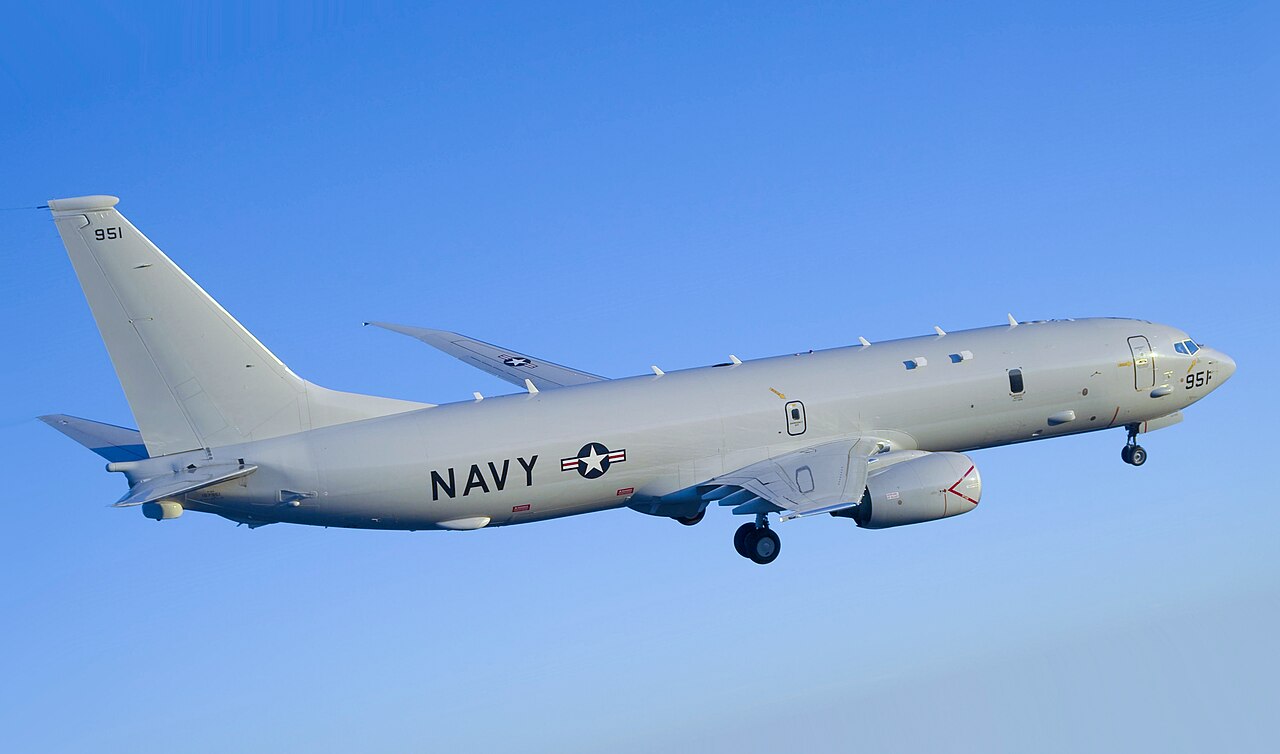
The P-8 Poseidon is Boeing’s 737-based maritime patrol aircraft, a nine-person submarine hunter and surface-ship killer that has been adopted by about nine nations since entering US Navy service in 2013. It replaced the propeller-driven P-3 Orion with a jet that can cross an ocean quickly, then linger over it listening for submarines.
What is the P-8 Poseidon
The P-8 is a militarized Boeing 737-800 with the wings of the 737-900 and a weapons bay in the rear fuselage. It was developed in the 2000s under the US Navy’s Multi-mission Maritime Aircraft program, beating a Lockheed Martin proposal, and first flew in 2009. Initial operational capability followed in 2013.
Its purpose is anti-submarine warfare, anti-surface warfare and intelligence gathering over the sea. Patrol aircraft drop sonobuoys, listening devices that float on the surface and transmit acoustic data, and use radar and electro-optical sensors to find ships. That mission matters more as submarine fleets grow; see our explainers on how sonar works and towed-array sonar for what the aircraft is hunting for.
P-8 Poseidon specifications
| Parameter | Value |
|---|---|
| Manufacturer | Boeing Defense, Space & Security |
| Base aircraft | Boeing 737-800ERX derivative |
| Crew | 9 in US Navy service (2 pilots plus mission crew) |
| Length / wingspan | About 39.5 m / 37.6 m (129 ft 5 in / 123 ft 6 in) |
| Max takeoff weight | About 85,800 kg (189,200 lb) |
| Engines | 2 x CFM56-7B27A turbofans, about 27,000 lbf each |
| Max speed | About 907 km/h (490 knots) |
| Service ceiling | About 12,500 m (41,000 ft) |
| Range | Roughly 2,200 km with four hours on station; ferry range well above 7,000 km |
| Radar | AN/APY-10 multi-mission surface search radar |
| Unit cost | Roughly $145 million or more, rounded program figure |
P-8 Poseidon weapons and sensors
The P-8 carries Mk 54 lightweight torpedoes, Harpoon anti-ship missiles and depth charges, stored in an internal bay and on wing pylons. It can launch a large number of sonobuoys from chutes in the fuselage and uses an acoustic processor to analyze the returns. The AN/APY-10 radar detects ships and periscopes, and it can produce synthetic-aperture radar images of coastlines.
Crews use the P-8 as a networked node rather than a stand-alone bomber. It passes tracks to destroyers, submarines and other aircraft, often from beyond the range of any threat. It also works alongside the MQ-4C Triton surveillance drone, which widens coverage. Newer aircraft and upgrades add improved data links and the ability to carry additional sonobuoys.
P-8 Poseidon variants and operators
| Operator | Variant | Notes |
|---|---|---|
| United States Navy | P-8A | Lead operator with well over 100 aircraft |
| India | P-8I Neptune | Export version with Indian communications and sensors; additional aircraft reported under consideration |
| Australia (RAAF) | P-8A | Fleet of around a dozen aircraft |
| United Kingdom (RAF) | Poseidon MRA1 | Nine aircraft; based at Lossiemouth |
| Norway | P-8A | Five aircraft replacing P-3 and Falcon 20 |
| South Korea | P-8A | Six aircraft ordered |
| Germany and Canada | P-8A | Ordered to replace aging P-3C and CP-140 aircraft |
| New Zealand | P-8A | Four aircraft for the RNZAF |
The UK’s return to maritime patrol after retiring the Nimrod in 2010 was a notable operator decision, as Britain had relied on allies to fill the gap for several years. India’s P-8I, meanwhile, is a separate build with the same airframe. The aircraft is built by Boeing, whose broader business is described in our Boeing Defense, Space and Security profile.
The P-8 has no significant combat record of shooting down or sinking enemy vessels. Its operational record consists of patrols, surveillance during regional crises and anti-submarine exercises, plus tracking of foreign submarines near allied waters. Submarine detection results are almost entirely classified.
P-8 Poseidon vs P-3 Orion and other patrol aircraft
The P-3 could loiter at low altitude for longer, but the P-8 flies higher, faster and farther, so it covers more ocean per hour. Its weakness is endurance at very low altitude, which is why the Navy pairs it with unmanned aircraft. Competing designs include the Airbus-based C295 MPA and Kawasaki’s P-1 from Japan, though none matches the P-8’s sensor fusion. Submarines remain the target; our top 10 attack submarines ranking shows what crews are trying to find.
P-8 Poseidon frequently asked questions
What is the P-8 Poseidon used for?
Anti-submarine warfare, anti-ship strike and maritime surveillance.
How much does a P-8 Poseidon cost?
Roughly $145 million or more per aircraft in rounded program reporting.
What aircraft is the P-8 based on?
The Boeing 737-800, with 737-900 wings and military modifications.
Which countries fly the P-8?
The United States, India, Australia, the United Kingdom, Norway, South Korea and New Zealand, with Germany and Canada ordering.
What replaced the P-3 Orion?
The P-8 Poseidon replaced the P-3 in US Navy service.
- US Navy and Boeing P-8 product literature
- SIPRI Arms Transfers Database
- Wikipedia – Boeing P-8 Poseidon (accessed October 2026)
- Defence & Tech reporting on maritime patrol aircraft