AS21 Redback Specs, Armament, Protection and Operators
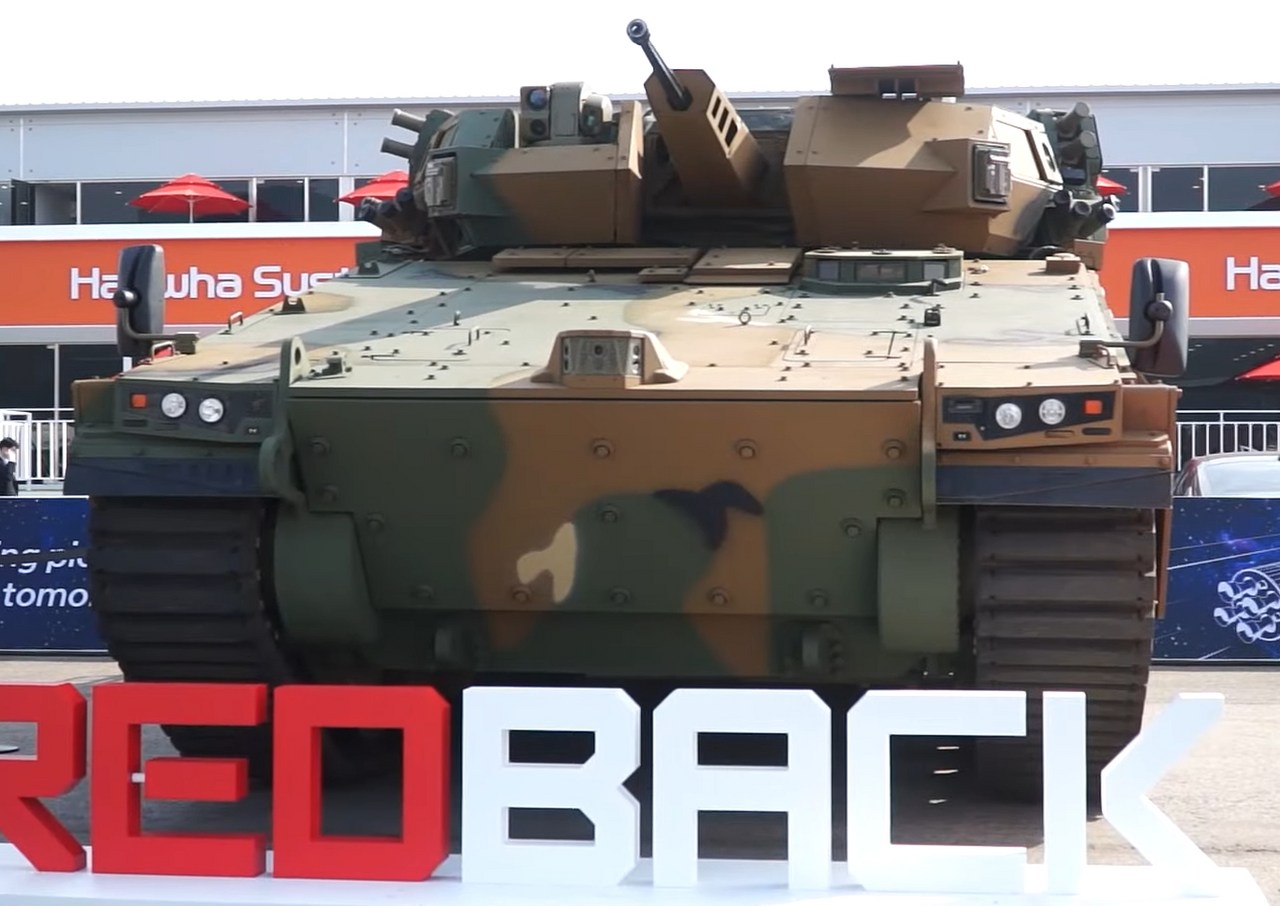
The AS21 Redback is the roughly 42-tonne infantry fighting vehicle with which South Korea’s Hanwha won Australia’s LAND 400 Phase 3 competition, a contract for 129 vehicles signed in December 2023. Built on the firepower heritage of the K21 and the running gear lineage of the K9 howitzer, the Redback is the first Korean armored vehicle designed from the outset for a Western export customer.
AS21 Redback specifications
| Item | Detail |
|---|---|
| Type | Tracked infantry fighting vehicle |
| Manufacturer | Hanwha Aerospace (Hanwha Defense Australia for AS21) |
| Combat weight | Roughly 42 tonnes depending on fit |
| Crew | 3 (commander, gunner, driver) plus 8 dismounts |
| Main armament | 30mm Mk44S Bushmaster II in a two-person turret |
| Secondary armament | 7.62mm coaxial machine gun; anti-tank guided missile launcher option |
| Engine | MTU diesel of around 1,000 hp, drivetrain shared with the K9 family |
| Road speed | Around 65 km/h |
| Range | Roughly 520 km on roads |
| Tracks | Composite rubber tracks, reducing weight, noise and vibration |
How the Redback was developed
Hanwha developed the AS21 specifically for Australia’s LAND 400 Phase 3 requirement to replace Vietnam-era M113 carriers. Rather than offer the in-service K21, which is lighter and optimized for Korean terrain, the company designed a heavier, better-protected vehicle around Australian survivability demands, borrowing the powerpack philosophy of the K9 Thunder self-propelled howitzer already in Australian service as the AS9 Huntsman.
After a three-year trial against the Rheinmetall Lynx KF41, Canberra selected the Redback in July 2023 and signed for 129 vehicles that December, with production centered at Hanwha’s Armoured Vehicle Centre of Excellence in Geelong, Victoria. Deliveries run into the late 2020s, and the first Australian-built hulls began emerging from Geelong roughly two years after signature.
AS21 Redback turret and weapons
The Redback carries a two-person turret developed with Australian industry, armed with the 30mm Mk44S Bushmaster II cannon that has become the Western IFV standard, a 7.62mm coaxial gun, and provision for anti-tank guided missiles that give it reach against armor beyond cannon range. A panoramic commander’s sight and independent gunner’s sight support hunter-killer engagements, and the sensor fit includes an infrared search and track function for spotting threats passively.
Just as important is what the turret plugs into. The vehicle was designed for an active protection system and full sensor fusion from the start rather than retrofitted, part of why it prevailed in trials against a strong German rival.
Protection and mobility
Protection is the Redback’s calling card. The hull accepts modular passive armor, a V-shaped belly and energy-absorbing seats address mines and IEDs, and an active protection system is integrated to intercept incoming projectiles. Hanwha has not published protection levels, but the roughly 42-tonne weight, against about 26 tonnes for the Korean K21, says most of the growth went into survivability.
Mobility comes from a diesel of around 1,000 horsepower driving composite rubber tracks, a first for a vehicle of this weight class at selection. The tracks cut running noise and vibration dramatically, which crews notice over long road marches, and in-arm hydropneumatic suspension smooths cross-country running. Road speed is around 65 km/h with roughly 520 km of range.
The choice of rubber tracks was not cosmetic. Australian trials put heavy emphasis on crew fatigue and interior noise over the long distances of the country’s north, and the composite tracks reportedly shaved tonnes of weight against a steel-link equivalent while simplifying field maintenance. It is the kind of detail that decided a competition in which both finalists met the core firepower and protection thresholds.
Who operates the AS21 Redback
Australia is the launch customer with 129 vehicles for the Army’s 3rd Brigade in Townsville. In Korea, the type informs Hanwha’s next-generation IFV offerings, and the company is marketing Redback derivatives to European customers including Poland and Romania, leaning on the export momentum documented in our Hanwha Aerospace company profile. No second firm order had been announced as of this writing, though Hanwha’s record of converting trials into contracts is strong.
AS21 Redback frequently asked questions
What is the AS21 Redback?
A roughly 42-tonne tracked infantry fighting vehicle developed by South Korea’s Hanwha for Australia, carrying three crew and eight dismounts behind a 30mm cannon.
How many Redbacks did Australia order?
129 vehicles under a December 2023 contract, built at Hanwha’s Geelong facility in Victoria for the Army’s 3rd Brigade.
What gun does the AS21 Redback use?
The 30mm Mk44S Bushmaster II chain gun, with a 7.62mm coaxial machine gun and an anti-tank guided missile option.
Is the Redback based on the K21?
It draws on K21 and K9 technology but is a heavier, newly designed vehicle with composite rubber tracks and substantially more protection.
Who competed against the Redback in Australia?
Rheinmetall’s Lynx KF41; the Redback won selection in July 2023 after extended comparative trials.
- Australian Department of Defence LAND 400 Phase 3 announcements
- Hanwha Aerospace product literature (manufacturer figures)
- Wikipedia – AS21 Redback (accessed October 2026)
- Defence & Tech reporting on Korean defense exports