
Meteor, the Ramjet Missile That Changed Air Combat Math
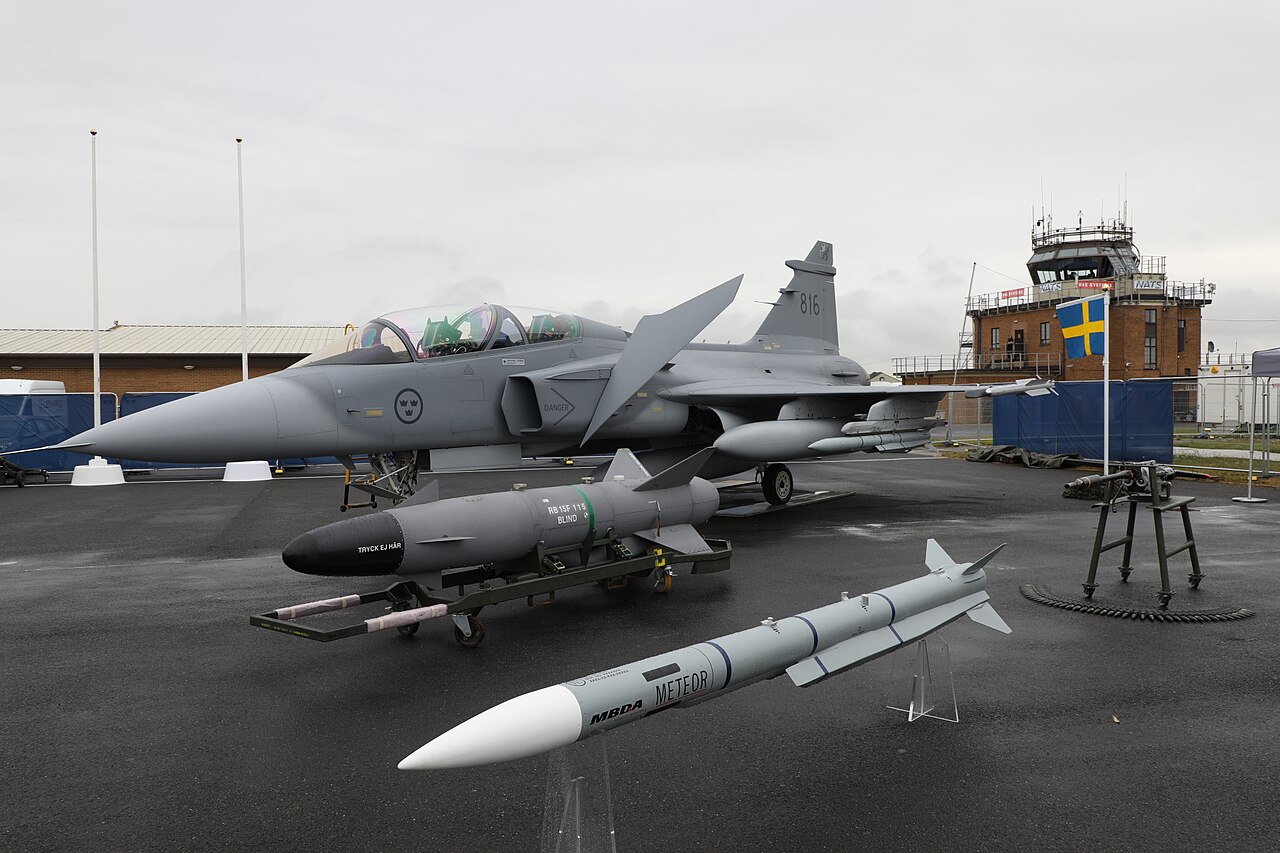
Meteor is Europe’s ramjet-powered air-to-air missile, a six-nation MBDA weapon in service since 2016 whose throttleable motor gives it a no-escape zone manufacturer claims put at several times that of conventional rivals. Officially credited with range “in excess of 100 kilometers” and Mach 4-class speed, it is the missile European fighters lead with, and the reason they can.
What makes Meteor different
Every conventional air-to-air missile has the same flaw, its rocket burns out seconds after launch, leaving it coasting, and bleeding energy through every maneuver that follows. Meteor replaces the rocket with a throttleable ducted rocket, a solid-fuel ramjet that breathes air and meters thrust across the entire flight. The missile can cruise efficiently, then throttle up in the endgame, arriving at a maneuvering target with energy to spare rather than on fumes.
Conceived to defeat sustained-turn tactics that could out-fly coasting missiles, the weapon was developed by MBDA for the United Kingdom, France, Germany, Italy, Spain and Sweden, a rare six-nation program, run by the missile house profiled in our MBDA company profile, that actually delivered. Development formally began in 2002 after the UK chose Meteor over an extended AMRAAM for the Typhoon, and the long road to 2016 service entry reflected both the novelty of the propulsion and the choreography of six national test programs.
Meteor missile range and no-escape zone
MBDA states range only as “in excess of 100 kilometers”; independent analysts commonly estimate 200 kilometers or more for high-altitude launches, since a fast, high shooter hands the ramjet both altitude and free kinetic energy at ignition. The more meaningful metric is the no-escape zone, the envelope within which a target cannot outrun or out-turn the missile, which manufacturer claims put at up to three times that of conventional medium-range missiles, a figure often quoted around 60 kilometers. Because the ramjet sustains speed through the terminal phase, Meteor’s effective lethal envelope shrinks far less against a fleeing target than a ballistic-coasting weapon’s does.
Meteor specifications
| Item | Detail |
|---|---|
| Type | Beyond-visual-range air-to-air missile |
| Propulsion | Throttleable ducted rocket (solid-fuel ramjet) by Bayern-Chemie |
| Speed | Mach 4 class |
| Range | Officially 100+ km; analyst estimates around 200 km |
| Seeker | Active radar, AD4A family heritage, with two-way datalink |
| Warhead | Blast-fragmentation, proximity and impact fuzing |
| Length / diameter | 3.65 m / 178 mm |
| Weight | About 190 kg |
| Service entry | 2016, Gripen; Rafale and Typhoon from 2018 |
Meteor missile vs AMRAAM
Against the AMRAAM family, Meteor trades production scale for endgame energy. The AIM-120 is cheaper, made in vastly greater numbers, integrated on more aircraft types than any Western missile, and carries a real combat record, advantages renewed by the record $20.7 billion AMRAAM contract. Meteor answers with kinematics, where an AIM-120D arrives coasting at extreme range, Meteor arrives under power. The two-way datalink also reports missile status back to the shooter, letting pilots manage multi-missile engagements with better information. China’s PL-15 and America’s coming AIM-260 bracket the same problem from the dual-pulse-rocket direction.
Which fighters carry Meteor
| Fighter | Status |
|---|---|
| Saab Gripen C/D and E | First to field, 2016; core Gripen E weapon |
| Dassault Rafale | Integrated with F3-R standard from 2018 |
| Eurofighter Typhoon | In service with program nations from 2018 |
| KF-21 Boramae | Test-fired during development; planned for Korean service |
| F-35 (UK, Italy) | Integration planned under Block 4, timeline has slipped |
Through those platforms Meteor reaches operators from India and Indonesia with the Rafale to Brazil with the Gripen E, plus Gulf Rafale customers. Export approval travels with the aircraft, giving European jets a distinctive selling point in every campaign, one weighed in our Rafale vs Typhoon comparison. No confirmed combat use has been publicly documented.
Meteor frequently asked questions
What is the range of the Meteor missile?
Officially “in excess of 100 km”; analysts commonly estimate around 200 km from high-altitude launch.
Why does Meteor use a ramjet?
The throttleable ducted rocket sustains thrust through the whole flight, preserving speed and maneuver energy in the terminal phase where coasting missiles are weakest.
Is Meteor better than AMRAAM?
It holds the kinematic edge at long range; AMRAAM counters with cost, production volume, combat record and broader integration. Mission and platform decide.
Which countries use Meteor?
The six program nations, UK, France, Germany, Italy, Spain and Sweden, plus export operators of Rafale, Gripen and Typhoon, including India, Brazil, Indonesia and Gulf states.
Has Meteor been used in combat?
No confirmed combat employment has been publicly documented as of 2026.
- MBDA product literature (manufacturer claims noted)
- Wikipedia – Meteor (missile) (accessed October 2026)
- Program nation statements on integration milestones
- Defence & Tech reporting on BVR missile programs