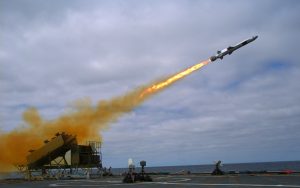

RIM-116 RAM, the Missile That Rolls for a Living

RAM is the missile that rolls: a German-American interceptor that spins in flight, homes on an attacker’s own radar emissions or heat, and packs 21 shots into a launcher that needs no shipboard radar of its own. Battle-tested against Houthi missiles in the Red Sea and fielded by ten navies, the RIM-116 owns the awkward zone between the Phalanx gun and the fleet’s big missiles.
What is the RIM-116 RAM
The Rolling Airframe Missile began in 1976 as a US-German program, General Dynamics with Diehl, today Raytheon and Germany’s RAM-System GmbH, to give ships a cheap, fast, fire-and-forget layer against sea-skimming missiles. Its economy came from theft: Sidewinder’s rocket motor and warhead, Stinger’s seeker lineage, wrapped in a five-inch airframe that spins like a rifle bullet. The result arms everything from US carriers and amphibs to German corvettes and, in its 21-round box, asks nothing of the ship but power and a threat cue.
Why it rolls, the guidance trick
Rolling lets two seeker antennas interferometrically track an emitter with the simplicity of one channel, so the baseline RAM homes passively on the incoming missile’s own radar seeker, no shipboard illumination, no emissions, no jamming handle for the attacker. Against radar-silent threats the dual-mode seeker hands over to imaging infrared. That passive-first logic makes RAM uniquely resistant to the electronic tricks that complicate other interceptors and explains the 95-percent-plus accuracy the program advertises from hundreds of test shots.
Specifications and Block 2
| Item | Detail |
|---|---|
| Guidance | Passive RF homing plus imaging IR; IR-only and dual modes |
| Range / speed | 9+ km / Mach 2+ |
| Launchers | Mk 49 with 21 rounds; SeaRAM with 11 |
| Block 2 | Larger 15.88 cm motor, four-axis control, upgraded seeker for maneuvering supersonic threats |
| Unit cost | Roughly $900,000-1 million per round |
| Makers | Raytheon and RAM-System GmbH (Diehl/MBDA Deutschland) |
SeaRAM, the autonomous version
SeaRAM bolts RAM’s firepower onto Phalanx’s brain: the CIWS dome’s search and track radars and FLIR, with the Gatling swapped for an 11-missile magazine. The hybrid needs no combat-system integration at all, making it the bolt-on defense of choice for destroyers forward-deployed against saturation threats and for ships whose own radars are otherwise occupied, and it has become standard kit on US destroyers rotating through Rota for exactly the Red Sea-style missile environment it anticipated.
Block 2 and the drone turn
Block 2 was designed for supersonic maneuvering sea-skimmers, bigger motor, independent canard control, sharper seeker, but its war arrived slower and cheaper: drones and subsonic cruise missiles in salvo. Against those, RAM’s virtues invert, the passive seeker ignores decoy emitters poorly and a million-dollar round trades badly against a $20,000 drone, which is why the US Navy now sequences RAM behind guns and EW rather than ahead of them and why magazine reloads at sea, long neglected, headline every fleet exercise since 2024. The missile remains the terminal layer’s best insurance; the Red Sea simply repriced when to spend it.
Combat use and operators
The Red Sea campaign of 2023-24 took RAM from range scores to war scores, with US warships crediting the family among the layers that stopped Houthi cruise missiles and drones inside the terminal zone, engagements whose details stay classified but whose survivals are public. Ten navies operate the missile, the US and Germany foremost, with Japan, South Korea, Turkey, whose MILGEM corvettes carry it, Greece, Egypt, Saudi Arabia, Mexico and the UAE completing the club, and Block 2 production runs hot against exactly the drone-and-missile mix fleet air defense now expects everywhere.
Frequently asked questions
What does RAM stand for?
Rolling Airframe Missile; the RIM-116 spins in flight as part of its guidance scheme.
How does RAM home on targets?
Passively, on the attacker’s own radar emissions, with imaging infrared as the terminal or alternate mode, no shipboard radar illumination needed.
What is the difference between RAM and SeaRAM?
RAM’s Mk 49 launcher holds 21 missiles cued by the ship; SeaRAM packages 11 missiles with Phalanx’s own autonomous sensors.
Has RAM seen combat?
Yes; it is credited within the layered defenses that defeated Houthi missiles and drones in the Red Sea from 2023.
Which countries use RAM?
The US, Germany, Japan, South Korea, Turkey, Greece, Egypt, Saudi Arabia, Mexico and the UAE.
- Wikipedia – RIM-116 Rolling Airframe Missile (accessed October 2026)
- US Navy and program statements on Red Sea employment
- Raytheon/RAM-System documentation