
UAE Taps South Korea’s Hanwha to Build Layered Air Defense Shield

UAE Taps South Korea’s Hanwha to Build Layered Air Defense Shield
Abu Dhabi-based EDGE Group and South Korea’s Hanwha Systems signed a term sheet on September 16, 2026, to jointly develop and eventually locally produce a multi-layered air defense network for the United Arab Emirates, spanning the long-range L-SAM interceptor, additional M-SAM (Cheongung-II) batteries and K239 Chunmoo rocket artillery. The framework, signed in Abu Dhabi by Hanwha Systems chief executive Yang Ki-won and EDGE Group chief executive Hamad Al Marar, moves the two companies beyond a customer-supplier relationship and toward a joint venture built around technology transfer and phased domestic manufacturing. It comes roughly six months after Iranian ballistic missiles and drones struck the UAE, including a THAAD radar site near Al Ruwais, giving Abu Dhabi direct combat experience with the Korean-made interceptors it already operates.
What Happened
According to EDGE Group and Hanwha statements confirmed by Korean and Gulf trade press, the two companies signed a term sheet at EDGE’s Abu Dhabi headquarters establishing a framework for a local joint venture, technology transfer arrangements and phased in-country production. The document is explicitly preliminary: both sides describe it as an initial step that requires government approvals and further negotiation on structure, ownership and production scope before any binding contract is signed.
Yang Ki-won said the term sheet “marks a turning point for Hanwha and EDGE to move into a strategic partnership that shares technologies and industrial capabilities for integrated air defense networks,” while Al Marar framed the deal as going “beyond the acquisition of individual weapon systems, with a focus on strengthening the UAE’s sovereign air defence capabilities.” Neither company published a monetary figure for the new agreement.
The Systems Involved
L-SAM: a new capability for the UAE
The Long-range Surface-to-Air Missile (L-SAM) is South Korea’s upper-tier interceptor, developed by Hanwha Aerospace and LIG Nex1 as the top layer of the Korea Air and Missile Defense (KAMD) architecture. Seoul completed L-SAM development in November 2024 and approved a 1.73 trillion won (roughly $1.19 billion) production budget through 2030, with initial deployment to South Korean forces targeted for 2027. The system is designed to engage ballistic and cruise missile threats at altitudes above roughly 40 kilometers with missiles capable of Mach 8.82 terminal speeds, occupying a niche comparable to the upper tier of THAAD. L-SAM would be an entirely new addition to the UAE’s inventory; Abu Dhabi has reportedly held exploratory interest in the system since at least early 2025.
M-SAM/Cheongung-II: already combat-tested in UAE service
The medium-range M-SAM, marketed as Cheongung-II, is already fielded by the UAE under a $3.5 billion contract signed in 2022 — Abu Dhabi was the system’s first export customer. It engages targets at 20-50 kilometers range and 15-40 kilometer altitude. Korean trade press reported that Cheongung-II batteries intercepted Iranian missiles fired at the UAE during the February-April 2026 strikes, a performance that reportedly boosted investor confidence in manufacturer LIG Nex1. The new term sheet covers additional M-SAM batteries and associated multifunction radars beyond the original contract.
K239 Chunmoo: rocket artillery moving into local production
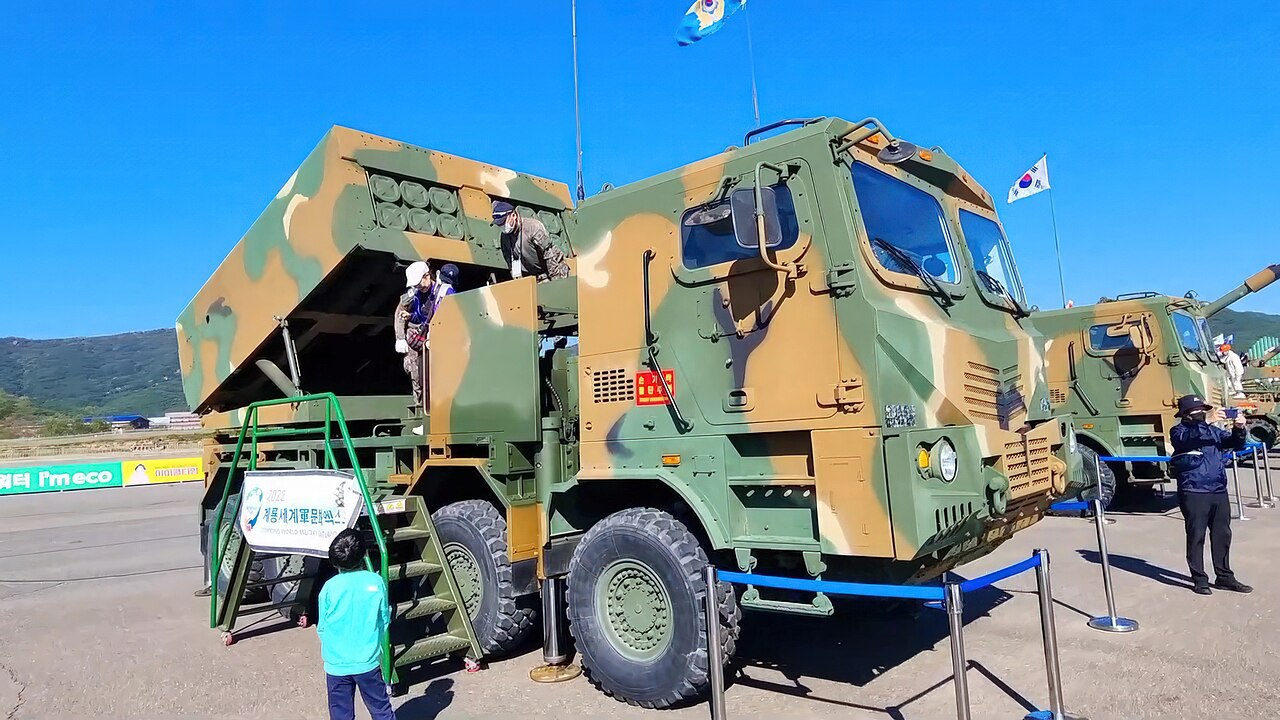
The K239 Chunmoo is a South Korean multiple rocket launcher system, in service since 2015 and capable of firing both guided rockets and short-range tactical ballistic missiles from a common launcher. The UAE already operates 12 units. The new agreement envisions expanding that fleet and, notably, developing local production capacity for the system in the UAE rather than continuing outright imports.
Who Uses These Systems
Confirmed M-SAM/Cheongung-II operators: South Korea (original operator), the United Arab Emirates (since 2022), Saudi Arabia (contracted February 2024, roughly $3.2 billion for 10 batteries) and Iraq (contracted September 2024, roughly $2.8 billion). L-SAM currently has one confirmed operator, South Korea, with production not yet complete; UAE interest is reported but not yet contracted. K239 Chunmoo is operated by South Korea and the UAE, with a separate, unrelated contract for 18 launchers signed by Croatia in September 2026.
Export and Procurement History
Hanwha’s Middle East footprint has expanded steadily since 2022: the UAE’s original $3.5 billion M-SAM deal included a $1.01 billion radar package from Hanwha Systems, followed by Saudi Arabia’s 2024 order and Iraq’s 2024 contract. Hanwha Systems has also supplied radar components to Saudi Arabia separately, in an $867 million deal reported in mid-2024. Hanwha has publicly floated L-SAM exports to the UAE’s EDGE Group since at least February 2025, meaning the September 2026 term sheet formalizes discussions that predate the recent Iranian strikes rather than originating from them. EDGE Group, formed in 2019 from more than 20 merged Emirati defense entities, reported a $12.8 billion order backlog and $4.9 billion in 2024 revenue, and has separately supplied naval drone helicopters to Angola this year, part of a broader push to become a net exporter rather than a pure buyer of foreign systems.
Global Competitors
The UAE’s air defense procurement sits alongside its existing US-supplied THAAD and Patriot batteries, both of which absorbed damage and depleted interceptor stocks during the 2026 Iran war; open-source estimates cited by regional press put UAE THAAD/Patriot interceptor holdings as high as 1,000 rounds, against a US Patriot inventory that fell below 1,000 interceptors and a THAAD stockpile down to roughly 250 by mid-2026. Israel’s Barak-8/MR-SAM family, jointly developed with India, competes for the same medium-range niche as Cheongung-II among Gulf and South Asian buyers, while Europe’s SAMP/T and France’s Aster missile family remain the main Western alternative for long-range coverage outside the US THAAD/Patriot ecosystem. South Korea’s pitch — Cheongung-II and Chunmoo already combat-proven on Emirati soil, paired with promised local production and technology transfer that Washington has been comparatively slower to offer for THAAD-class systems — is central to Seoul’s case for displacing a larger share of Gulf air defense budgets.
Why It Matters
For the UAE, the deal continues a shift toward diversifying air defense suppliers beyond the United States while building sovereign production capacity, a lesson reinforced when the February-April 2026 Iranian barrage strained even US interceptor stockpiles across the region. For South Korea, the term sheet extends a broader export drive that has already made Seoul a significant supplier to Saudi Arabia and Iraq, and positions the UAE — via EDGE — as a potential manufacturing and re-export hub for Korean air defense technology across the wider Middle East. The inclusion of L-SAM is the more consequential element: it would mark the system’s first export interest of any kind, ahead of even South Korea’s own full operational deployment.
What Happens Next
Both companies describe the term sheet as a framework requiring further negotiation and UAE and South Korean government approval before a binding joint-venture agreement or production contract is signed. Neither side has published a timeline for finalizing terms, and L-SAM’s own South Korean production run is not scheduled to reach initial deployment until 2027, which will likely set the pace for any UAE-bound variant or export clearance.
FAQ
Is this a signed weapons contract?
No. It is a term sheet — a preliminary framework for a joint venture, technology transfer and local production — not a binding procurement contract. Structure, scope and pricing remain subject to further negotiation and government approval.
Does the UAE already operate these systems?
The UAE already operates Cheongung-II (M-SAM) batteries, purchased in 2022, and 12 K239 Chunmoo launchers. L-SAM would be a new system for the UAE; South Korea itself has not yet completed L-SAM’s initial deployment.
Did Iranian strikes on the UAE drive this deal?
They likely accelerated it and demonstrated Cheongung-II’s combat performance, but Hanwha and EDGE were reportedly discussing L-SAM exports as early as February 2025, before the February-April 2026 Iranian missile and drone attacks on the UAE.
How does this compare to the UAE’s US-supplied systems?
THAAD and Patriot remain the backbone of UAE missile defense, but both systems saw stockpiles strained during the 2026 Iran war. The Hanwha-EDGE framework offers an additional, diversified layer with a stronger local-production and technology-transfer component than the UAE’s US-sourced systems.
Sources
- Army Recognition, “EDGE and Hanwha Deepen UAE Integrated Air Defense Cooperation,” September 2026 — deal terms, Iranian attack statistics, prior contract figures. armyrecognition.com
- The Korea Times, “Hanwha, EDGE to build UAE’s integrated air defense network,” September 17, 2026 — signing details, CEO quote, Hanwha’s Gulf export history. koreatimes.co.kr
- Defence Industry EU, “EDGE and Hanwha Explore UAE Joint Venture and Local Production of L-SAM, M-SAM and Chunmoo Integrated Air Defence Systems,” September 2026 — systems list, both CEOs’ quotes. defence-industry.eu
- KED Global, “LIG Nex1 shares surge as its Cheongung-II missile defense in UAE intercepts Iranian strikes,” March 2026 — Cheongung-II combat performance in the UAE. kedglobal.com
- KED Global, “S.Korea’s Hanwha eyes L-SAM exports with UAE’s EDGE,” February 2025 — origin of L-SAM export discussions predating the 2026 strikes. kedglobal.com
- The Defense Post / Korea Times, L-SAM development completion and production budget reporting, 2024-2026 — L-SAM technical specifications and deployment timeline.
- Global Defense Corp / KED Global, Saudi Arabia and Iraq Cheongung-II contract reporting, 2024 — regional M-SAM export figures.
- CNN and Eurasian Times, UAE THAAD radar damage and US interceptor inventory reporting, March-July 2026 — competitor system stockpile context.