US Navy Evaluates Japanese, South Korean and Turkish Frigates to Replace Constellation
The U.S. Navy has begun formally evaluating three foreign frigate designs — Japan’s upgraded Mogami class, South Korea’s Chungnam class and Turkiye’s Istanbul class — as it looks for a way to rebuild surface combatant numbers after the collapse of the Constellation-class programme. The review, first reported on 1 September, is due to report in November.
Acting Secretary of the Navy Hung Cao ordered the assessment under an August directive. It examines what officials have described as a “Finland model,” in which an allied shipyard builds the first hulls to a proven design while technology, tooling and production know-how transfer to American yards for subsequent ships. The framework under discussion would set aside roughly $1.85 billion in fiscal 2027 funding for up to two overseas-built lead ships, with construction shifting to U.S. yards from the third hull onward.
Why the Navy is shopping abroad
The Constellation class was supposed to avoid precisely this outcome. Based on Fincantieri’s FREMM design, it was pitched as a low-risk parent-design programme that would deliver a capable frigate quickly by resisting the temptation to redraw a working ship. That discipline did not hold. Successive modifications pushed commonality with the parent design down sharply, weight and cost grew, and schedules slipped by years before the programme was truncated.
The result is a fleet arithmetic problem. The Navy needs hulls in numbers it cannot currently produce, at a moment when Chinese yards are launching surface combatants at a tempo no Western shipbuilding base matches. Buying a design that is already in serial production somewhere else is an admission that the domestic path has not worked — and, its advocates argue, the only route to ships in the water this decade.
The three candidates
The designs under review are notably different from one another, which suggests the Navy has not yet settled on what it wants the ship to do.
Mitsubishi Heavy Industries’ upgraded Mogami is the largest at roughly 6,200 tonnes and 142 metres, with a 17-metre beam. Its distinguishing feature is manning: an automated crew of about 90, the leanest of the three. For a navy under sustained pressure on recruitment and retention, that number carries real weight. The design also has an export track record, having been selected by Australia.
South Korea’s Chungnam class sits in the middle at about 4,300 tonnes and 129 metres, crewed by roughly 120. South Korean yards bring something the others do not — demonstrated high-volume warship output and, through Hanwha’s acquisition of the Philadelphia shipyard, an existing foothold in American shipbuilding.
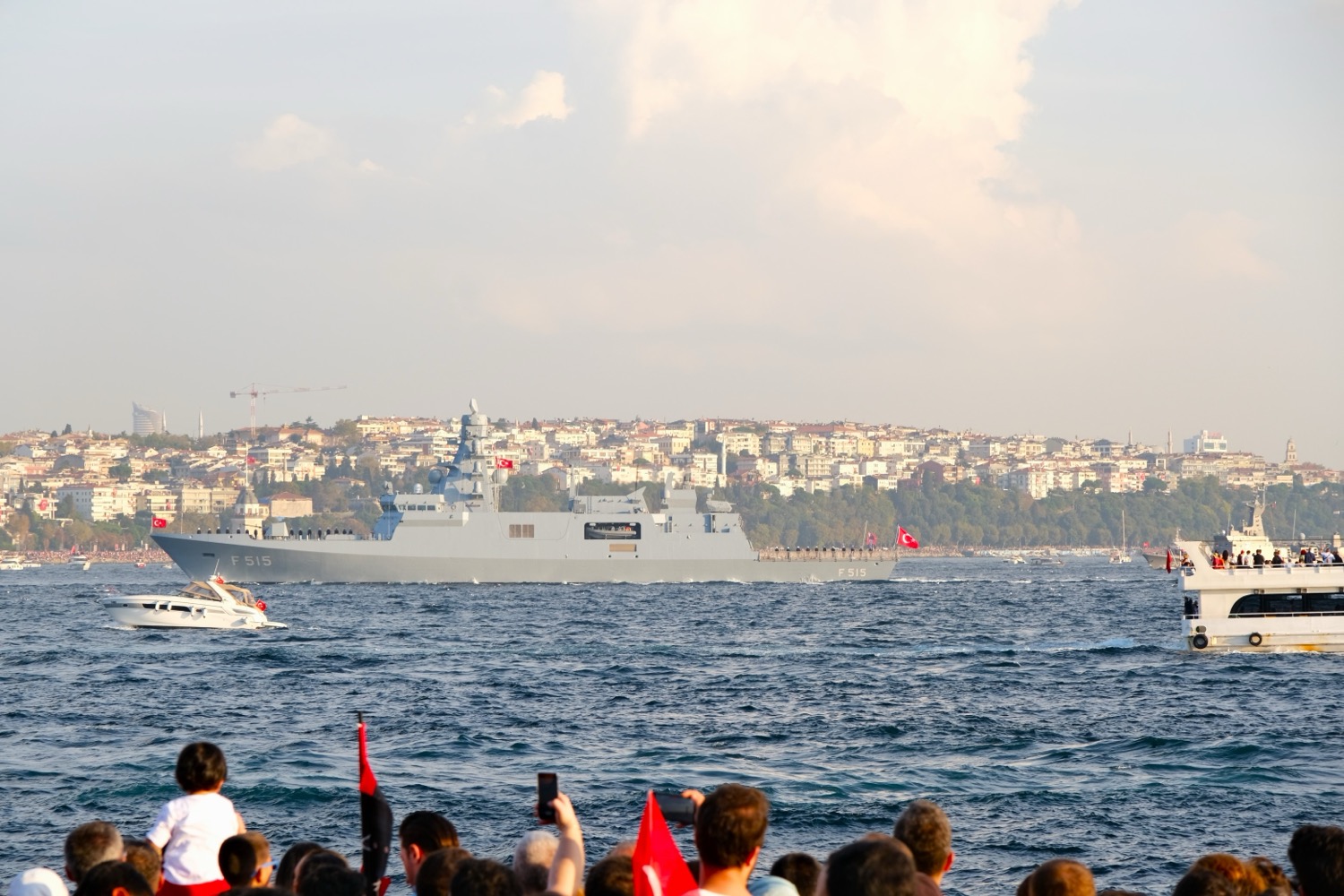
Turkiye’s Istanbul class is the smallest and cheapest at roughly 3,000 tonnes and 113 metres, with a complement of about 123. Built at Istanbul Naval Shipyard as the evolution of the Ada-class corvettes under the MILGEM programme, it is a domestically designed ship with a high proportion of Turkish systems, including the ASELSAN-supplied combat management and sensor suite and ROKETSAN’s ATMACA anti-ship missile. Its inclusion in a U.S. Navy shortlist is the most striking element of the review — no Turkish warship design has previously been considered for American service.
What each choice would mean
The size spread is not incidental. A 6,200-tonne Mogami and a 3,000-tonne Istanbul-class ship are answers to different questions. The larger design offers growth margin — magazine depth, power and cooling for future radars and directed-energy weapons — at higher unit cost. The smaller one offers numbers.
Whichever design is chosen, the practical obstacles are substantial. A foreign combat system would need to be reconciled with U.S. Navy networks, weapons and certification standards, and integrating the Aegis-derived architecture the service prefers is neither quick nor cheap. American shipyards would need to absorb a foreign design’s engineering data package, which the Constellation experience suggests is harder than programme documents assume. Congressional politics around building warships overseas will be its own contest, and existing law restricts naval construction in foreign yards.
The wider signal
For the shipbuilding industries of Japan, South Korea and Turkiye, the review is a validation independent of its outcome. Being assessed as a credible source of a frontline U.S. Navy combatant is a form of certification that carries into every other export competition.
For Turkiye in particular, it lands at a point when the MILGEM lineage has already found buyers in Pakistan and Ukraine, and when Turkish yards have been steadily expanding their share of the mid-sized surface combatant market. Whether or not the Istanbul class advances, its presence on the list reflects how far Turkish naval design and systems integration have moved in a decade.
The November report will not, by itself, settle anything. It will inform a decision that runs through the fiscal 2027 budget process and a Congress that has its own views about where American warships are built. But the fact that the question is being asked at all is the story: the U.S. Navy has concluded it cannot solve its frigate problem alone.
Sources
- USNI News, “Japanese, South Korean, Turkish Warships Under Consideration for New U.S. Frigate Competition,” 1 September 2026
- Army Recognition, “US Navy eyes three foreign frigate designs to rapidly match China’s growing production rates,” September 2026
- The War Zone, “The Three Foreign Frigates Being Studied For Possible U.S. Navy Service,” September 2026
- Asia Times, “US shops allied frigates to close China shipbuilding gap,” September 2026