MiG-31 Foxhound Specs, Radar, Missiles and Kinzhal Role
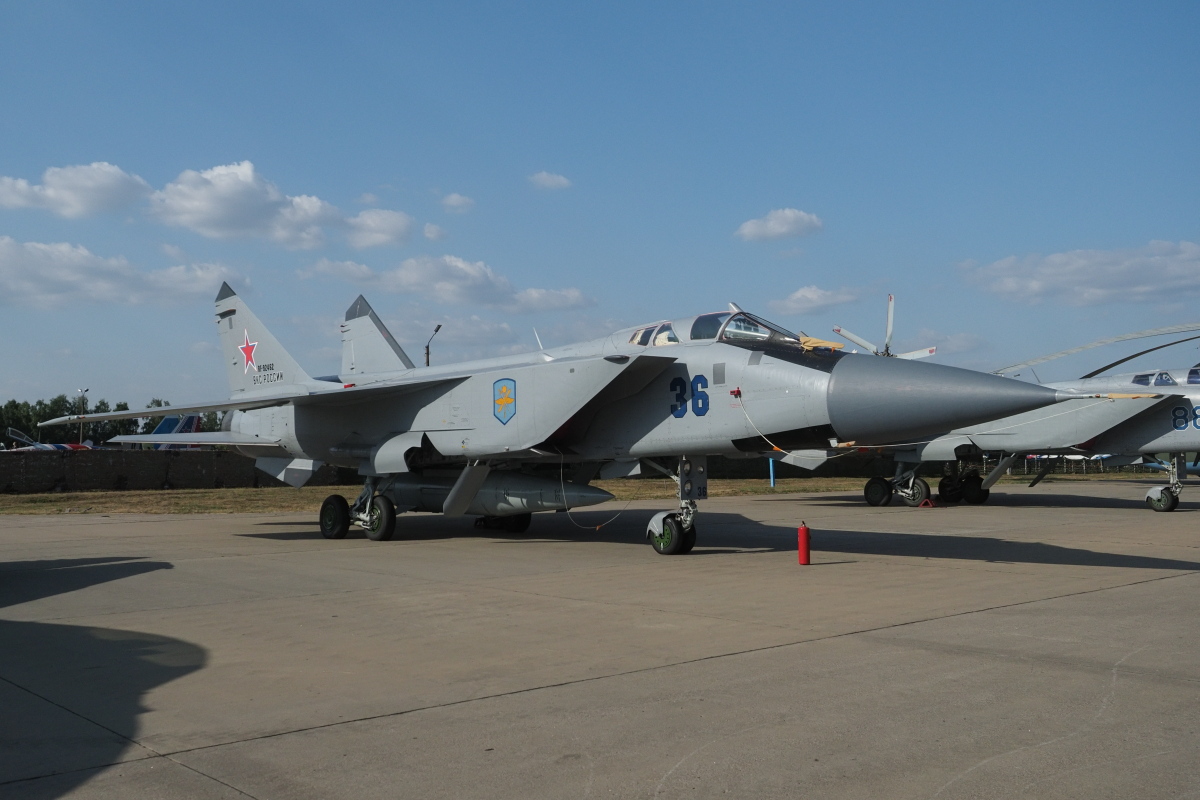
The MiG-31 Foxhound is the world’s fastest fighter still in front-line use, a two-seat interceptor with a claimed top speed of about Mach 2.8 and a radar that was the first phased-array set fitted to a production fighter. Built in the Soviet Union from 1981 to defend against low-flying bombers and cruise missiles, it now has a second life as the launch platform for the Kinzhal missile, and its performance figures below are manufacturer claims unless noted.
MiG-31 specs
| Parameter | Value (manufacturer claims unless noted) |
|---|---|
| Role | Long-range interceptor, now also a missile carrier |
| Crew | 2 (pilot and weapon systems officer) |
| Length / wingspan | About 22.7 m / about 13.5 m |
| Max takeoff weight | About 46,000 kg |
| Engines | 2 x Aviadvigatel D-30F6 turbofans, about 15,500 kgf each with afterburner |
| Max speed | About Mach 2.8 at altitude, limited by airframe heating; cruise near Mach 2.3 |
| Range | About 1,450 km on internal fuel; about 3,000 km with external tanks |
| Service ceiling | About 20,600 m |
| Gun | 1 x 23mm GSh-6-23 six-barrel cannon |
| Radar | Zaslon (RP-31) passive electronically scanned array, about 200 km detection claimed |
| Main missiles | R-33 long-range, R-37M very long-range, R-60 and R-73 short-range |
How was the MiG-31 developed
The MiG-31 grew out of the MiG-25 Foxbat, whose high-speed design the Soviet Union had built to catch American bombers. The Foxbat was fast but had short-lived engines and a radar that struggled against low-flying targets. Mikoyan fitted a second crew member, a powerful look-down radar, and more durable engines, flying the new aircraft for the first time in 1975 and introducing it into service in 1981.
Production ran until the 1990s and reached roughly 500 airframes, according to public estimates. The aircraft was designed to fly in pairs or larger groups, sharing target data by datalink so that one interceptor could scan a wide strip of sky and cue the others. That role, patrolling Russia’s enormous northern and eastern borders, is why the type remains in service today.
MiG-31 radar and missiles
The Zaslon radar was the first passive electronically scanned array in a production fighter. It can track multiple targets and guide several missiles at once, and it works against low-flying targets that would escape older radars. A PESA set like Zaslon is distinct from modern arrays described in our guide on how AESA radar works, and it is more vulnerable to jamming and less flexible, but it was years ahead when introduced.
The aircraft carries four R-33 missiles under the fuselage, and upgraded jets can also fire the R-37M, which Russia claims reaches beyond 200 km. The R-33 has a claimed range of about 120 km. Those figures are manufacturer claims, and the very long-range missiles are best used against large, non-maneuvering aircraft such as tankers and surveillance platforms.
MiG-31 variants and operators
| Version or user | Status | Notes |
|---|---|---|
| MiG-31B / BS | Original production | Baseline interceptor; the B model added aerial refueling |
| MiG-31BM | Modernized | New radar processing, cockpit displays and ability to fire R-77 and R-37M |
| MiG-31K | Kinzhal carrier | Carries the air-launched Kh-47M2 ballistic missile |
| MiG-31D / I | Experimental | Anti-satellite and space-launch concepts that did not enter service |
| Russia | Main operator | Fleet estimated at roughly 100 to 120 operational aircraft |
| Kazakhstan | Operator | Small fleet inherited from the Soviet Union |
Russia is the main user, and Kazakhstan is the only other confirmed operator. The MiG-31K variant is by far the most notable development, because it turned an old interceptor into a hypersonic missile truck, a role covered in our guide to the Kinzhal missile and in our explainer on hypersonic missiles.
MiG-31 in the Ukraine war
The MiG-31K has launched Kinzhal missiles at Ukrainian targets since 2022, usually from airspace within Russia. Russia has called the missile nearly unstoppable, but Ukraine has reported intercepting some with Patriot batteries, and those interception rates are operator-reported and not independently verified. The MiG-31BM has also flown long-range patrols, and is reported to have fired R-37M missiles at long range.
Ukraine has also claimed strikes on airbases that host Foxhounds, which is operator-reported. Whether an aircraft built in 1981 can survive in a war of long-range drones and cruise missiles is a question the Russian Aerospace Forces are now testing, since ground attack on parked aircraft is a more credible threat than air combat.
MiG-31 frequently asked questions
How fast is the MiG-31?
Russia claims a maximum speed of about Mach 2.8, with cruise near Mach 2.3. These are manufacturer claims.
What is the difference between the MiG-31 and the MiG-25?
The MiG-31 adds a second crew member, a look-down phased-array radar, stronger engines and datalinked group tactics.
Which aircraft carries the Kinzhal missile?
The MiG-31K variant is the main carrier, and Tu-22M3 bombers have reportedly also been used.
How many MiG-31s are there?
Roughly 500 were built, and public estimates put the Russian operational fleet at around 100 to 120 aircraft.
Does Ukraine shoot down Kinzhal missiles?
Ukraine has reported intercepting some launched from MiG-31K aircraft, but those claims are operator-reported.
- Wikipedia – Mikoyan MiG-31 (accessed October 2026)
- Russian state media and United Aircraft Corporation statements (manufacturer claims)
- Ukrainian Air Force statements (operator-reported)
- Defence & Tech reporting on Russian interceptors and Kinzhal launches