US Navy Unveils AIM-424 Malice Long-Range Air-to-Air Missile
The U.S. Navy has lifted the veil on a weapon it has been developing quietly for the better part of a decade: the AIM-424 Long Range Air-to-Air Missile, a very-long-range interceptor carrying the service nickname “Malice” and a stated reach of more than 250 nautical miles.
The missile was shown publicly for the first time at the Tailhook Association convention in Reno, Nevada, the annual gathering of the U.S. naval aviation community. Aviation Week first reported details of the unveiling. Raytheon’s Advanced Technology division is the prime developer.
For a programme that had left only fragmentary traces in budget documents and test-range photography, the reveal was unusually direct. The Navy did not merely confirm the weapon exists; it named it, gave it a designation in the AIM series, and put a headline range figure against it.
What the Navy disclosed
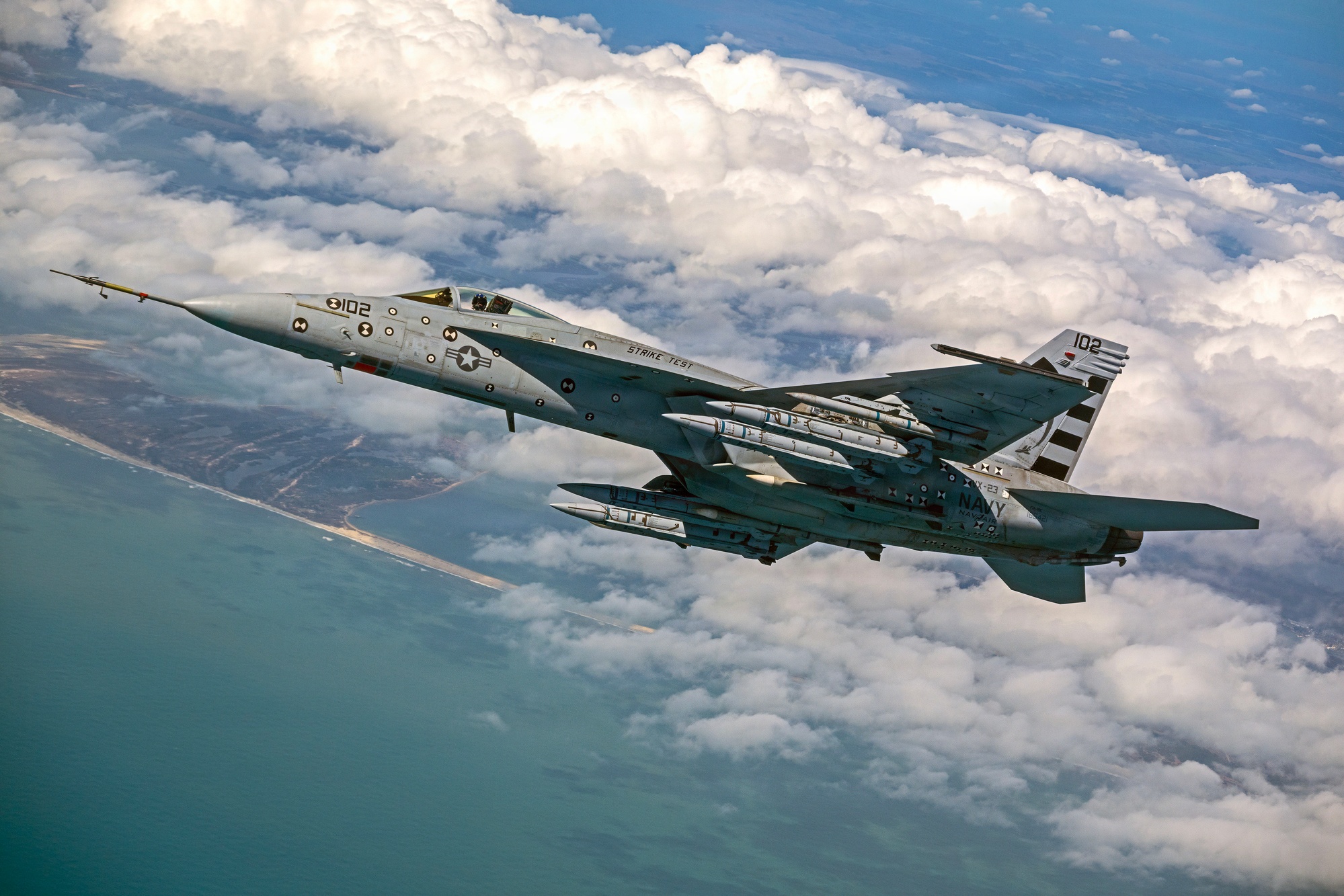
The AIM-424 is a large weapon by air-to-air standards. Its body measures 13.5 inches in diameter, roughly double the seven-inch airframe of the AIM-120 AMRAAM that has been the backbone of Western beyond-visual-range engagements since the early 1990s. The Navy says both the range and the speed of the AIM-424 exceed those of the AIM-174B, the air-launched adaptation of the SM-6 that Super Hornet squadrons began carrying in 2024.
That comparison matters, because the AIM-174B was itself an unusual weapon: a ship-launched interceptor pressed into service under a fighter’s wing as a stopgap answer to the range problem. It worked, but it is heavy, it consumes hardpoints, and it was never optimised for carriage on a strike fighter. The AIM-424 appears to be the purpose-built answer.
Photographs released with the announcement show four AIM-424 rounds loaded on an F/A-18E Super Hornet from the Navy’s strike test squadron for a test event — a loadout that suggests the missile, despite its bulk, is meant to be carried in useful numbers rather than one or two at a time.
To make a weapon of that diameter manoeuvrable, the designers have fitted specialised aerodynamic fins and strakes along the body. Long-range air-to-air missiles face a persistent physics problem: the propellant volume that buys reach also buys mass and drag, and a missile that arrives at 250 nautical miles with no energy left to manoeuvre is not a threat to anything that can turn. The strake arrangement is the visible sign of an attempt to solve that.
Where it fits in the programme landscape
The AIM-424 is not the AIM-260 Joint Advanced Tactical Missile, and the distinction is worth drawing clearly because the two are easily conflated. The AIM-260 JATM is a Lockheed Martin programme, developed principally for the Air Force, and was itself photographed under a Navy Super Hornet at Eglin Air Force Base in May 2026. The AIM-424 is a separate Raytheon effort with its own designation and, on the Navy’s account, a longer reach.
Development traces back to the mid-2010s. The public record thickened considerably in 2026: cyber development teams began work in January, a captive-carry test was disclosed in April, and an F-35 fit check was conducted in August, days before the Tailhook reveal.
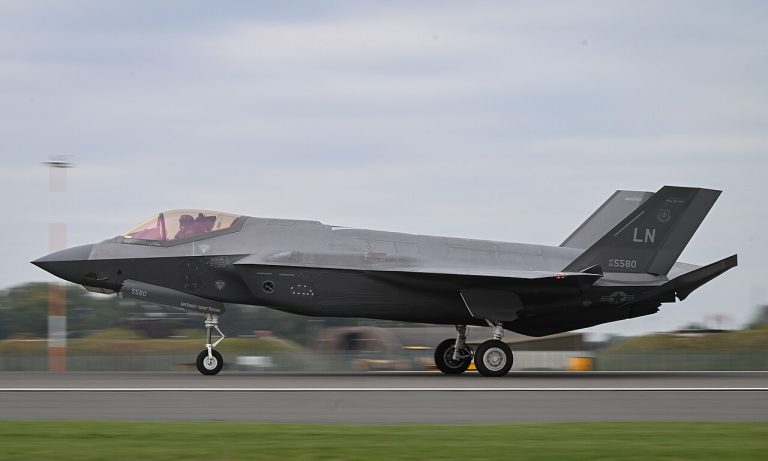
The intended platform list is broad. The Navy identifies the F/A-18E Super Hornet and the F-35C as carriers, with the Air Force’s F-47 sixth-generation fighter also named. The F/A-XX, the Navy’s own next-generation carrier fighter, is a likely follow-on. The inclusion of the F-35C is notable given the missile’s diameter — a 13.5-inch weapon will not fit an F-35’s internal bays, which implies external carriage and the radar-cross-section penalty that comes with it.
“The AIM-424 delivers a generational leap in air dominance,” said Phil Jasper, president of Raytheon, in remarks accompanying the unveiling.
The problem it is meant to solve
The strategic driver is not obscure. For three decades, Western air forces enjoyed a comfortable margin in beyond-visual-range engagement: the AMRAAM outranged what most adversaries fielded, and the supporting sensor and datalink architecture was better. That margin has narrowed. Chinese development of long-range air-to-air weapons, and the operational reach they give to fighters and to the airborne early-warning and tanker aircraft they protect, has changed the arithmetic of a Pacific air campaign.
Range in this context is not only about killing fighters. A missile that reaches 250 nautical miles threatens the enabling aircraft — tankers, airborne early warning platforms, maritime patrol aircraft — that a modern air campaign cannot function without. Forcing those assets to operate further back degrades an opponent’s entire air picture without a single aircraft being shot down. That is the deterrent logic behind very-long-range weapons on both sides of the Pacific.
It also changes the geometry for the carrier. A carrier air wing equipped with a weapon of this reach can hold threat aircraft at arm’s length further from the ship, which lengthens the chain an adversary must complete to put an anti-ship missile in the air.
What remains unknown
The Navy has not disclosed the AIM-424’s guidance package, its propulsion arrangement, or a production timeline. Those are the details that determine whether a headline range figure translates into operational capability. A very-long-range shot is only useful if something can provide mid-course guidance across that distance and the seeker can acquire a manoeuvring target at the end of it — which is as much a question of networked sensors, datalinks and airborne relays as it is of the missile itself.
Nor has the service said how many it intends to buy, or at what unit cost. Weapons of this class are expensive, and magazine depth has become one of the more uncomfortable questions in Western defence planning after several years of watching munitions stockpiles drain faster than industry could refill them.
What the unveiling does establish is intent. By putting a designation, a name and a range figure into the public domain, the Navy has chosen to signal the capability rather than conceal it — a decision that says something about how it wants the weapon to be read in Beijing as well as in Reno.
Sources
- Naval News, “U.S. Navy Unveils AIM-424 Malice Long-Range Air-to-Air Missile,” 23 August 2026
- U.S. Navy / DVIDS, “AIM-424 Long Range Air-to-Air Missiles (LRAAM),” official imagery and caption release
- Aviation Week, initial reporting on the AIM-424 unveiling at the Tailhook Association convention, Reno, Nevada
- The Aviationist, “First Photo Emerges Of AIM-260A JATM Missile Carried By A U.S. Navy F/A-18F Super Hornet,” 15 May 2026 (for AIM-260 programme distinction)