Sivrisinek Loitering Munition: Baykar’s 76 kg Catapult-Launched Swarm Drone
SİVRİSİNEK (Turkish for “mosquito”) is Baykar’s lightest intelligent loitering munition: a catapult-launched aircraft of 76–78 kg that the company says carries a 20 kg warhead up to 1,000 km, stays airborne for more than eight to nine hours and can navigate without satellite signals. Baykar showed it flying in a swarm with its K2 Kamikaze UAVs at Keşan in April 2026, put it on public display at SAHA 2026 in Istanbul in May, and in October 2026 said 20 Sivrisinek flew as a swarm at the Ateş Serbest-2026 exercise near Ankara. The figures below are Baykar’s own, checked on its product page on 12 November 2026 (Baykar); they have not been independently verified.
- Maker: Baykar, Türkiye; “intelligent loitering munition” (manufacturer’s class)
- Two configurations: SİVRİSİNEK-UM (longer range) and SİVRİSİNEK-UMX (adds an AI-assisted EO camera)
- Baykar figures: 76 kg (UM) / 78 kg (UMX) MTOW, 20 kg warhead, 1,000 km (UM) / 900 km (UMX) range, 9+ h / 8+ h endurance, 55/70 KIAS
- Catapult launch, no runway; internal combustion engine; 3.2 m wingspan, 3.8 m length
- Milestones: Keşan swarm demonstration 17 April 2026; public debut at SAHA 2026 (5–9 May); 20-aircraft swarm at Ateş Serbest-2026, 13 October 2026
- No unit price, Turkish Armed Forces order or confirmed export contract has been published
What is Sivrisinek?
Baykar describes Sivrisinek as “a versatile next-generation loitering munition system developed by Baykar to deliver high impact at medium altitude”. A loitering munition is an expendable unmanned aircraft that flies to an area, searches with its sensors and then attacks by diving onto a target; it is not recovered afterwards. Baykar says Sivrisinek combines autonomous navigation, AI-based target recognition and integrated mission-planning software to reduce the need for operator intervention (Baykar product page).
Its defining practical feature is the launch method. Sivrisinek leaves a catapult rather than a runway, and Baykar says it can be “programmed on the ground and launched within minutes” from forward bases, rough terrain or confined areas. That separates it from Baykar’s runway-capable MIZRAK and the much larger K2 Kamikaze UAV. For the company background, see our Baykar company profile.
Sivrisinek specifications
The table follows Baykar’s English product page; the Turkish page lists the same values. Metric conversions are ours.
| Parameter | SİVRİSİNEK-UM | SİVRİSİNEK-UMX |
|---|---|---|
| Maximum take-off weight | 76 kg | 78 kg |
| Payload capacity / warhead | 20 kg / 20 kg warhead | 20 kg / 20 kg warhead |
| Operational range | 1,000 km | 900 km |
| Endurance | 9+ hours | 8+ hours |
| Communication (“fire and forget”) | 10+ km | 80+ km |
| Payload sensor | None listed | AI-assisted EO camera |
| Terminal guidance | GNSS | GNSS, EO |
| Cruise / maximum speed | 55 KIAS / 70 KIAS (about 102 / 130 km/h) | |
| Service ceiling / operational altitude | 10,000 ft / 4,000 ft (about 3,050 / 1,220 m) | |
| Wingspan / length / height | 3.2 m / 3.8 m / 0.8 m | |
| Power plant | Internal combustion engine (model not named) | |
| Launch | Catapult | |
Baykar’s page lists the EO camera and EO terminal guidance against the UMX only; we read that as the UM relying on satellite navigation for the final phase, but Baykar does not spell this out. Baykar does not publish a unit price, production rate, warhead type or engine model. Those points are left open rather than estimated.
UM and UMX: two configurations, one product
The two versions trade range for sensing and control. The UM is listed with the longer range (1,000 km) and endurance (9+ hours) and a communication figure of 10+ km. The UMX is 2 kg heavier, adds the AI-assisted electro-optical camera, and is listed with 900 km range, 8+ hours endurance and an 80+ km communication range. Because both share the airframe, warhead, engine and launch method, Defense and Tech covers them in this article rather than on separate pages.
Swarm and navigation claims
Baykar lists communication relays through a Bayraktar TB2, TB3 or AKINCI, an optional anti-jamming system, visual navigation, a digital data and video link, sensor-fusion-assisted autonomous operation, an AI-assisted autopilot and an AI-assisted optical guidance set. In its 24 April 2026 release, the company said Sivrisinek units can “instantly share detected targets with one another” inside a swarm and keep navigating by AI-based visual positioning where GNSS signals are unavailable or jammed (Baykar press release).
These are manufacturer descriptions. We found no independent assessment of Sivrisinek’s accuracy, resistance to jamming or survivability, and this article does not describe targeting or employment procedures.
Tests and public appearances
Keşan, 17 April 2026. According to Baykar, five K2s took off within five minutes and ten Sivrisinek then joined them, forming a swarm beneath the K2s while a TB2, a TB3 and an AKINCI filmed from above. Baykar says the aircraft demonstrated GNSS-independent navigation and automatic target detection, that a group of Sivrisinek dived on designated coordinates, and that the flight ended with an 18-aircraft formation (5 K2, 10 Sivrisinek, 1 TB2, 1 TB3, 1 AKINCI). The company announced the demonstration on 24 April.
SAHA 2026, Istanbul, 5–9 May. Baykar said Sivrisinek and K2 would make their public debut at the fair. There, Baykar chief executive Haluk Bayraktar told the Azerbaijani agency Report that Azerbaijan and Türkiye would jointly produce Sivrisinek and that the systems shown at the exhibition would be manufactured at factories in Azerbaijan (Report.az). In an interview with Anadolu reported by Türkiye Today, he also said Baykar produces all engines for K2, MIZRAK and Sivrisinek in-house (Türkiye Today). Baykar has not named the engine.
Ateş Serbest-2026, Polatlı, 13 October 2026. Baykar says five K2s, linked to a ground control station, controlled and coordinated a swarm of 20 Sivrisinek in flight, and that ten of them broke away and made a salvo dive, “destroying the targets with direct hits” (Baykar). Anadolu Agency carried the same figures from a social-media post by Haluk Bayraktar (AA). The Turkish defence site TURDEF, which also described the K2s as swarm communication nodes, counted 29 or 30 Sivrisinek in two groups in the footage (TURDEF); we report Baykar’s figure of 20 as the company’s statement and TURDEF’s count as its own observation. Taking part in a Turkish Armed Forces exercise is not the same as being in the TSK inventory, and no Turkish order has been announced.
Is Sivrisinek the “YIHA-III”?
Janes reports that the 24 April 2026 Baykar video, which showed 16 of the type at Keşan, effectively identified Sivrisinek as the loitering munition previously reported as the “YIHA III”. Reports in 2023 had described YIHA III as a joint development of Baykar and Pakistan’s National Aerospace Science and Technology Park (NASTP), and Janes says the type was seen at the Albanian Air Force’s 74th anniversary in April 2025; Janes adds that the origin of the YIHA III name is unclear (Janes). Baykar does not use the YIHA-III designation on its own pages and has not described any Pakistani role, so these points remain reported, not confirmed.
Operators and exports
No customer has been officially announced. In September 2026 The Defence Blog, citing a post by the Azerbaijani outlet TURAN Defence AZ, reported that Azerbaijan’s Nakhchivan Separate Combined Arms Army had received Sivrisinek; it noted that Baku had not announced a delivery and that no quantity was given (The Defence Blog). We found no statement from Baykar, Türkiye’s Presidency of Defence Industries (SSB) or Azerbaijan’s defence ministry confirming a contract or delivery, so we treat the report as unconfirmed. Azerbaijan did sign a separate supply contract for Baykar’s MIZRAK at ADEX 2026, as covered in our MIZRAK article.
How Sivrisinek compares with MIZRAK and K2
| Baykar figures | Sivrisinek (UM / UMX) | MIZRAK | K2 Kamikaze |
|---|---|---|---|
| MTOW | 76 / 78 kg | 200 kg | 800 kg |
| Payload / warhead | 20 kg | 40 kg | 200 kg |
| Range | 1,000 / 900 km | 1,000+ km | 2,000+ km |
| Endurance | 9+ / 8+ h | 7+ h | 13+ h |
| Launch | Catapult | Runway or RATO | Runway |
Sources: Baykar’s Sivrisinek, MIZRAK and K2 pages. Sivrisinek is the smallest of the three: roughly two-fifths of MIZRAK’s weight and under a tenth of the K2’s, with half of MIZRAK’s listed warhead weight but a similar quoted range. Baykar has used the heavier K2 as the controlling element of Sivrisinek swarms in both published demonstrations. This is a comparison of published manufacturer figures, not a ranking of capability.
Frequently asked questions
Who makes Sivrisinek?
Baykar of Türkiye, which says it developed the munition indigenously.
What is Sivrisinek’s range?
Baykar lists 1,000 km for the UM configuration and 900 km for the UMX, with endurance of more than nine and eight hours respectively.
What is the difference between Sivrisinek UM and UMX?
The UMX adds an AI-assisted electro-optical camera and EO terminal guidance, and has a longer communication range (80+ km against 10+ km), at the cost of 2 kg more weight and 100 km less range.
Does Sivrisinek need a runway?
No. Baykar says it is launched from a catapult and can be deployed from forward bases, rough terrain and confined areas.
Has Sivrisinek been exported?
No export contract has been officially announced. Baykar’s chief executive has said Azerbaijan and Türkiye will produce it jointly, and a September 2026 media report of deliveries to Azerbaijan’s Nakhchivan army has not been officially confirmed.
Is Sivrisinek the same as MIZRAK or K2?
No. All three are separate Baykar products; Sivrisinek is the lightest and the only one launched by catapult.
Sources
- Baykar – Sivrisinek product page (EN) (accessed 12 November 2026)
- Baykar – Sivrisinek product page (TR) (accessed 12 November 2026)
- Baykar – K2 and Sivrisinek take to the field, 24 April 2026
- Baykar – Baykar platforms at Ateş Serbest-2026, October 2026
- Anadolu Agency – Sivrisinek at Ateş Serbest-2026, 13 October 2026
- TURDEF – Baykar demonstrates swarm teaming at Ateş Serbest 2026, 15 October 2026
- Janes – Baykar displays previously little-known one-way attack UAV
- Report.az – Baykar: Azerbaijan, Türkiye to produce SIVRISINEK UAVs
- Türkiye Today – Haluk Bayraktar interview at SAHA 2026
- The Defence Blog – report on Nakhchivan deliveries (unconfirmed), 24 September 2026
- Wikimedia Commons – cover photograph, a Bayraktar TB2 at Teknofest 2022 (CC BY-SA 4.0)
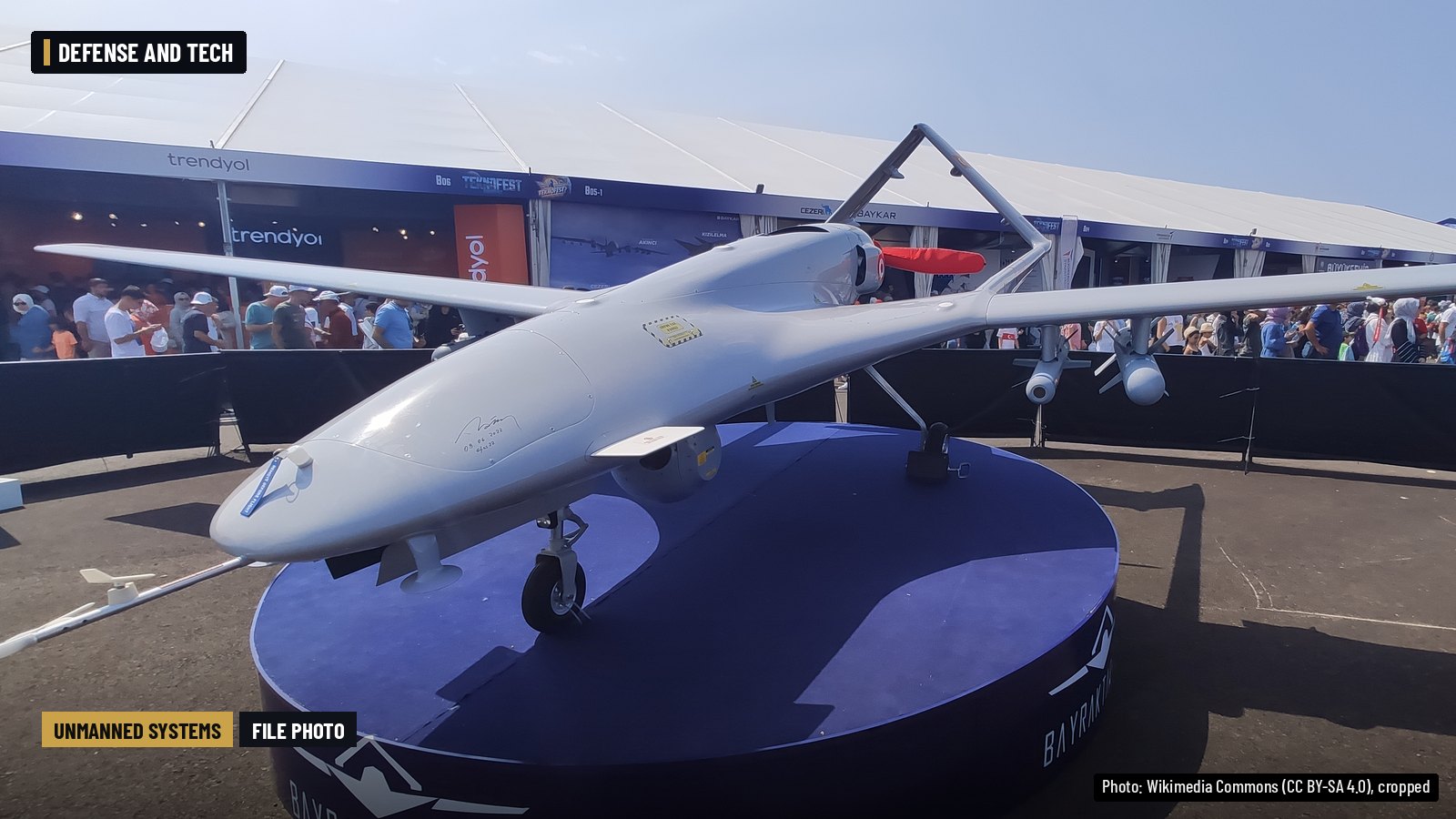
Last updated: 12 November 2026. The cover photograph is a file photo of a Bayraktar TB2, one of the relay aircraft Baykar lists for Sivrisinek, at Teknofest 2022 in Samsun; it does not show Sivrisinek.