K2 Kamikaze UAV: Baykar’s 800 kg Swarm-Capable Strike Drone
The K2 Kamikaze UAV is Baykar’s large, AI-enabled kamikaze drone, which the company says weighs 800 kg at take-off, carries a payload of 200+ kg, flies more than 2,000 km for over 13 hours and can operate in swarms and without GNSS. Baykar unveiled it in March 2026 after multi-aircraft trials at Keşan, showed a swarm demonstration in April and exhibited it publicly at SAHA 2026 in May. The figures below are Baykar’s published numbers, checked on its product page on 9 November 2026 (Baykar); they have not been independently verified.
- Maker: Baykar, Türkiye; AI-enabled kamikaze UAV (manufacturer class)
- Baykar figures: 800 kg MTOW, 200 kg payload (200+ kg warhead capacity), 2,000+ km range, 13+ h endurance, 70/110 KTAS, 100 hp engine
- Navigation and autonomy (Baykar): GNSS-independent position estimation by visual matching, swarm operation, autonomous take-off and landing
- Milestones: Mar 2026 five-aircraft formation tests at Keşan; 17 Apr 2026 swarm demonstration with Sivrisinek; SAHA 2026 public debut (5–9 May)
- Pakistan inventory report (7 Sep 2026) is secondary and unconfirmed; no quantity or contract value disclosed
- No unit price, engine brand, inventory date or SSB contract statement found; performance claims are not independently verified
What is the K2 Kamikaze UAV?
Baykar describes the K2 as a next-generation platform developed “indigenously and originally” with artificial intelligence and autonomy, a “cost-effective” design, swarm flight, precision strike, navigation that can work in electronic-warfare conditions, and take-off from short and unimproved airstrips. It calls the K2 “the largest platform in its class” – a manufacturer claim that this article does not test against other systems (Baykar).
The K2 is a separate product from Baykar’s missiles and from its Sivrisinek (“Mosquito”) loitering munition, which flew with it in the April demonstration but is not covered here. For the company context, see the Baykar company profile, our Bayraktar AKINCI guide (the UCAV that accompanied the K2 swarm) and the KEMANKEŞ 1 missile page.
K2 Kamikaze specifications
The table follows Baykar’s English product page; the Turkish page lists the same values.
| Parameter | K2 Kamikaze UAV (Baykar figures) |
|---|---|
| Maximum take-off weight | 800 kg |
| Payload / warhead capacity | 200 kg (table); “200+ kg warhead payload capacity” (text) |
| Operational range | 2,000+ km |
| Endurance | 13+ hours |
| Cruise / maximum speed | 70 KTAS / 110 KTAS (about 130 / 204 km/h, our conversion) |
| Service ceiling / operational altitude | 10,000 ft / 8,000 ft |
| Wingspan / length / height | 10 m / 5.1 m / 2.1 m |
| Power plant | Internal combustion engine, 100 hp (maker and model not named) |
| Take-off, landing, cruise, taxi | Autonomous |
| Communications | Line of sight and beyond line of sight; 100+ km LOS, BLOS optional |
| Datalink with other Baykar UAVs | Available for TB2, TB3 and AKINCI |
| Sensors | EO/IR gimbal camera; visual target lock |
| Listed features | GNSS-independent position estimation by visual matching; adaptive route generation; autonomous emergency management after thrust loss; swarm operation; coordinate-based and visual-target dive attack |
Baykar does not publish a unit price, production rate, engine brand, Turkish Armed Forces inventory-entry date or customer list on the product page. We found no statement from the Presidency of Defence Industries (SSB) describing a K2 contract or its own coordination role; Baykar presents the K2 as an in-house development. Those items are therefore left out rather than estimated.
Autonomy, navigation and swarm claims
The core of the K2 pitch is autonomy. Baykar says the aircraft can estimate its position by matching camera imagery when satellite navigation is unavailable, generate routes adaptively, handle a loss of thrust autonomously and fly as part of a swarm. It lists two attack modes: a dive on a coordinate and a dive on a visually locked target (Baykar). These are manufacturer descriptions of capability. Baykar has shown formation flying and demonstration dives, but no independent assessment of accuracy, survivability or electronic-warfare resilience has been published in the sources reviewed. This article does not describe targeting or employment procedures.
Development and demonstrations
13–14 March 2026. Five K2 aircraft took off from the Keşan Flight Training and Test Center and flew formation tests over the Gulf of Saros for two days in “right echelon”, “line” and “V” patterns, according to an SSB Medya report of 14 March 2026. The report adds that the K2 can also fly “Turan” and “wall” formations and that a planned next R&D step is a version that returns to base after releasing its munition and can be reused (SSB Medya). The SSB’s own weekly industry summary of 16 March 2026 lists the K2 as introduced, with 2,000+ km range, a 200 kg warhead and 800 kg take-off weight (SSB).
17 April 2026. In a demonstration at Keşan, announced by Baykar on 24 April, five K2 aircraft took off in sequence within five minutes and flew patrol formations. Ten Sivrisinek loitering munitions then joined below them, while a Bayraktar TB2, TB3 and AKINCI accompanied the swarm and filmed it. Baykar said the platforms used AI-supported visual navigation independent of GNSS and showed automatic target detection and strike. One K2 left the swarm and made a high-speed dive on designated coordinates, “conducting a pass”; the finale was an 18-aircraft “V” formation of five K2, ten Sivrisinek, one TB2, one TB3 and one AKINCI (Baykar).
5–9 May 2026. The K2 and Sivrisinek made their public debut at SAHA 2026 in Istanbul (Airforce Technology).
1 August 2026. Baykar chairman Selçuk Bayraktar shared footage of an “Autonomous Swarm and Formation Flight Test” of the K2, according to Anadolu Agency’s video gallery; the entry gives no new specifications (Anadolu Agency).
Pakistan report: unconfirmed
On 7 September 2026 The Defense News reported that Pakistan had added K2 UAVs to its inventory, citing a video said to have been released by the Pakistan Army and relayed on X by a Turkish defence account. It called Pakistan the “reportedly” first known export customer and noted that no quantity, contract value, delivery schedule or basing had been disclosed (The Defense News). Defense and Tech did not find a Baykar, SSB or Pakistani government statement confirming a sale and has not verified the video, so we treat this as an unconfirmed secondary report, not as an export fact.
Industry context
The K2 extends Baykar’s range beyond armed UAVs such as the TB2 and AKINCI into expendable, lower-cost strike aircraft that can be launched in numbers. SSB Medya frames the programme goal as a capability that can be produced in volume at relatively low cost, reducing the use of expensive munitions against high-value targets. Whether the K2 reaches that cost goal depends on production and unit-price data that have not been published. The only reuse statements are the SSB summary’s mention of multi-use among development features and the SSB Medya note that reusable versions are a planned next step; the Baykar product page describes a kamikaze aircraft.
Frequently asked questions
Who makes the K2 Kamikaze UAV?
Baykar of Türkiye, which says it developed the aircraft indigenously.
What are the main K2 specifications?
Baykar lists 800 kg maximum take-off weight, a 200 kg payload (200+ kg warhead capacity in its text), 2,000+ km range, 13+ hours’ endurance, 70 KTAS cruise and 110 KTAS maximum speed, a 10 m wingspan, 5.1 m length and a 100 hp internal combustion engine.
Can the K2 fly in a swarm?
Baykar says yes. Five K2 flew formation tests in March 2026 and a swarm demonstration with Sivrisinek munitions and other Baykar UAVs on 17 April 2026, according to Baykar and SSB Medya.
Has the K2 been exported?
Not confirmed. A 7 September 2026 report said Pakistan had added the K2, but it rests on a video relayed on social media and no government or manufacturer confirmation was found.
Is the K2 reusable?
Unclear. The SSB weekly summary lists multi-use among development features, SSB Medya describes reusable versions as a planned next step, and Baykar’s product page presents the K2 as a kamikaze UAV without describing recovery.
Is the K2 the same as the Sivrisinek?
No. Sivrisinek is a separate Baykar loitering munition that took part in the same April 2026 demonstration.
Sources
- Baykar – K2 Kamikaze UAV product page (EN) (accessed 9 November 2026)
- Baykar – K2 Kamikaze İHA product page (TR) (accessed 9 November 2026)
- Baykar – K2 and Sivrisinek demonstration, 24 April 2026
- SSB – weekly Turkish defence industry summary, 16 March 2026
- SSB Medya – K2 swarm autonomy tests, 14 March 2026
- Anadolu Agency – K2 formation flight test video, 1 August 2026
- Airforce Technology – K2 Kamikaze UAV project page, 18 May 2026
- The Defense News – Pakistan report, 7 September 2026 (secondary, unconfirmed)
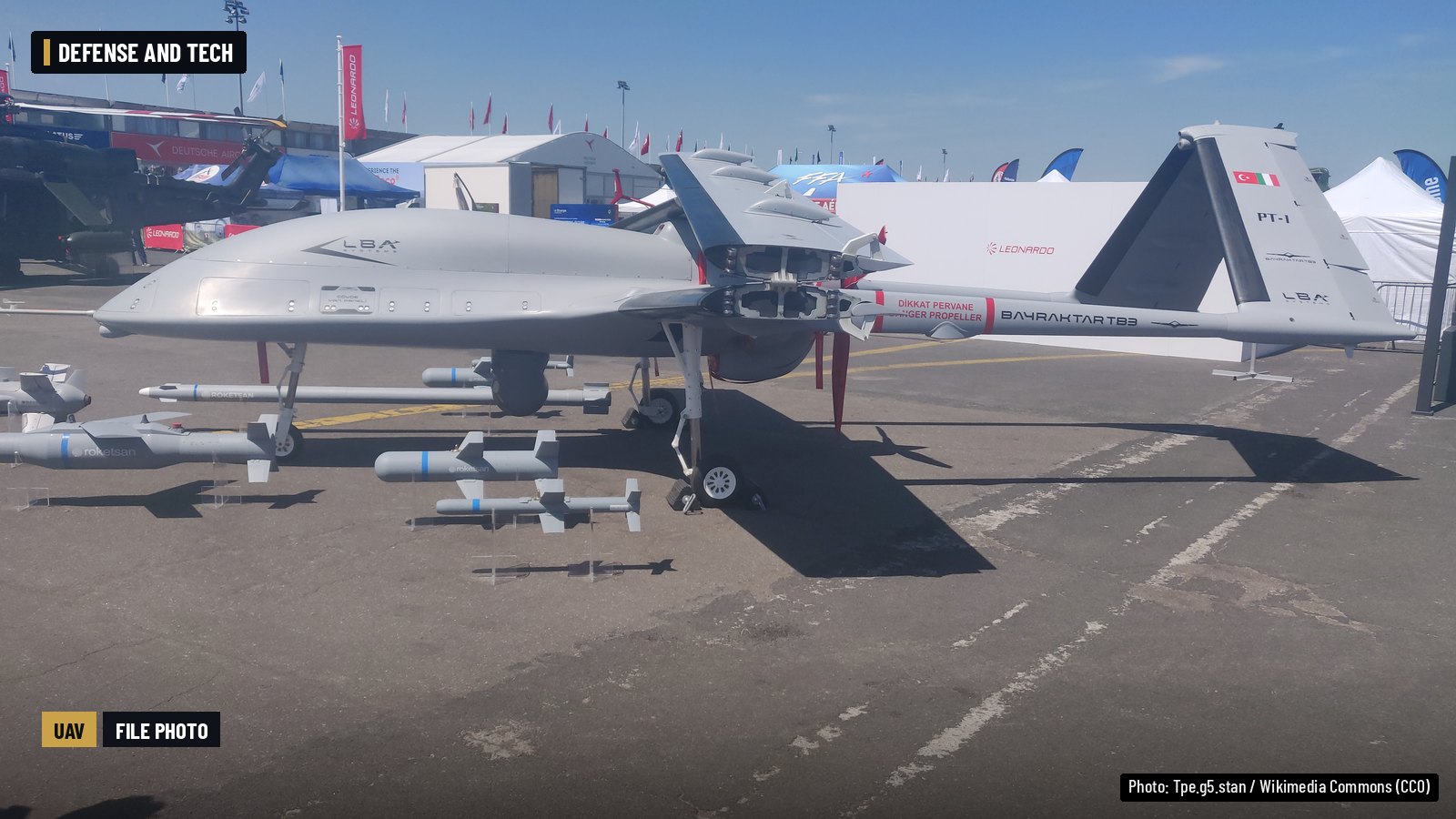
- Wikimedia Commons – cover photograph, a Bayraktar TB3 (Tpe.g5.stan, CC0)
Last updated: 9 November 2026. The cover photograph is a file photo of a Baykar Bayraktar TB3, not of the K2.