CENTCOM Chief Visits Strait of Hormuz as US Says Gulf Oil Exports Pass 1.5 Billion Barrels
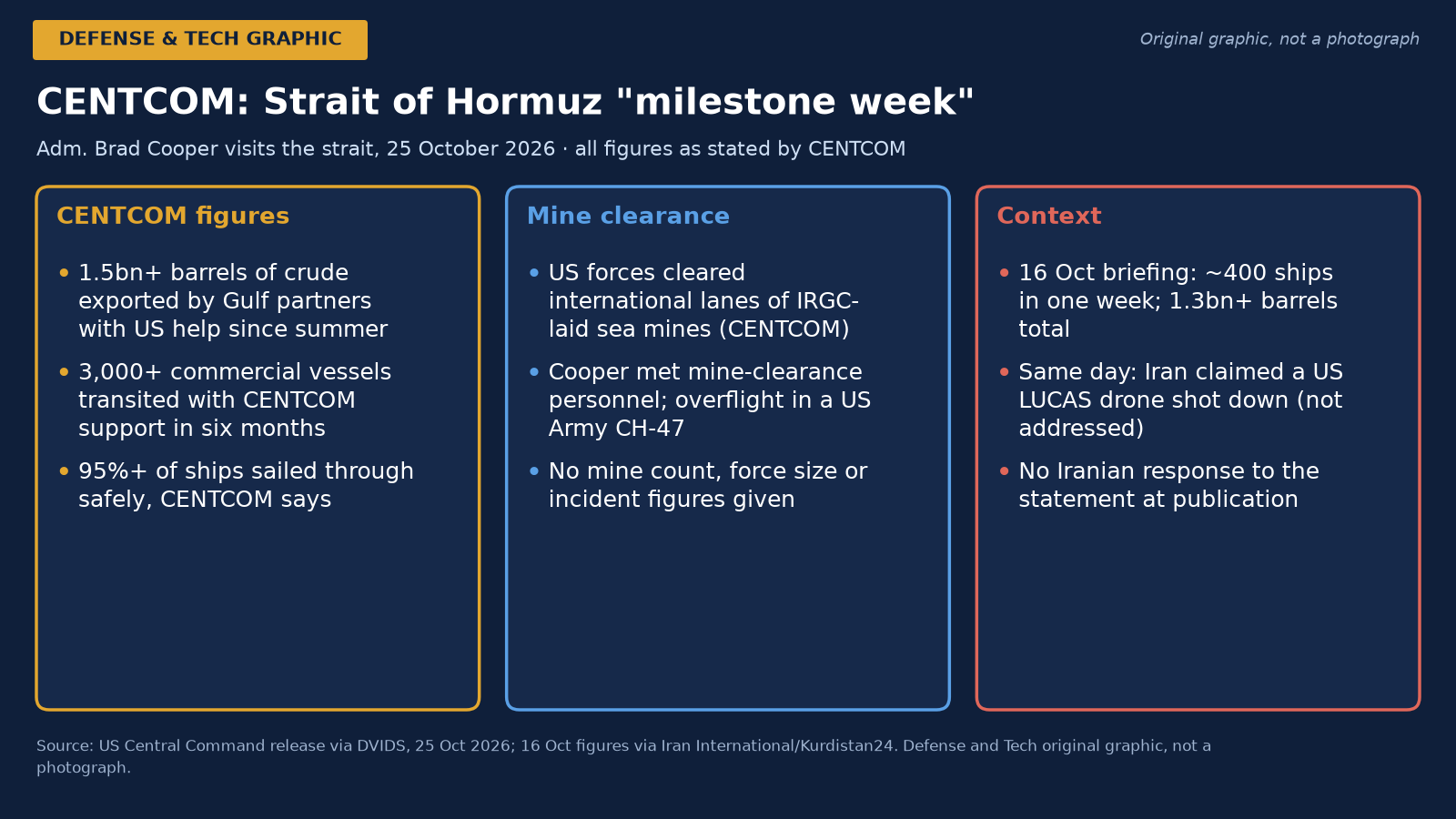
The commander of US Central Command, Admiral Brad Cooper, visited the Strait of Hormuz on Sunday, 25 October 2026, as CENTCOM said US forces had now helped Gulf partners export more than 1.5 billion barrels of crude oil through the waterway since the summer. Cooper flew over the strait in a US Army CH-47 Chinook, according to a CENTCOM release distributed through DVIDS (CENTCOM/DVIDS, CENTCOM on X).
- Adm. Brad Cooper, commander of US Central Command, visited the Strait of Hormuz on 25 October 2026 and flew over it in a US Army CH-47 Chinook
- CENTCOM says US forces have helped Gulf partners export more than 1.5 billion barrels of crude oil since the summer
- According to CENTCOM, more than 3,000 commercial vessels have transited the strait with its support over the past six months
- CENTCOM says US forces cleared the international shipping lanes of sea mines laid by Iran’s IRGC; Cooper met personnel from the mine-clearance mission
- The statement gives no figures for ships attacked, mines cleared or forces involved; no Iranian response had been published at the time of writing
What CENTCOM said
According to the release, more than 3,000 commercial vessels have passed through the Strait of Hormuz with support from CENTCOM forces over the last six months. CENTCOM said that “over 95% of ships navigating the Strait of Hormuz have sailed through safely despite the IRGC’s unwarranted aggression”, which in its words showed “that the United States and regional partners control the international waterway” (CENTCOM/DVIDS). The command did not say how many ships had been attacked, damaged or turned back, and these figures have not been independently verified.
“We continue to stand shoulder to shoulder with our Gulf partners and the shipping industry,” Cooper said. “This visit underscores our strong commitment to continued freedom of navigation through the Strait of Hormuz.”
Mine clearance
CENTCOM said American forces had cleared the strait’s international shipping lanes of sea mines laid by Iran’s Islamic Revolutionary Guard Corps (IRGC), and that Cooper met the US service members who supported the mine-clearance mission during the trip. “Today, primary transit routes in the Strait of Hormuz remain free and clear of Iranian sea mines thanks to incredible efforts by our people,” he said. “We remain intensely focused on keeping commercial traffic flowing as we work with our teammates in the U.S. interagency, Gulf Cooperation Council, and shipping industry.” The release did not give the number of mines found or the units and vessels involved. For background on how such operations are carried out, see our explainer on mine-clearing robots and the US Navy in Hormuz.
Previous developments
The new total builds on figures CENTCOM gave in a video briefing on 16 October. Cooper said then that about 400 ships had transited in a single week, carrying more than 100 million barrels of oil, and that more than 1.3 billion barrels had moved through the strait with US support in total, according to Iran International and Kurdistan24 (Iran International, Kurdistan24). If both figures are accurate, roughly 200 million more barrels have been exported in the nine days since.
Sunday’s release came on the same day that Iran claimed to have shot down a US LUCAS drone near Bandar Abbas, a claim CENTCOM’s statement did not address (our report on the Iranian claim). No Iranian official response to the CENTCOM statement had been published at the time of writing. For the wider conflict, see our US-Israel-Iran war live page.
Why it matters
About a fifth of the world’s seaborne oil normally moves through the Strait of Hormuz, so traffic levels there are watched closely by insurers, shipping companies and energy importers in Asia and Europe. The figures CENTCOM chose to publish, cumulative barrels and transits rather than incidents, are meant to show that the shipping route is working. Whether shipping lines and insurers treat the waterway as normal will depend on what happens next with IRGC activity, which the release did not describe in detail.
Sources: US Central Command release via DVIDS, 25 October 2026; CENTCOM on X; Iran International and Kurdistan24 (16 October 2026).