Top 10 Aircraft Carriers in the World in 2026
Aircraft carriers remain the ultimate symbol of naval power: floating airbases that let a country fight far from home. Only a handful of nations operate them, and in 2026 the gap between the best and the rest is still enormous. This ranking weighs size, propulsion, launch systems, air wing and real-world readiness, and lists each ship class once.
- Largest class: Gerald R. Ford (~100,000 tonnes)
- Nuclear-powered carriers: US and France only
- China’s Fujian: EMALS catapults, commissioned November 2025
- US carriers in service: 11
1. Gerald R. Ford class (United States)
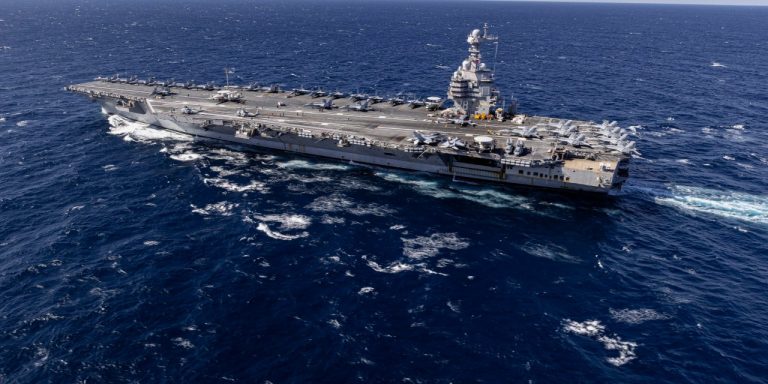
The world’s largest and most advanced carriers, at about 100,000 tonnes, with electromagnetic catapults (EMALS), advanced arresting gear and nuclear power. USS Gerald R. Ford has completed combat deployments, and the future USS John F. Kennedy launched and recovered its first F-35C in October 2026.
2. Nimitz class (United States)
Ten nuclear-powered ships that have formed the core of US sea power for five decades. Each carries an air wing of F/A-18 Super Hornets, F-35Cs, EA-18G Growlers and E-2D Hawkeyes.
3. Fujian (China)
Commissioned in November 2025, China’s third carrier is its first with a flat flight deck and electromagnetic catapults, displacing around 80,000 tonnes. It can launch heavier aircraft such as the J-35 stealth fighter and KJ-600 early-warning plane, a major leap for the PLA Navy.
4. Queen Elizabeth class (United Kingdom)
HMS Queen Elizabeth and HMS Prince of Wales are 65,000-tonne carriers built around the F-35B and a ski-jump. They are the largest warships ever built for the Royal Navy and among the most automated.
5. Charles de Gaulle (France)
The only nuclear-powered carrier outside the US Navy, with catapults that allow it to fly Rafale M fighters and E-2 Hawkeyes. France is building a larger successor, known as PANG, due in the late 2030s.
6. Shandong (China)
China’s first domestically built carrier, a ski-jump design of roughly 60,000-70,000 tonnes flying J-15 fighters. Reports in 2026 suggest it may stay in maintenance into 2027 while the navy focuses on bringing Fujian to full capability.
7. INS Vikrant (India)
India’s first homegrown carrier, commissioned in 2022 at about 45,000 tonnes. It currently flies MiG-29K fighters, and India has ordered 26 Rafale M jets for it.
8. Liaoning (China)
A rebuilt Soviet-era hull that became China’s training and first operational carrier. It remains very active, with deployments into the Philippine Sea in 2026.
9. INS Vikramaditya (India)
A heavily modified Russian Kiev-class ship, in Indian service since 2013. With Vikrant, it gives India a two-carrier navy.
10. Cavour (Italy)
A 30,000-tonne light carrier that now operates F-35Bs, giving Italy a genuine fifth-generation capability at sea. Spain’s Juan Carlos I, Japan’s converted Izumo-class ships and America-class amphibious ships fill a similar “light carrier” niche.
The big picture
The United States still operates 11 of the world’s largest carriers, more than everyone else combined. But China is closing the gap fastest, with Fujian in service and a fourth, nuclear-powered carrier under construction. Russia’s only carrier, Admiral Kuznetsov, has spent years in refit and is no longer a meaningful factor.
Featured image: U.S. Navy / Public domain, via Wikimedia Commons