What Artillery Does Turkey Have? Fırtına, Boran and TRG-300
Turkey has one of the largest artillery forces in NATO: about 1,045 self-propelled guns, 635 towed guns and 200 rocket launchers. As with its tanks, the total hides two different armies. One is equipped with the T-155 Fırtına, a modern 155 mm howitzer built in Turkey, and with guided rockets made by Roketsan. The other still uses American guns from the 1950s.
This guide counts the guns and launchers by type, explains the Fırtına and its successor, and sets out the ranges of Turkish rockets.
What artillery does Turkey have?
The figures below are from the GlobalMilitary database, updated in September 2026.
| System | Type | Calibre | Number | Notes |
|---|---|---|---|---|
| T-155 Fırtına I | Self-propelled howitzer | 155 mm | 280 | Built 2005–2010 |
| T-155 Fırtına II | Self-propelled howitzer | 155 mm | 30 | 110 more on order |
| M52T | Self-propelled howitzer | 155 mm | 365 | 1950s hull rebuilt in Turkey |
| M44T1 | Self-propelled howitzer | 155 mm | 150 | 1950s hull rebuilt in Turkey |
| M110A2 | Self-propelled howitzer | 203 mm | 219 | Heaviest gun in service |
| M114 | Towed howitzer | 155 mm | 517 | Second World War design |
| Boran | Towed light howitzer | 105 mm | 7 | 114 more on order |
| T-300 Kasırga | Rocket launcher | 302 mm | 54 | Four tubes on a truck |
| T-122 Sakarya | Rocket launcher | 122 mm | 36 | 40 tubes on a truck |
| M270A1 MLRS | Rocket launcher | 227 mm | 12 | Also fires the ATACMS missile |
| T-107 | Rocket launcher | 107 mm | 100 | Light towed launcher |
T-155 Fırtına: the main gun
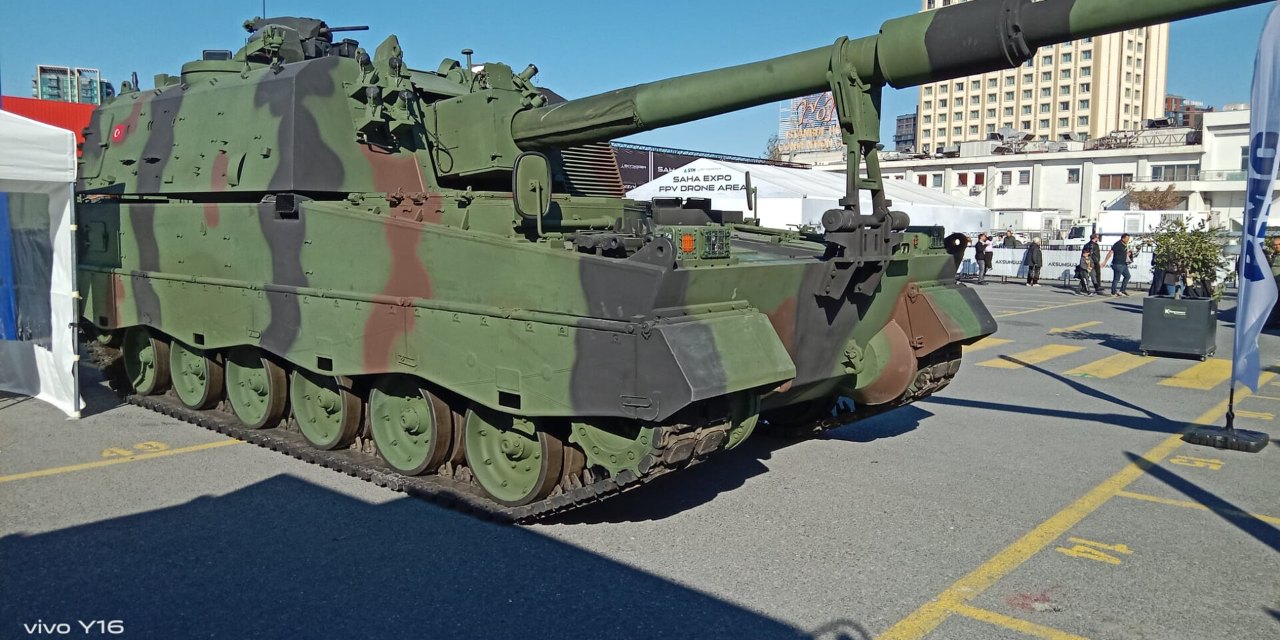
The Fırtına, Turkish for storm, is a tracked 155 mm howitzer based on South Korea’s K9 Thunder. Turkey built it under a technology transfer agreement, with a turret of its own design and Turkish electronics, after Germany refused to license parts of the PzH 2000. The army took delivery of 280 between 2005 and 2010.
| Item | Figure |
|---|---|
| Weight | 47 tonnes |
| Gun | 155 mm, 52 calibres, made by MKE |
| Range | 18 km with standard shells; 30 km rocket-assisted; about 40 km with extended-range shells |
| Engine | MTU diesel, 1,000 hp |
| Road speed | 65 km/h |
| Driving range | 360 km |
| Crew | 5 |
| Time to open fire | About 30 seconds after halting |
It has been used more than any other Turkish heavy weapon. Fırtınas fired into northern Iraq in 2007 and 2008 and supported every Turkish operation in Syria from 2016. Their long barrel lets them hit targets from inside Turkey that older guns could not reach.
Fırtına II: what is new
The Fırtına II keeps the gun and replaces much of what surrounds it. An automatic loader takes over the work of two crew members and raises the rate of fire. The turret and gun are moved by electric drives. A new fire-control system by Aselsan, a remotely operated machine gun and air conditioning complete the changes. The first six were handed over at the army’s factory in Sakarya, and the government has said it wants at least 140.
The first batch uses an American engine. The remainder are to have the Utku, a 1,000 hp engine made by BMC, for the same reason the Altay tank is getting a Turkish engine: Germany’s export rules stopped a sale of the original Fırtına to Saudi Arabia because of its MTU engine. Azerbaijan ordered 36 and has received one for evaluation while it waits for the Turkish engine.
Panter and Boran: the towed guns
The Panter is a towed 155 mm gun with the same 52-calibre barrel length as the Fırtına’s and a range of about 40 km. A small engine on its carriage lets the crew move it short distances without a truck. A wheeled version on a truck chassis is on order, listed at 40 units.
The Boran is at the other end of the scale. It is a 105 mm howitzer light enough to be carried under a helicopter, with a range of about 17 km, built for commando and mountain units. The army has ordered 121.
Behind these are the old guns: 517 M114s, a design from the Second World War, two types of American self-propelled gun from the 1950s that Turkey rebuilt with longer barrels and new engines, and the 203 mm M110. The last three make up two thirds of the self-propelled fleet.
Rocket launchers and guided rockets
Turkish rocket artillery is the work of one company, Roketsan. Its launchers are trucks that carry sealed pods, so one vehicle can fire several calibres.
| Rocket | Calibre | Range | Guidance |
|---|---|---|---|
| TR-107 | 107 mm | About 11 km | Unguided |
| TR-122 | 122 mm | About 40 km | Unguided |
| TRG-122 | 122 mm | About 30 km | Satellite and inertial |
| TRG-230 | 230 mm | 20–70 km | Satellite and inertial |
| TRLG-230 | 230 mm | About 70 km | Laser homing |
| TRG-300 Kaplan | 300 mm | About 120 km | Satellite and inertial |
| Bora | 610 mm | 280 km | Ballistic missile |
The guided rockets matter more than the launcher count suggests. Roketsan says a TRG-300 lands within about ten metres of its aim point at 120 km, which lets a battery do work that once needed aircraft. The TRLG-230 homes on a laser spot, and in tests that spot has been provided by a Bayraktar TB2 drone. The Bora and the longer-range Tayfun are covered in our guide to Turkey’s missiles. The army also has 12 American M270 launchers and the ATACMS missiles bought with them in the 1990s.
How Turkey uses its artillery
Turkish practice since 2016 has been to pair guns with drones. A drone finds the target and corrects the fire, and the Fırtına or a rocket battery delivers it. Radars made by Aselsan track incoming shells back to their source, a technique explained in our article on counter-battery radar. The same wars have shown the risk: in northern Syria in 2024 at least one Fırtına was damaged by a small first-person-view drone, the weapon that has changed artillery warfare in Ukraine.
How strong is Turkish artillery?
In modern systems, Turkey has about 310 Fırtınas, the Panter towed guns and some 90 heavy rocket launchers. That is more modern gun artillery than Germany, France or Britain fields. The remaining 700 or so self-propelled guns are short-ranged and slow to fire by current standards. The Fırtına II order will replace only a fifth of them.
Frequently asked questions
How much artillery does Turkey have?
About 1,045 self-propelled guns, 635 towed guns and 200 rocket launchers, according to the GlobalMilitary database in September 2026.
What is the T-155 Fırtına?
A 47-tonne tracked 155 mm howitzer based on South Korea’s K9 Thunder and built in Turkey. It has a 52-calibre barrel and a range of about 40 km.
What is the range of the Fırtına?
18 km with standard shells, 30 km with rocket-assisted shells and about 40 km with extended-range ammunition.
What is the difference between Fırtına and Fırtına II?
The Fırtına II adds an automatic loader, electric turret drives, a new fire-control system and a remote weapon station. Later vehicles will use a Turkish engine.
Does Turkey have HIMARS?
No. It has 12 American M270 tracked launchers. Its own truck-mounted launchers fire Roketsan rockets with ranges of up to 120 km.
What is the longest-range Turkish rocket?
Among artillery rockets, the TRG-300 Kaplan at about 120 km. The Bora ballistic missile reaches 280 km.
- GlobalMilitary – Turkish Land Forces equipment (September 2026): globalmilitary.net
- Wikipedia – T-155 Fırtına: en.wikipedia.org
- Wikipedia – List of equipment of the Turkish Land Forces: en.wikipedia.org
- TRT World – What you need to know about Türkiye’s Fırtına II howitzers: trtworld.com
- Defence Turkey – Newest member of Roketsan’s surface-to-surface family: TRG-230: defenceturkey.com