
What Is Turkey’s Steel Dome? Layers, Cost and Status in 2026
Steel Dome (Çelik Kubbe) is Turkey’s plan to link every air defence weapon it builds, from 35 mm guns to the 150 km Siper missile, into a single network with one air picture. It was approved in August 2024, received its first equipment a year later and was deployed in the field as a complete set for the first time in May 2026.
More than $10 billion in contracts has been announced since September 2025. This guide explains what the system consists of, what has been delivered and where the gaps are.
What is the Steel Dome?
It is an architecture, and the name can mislead. Israel’s Iron Dome is one short-range interceptor system. Steel Dome is closer to the whole of a layered national defence: guns and shoulder-fired missiles at the bottom, the Hisar family in the middle and Siper at the top, with radars, electronic warfare units and a command system called HAKİM tying them together. Aselsan is the lead contractor. Roketsan builds the missiles and Havelsan the command software, and TÜBİTAK SAGE and the state arms maker MKE are also involved.
The decision came on 6 August 2024. Turkey had spent the previous five years outside the F-35 programme, holding a Russian S-400 system that cannot be connected to NATO networks and with no long-range missile of its own in service. The government’s answer was to stop buying systems one at a time and fund the whole network at once.
What are the layers of the Steel Dome?
| Layer | System | Type | Reach |
|---|---|---|---|
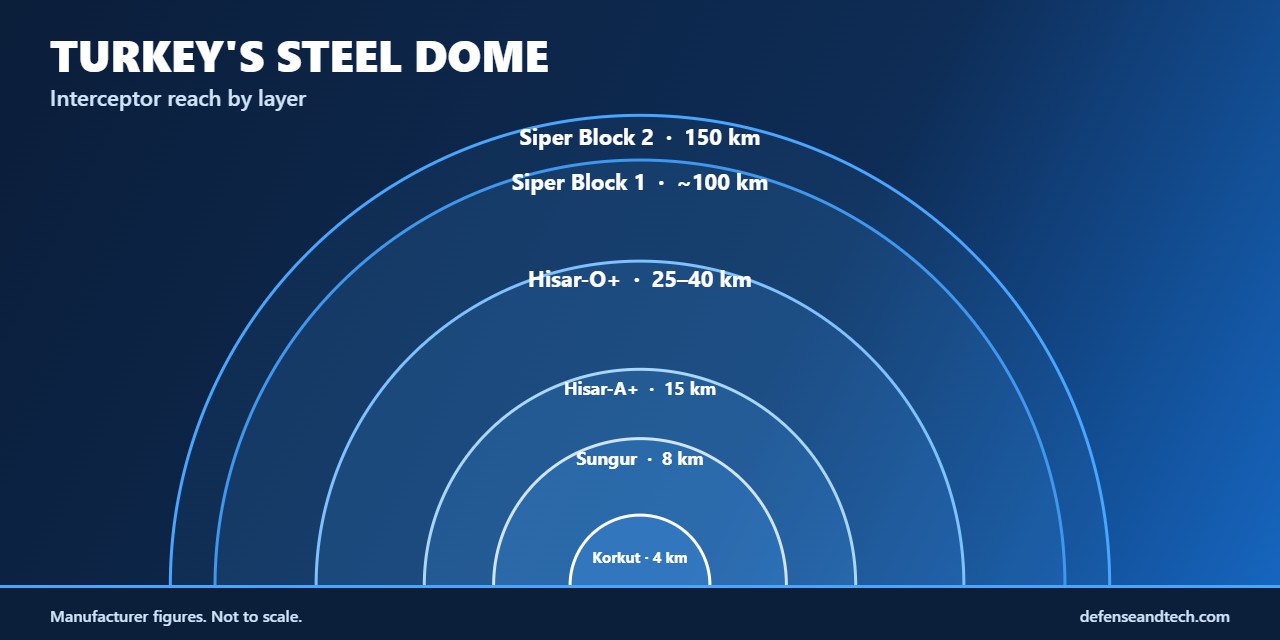
| Very short range | Korkut | Twin 35 mm self-propelled gun | About 4 km |
| Very short range | Sungur | Shoulder-fired and vehicle-mounted missile | 8 km |
| Short range | Hisar-A+ | Infrared-guided missile | 15 km |
| Medium range | Hisar-O+ | Infrared and radar-guided missile | 25 km; 40 km for the radar-guided version |
| Long range | Siper Block 1 | Radar-guided missile, in service | About 100 km |
| Long range | Siper Block 2 | Radar-guided missile, tested in June 2026 | 150 km |
| Missile defence | Siper Block 3 | In development | Not disclosed |
| Counter-drone | Gürz, Gökberk, Ejderha | Gun-missile hybrid, laser and microwave weapon | Short range |
Sensors and jammers are counted as part of the system. The first delivery included ALP 300-G long-range and ALP 100-G low-altitude radars and PUHU and REDET electronic warfare vehicles, and the Koral radar jammer belongs to the same network. The idea is that a drone can be jammed, shot with a gun or hit with a missile, whichever is cheapest, and that one command post makes the choice.
What has been delivered so far?
| Date | Milestone |
|---|---|
| 27 August 2025 | First delivery: 47 vehicles worth $460 million, including one Siper battery, three Hisar batteries and radars |
| 26 November 2025 | Contracts worth $6.5 billion signed with Aselsan, Roketsan and Havelsan |
| January 2026 | First serial-production Siper Block 1 battery accepted after a live firing at Sinop |
| 20–21 May 2026 | All gun and missile layers deployed together at exercise EFES 2026 near İzmir |
| 16 June 2026 | A Siper battery destroys a high-speed target near Ankara; a Siper Block 2 test follows |
| June–July 2026 | Aselsan signs further contracts worth €780 million and €1.47 billion |
Aselsan says it will hand over more than 150 Steel Dome components in 2026, half as many again as in 2025, and that more than ten Hisar and Siper batteries are on order for the air force. Equipment under the newest contracts arrives between 2028 and 2032, which is the realistic date for a network of national scale.
How much does the Steel Dome cost?
No total has been published. The announced contracts add up to more than $10 billion: $1.9 billion to Aselsan in September 2025, $6.5 billion to three companies that November, and two further Aselsan deals worth about $900 million and $1.7 billion in June and July 2026. Aselsan is also spending $1.5 billion on a production site at Oğulbey near Ankara that is meant to double its output. Roketsan’s new missile plants, described in our guide to Turkey’s missiles, serve the same programme.
What are the gaps?
Three stand out. The first is ballistic missile defence. Siper Blocks 1 and 2 are built to stop aircraft and cruise missiles. The Block 3 that is meant to engage ballistic missiles is still in development, and until it arrives Turkey relies on NATO for that cover.
The second is proof. At EFES 2026 the layers were deployed and networked in front of observers from 50 countries, but the analysis site Quwa noted that no public reporting confirmed a live intercept by the combined system. The individual missiles have hit targets in tests. The network has not yet been shown doing so under jamming.
The third is numbers. A handful of Siper batteries cannot cover a country of 780,000 square kilometres, and interceptor stocks are what ran short for the United States and Israel in the war with Iran this year. Production capacity, more than design, will decide how much of Turkey the dome covers.
Then there is the S-400. The Russian system bought in 2019 sits outside the network because it cannot be linked to NATO-standard equipment. Turkish media reported in July 2026 that Ankara was preparing to sell it to a Gulf state, which the Defence Ministry has not confirmed.
Where is it deployed, and who else wants it?
Ankara does not publish battery locations. Greek Cypriot media reported in January 2026 that Hisar-O and Korkut units had been set up around Kyrenia in northern Cyprus. Turkey has not confirmed it. Abroad, the Czechoslovak Group showed an air defence system at Eurosatory 2026 that uses Roketsan interceptors, and Aselsan says its foreign orders doubled in a year. Our ranking of the top 10 air defence systems shows what the Turkish missiles are competing against.
Frequently asked questions
What is Turkey’s Steel Dome?
A national air defence network that connects guns, short-, medium- and long-range missiles, radars and electronic warfare systems under a single command system. It was approved in August 2024.
Is Steel Dome the same as Iron Dome?
No. Iron Dome is a single Israeli short-range system. Steel Dome is a multi-layer architecture that includes long-range missiles such as Siper.
Is the Steel Dome operational?
Parts of it are. The first 47 vehicles were delivered in August 2025 and Siper Block 1 entered service in January 2026. Deliveries under current contracts run to 2032.
Can the Steel Dome stop ballistic missiles?
Not yet. The Siper Block 3 interceptor intended for that role is still in development.
Who builds the Steel Dome?
Aselsan leads the programme, with Roketsan, Havelsan, TÜBİTAK SAGE and MKE.
How much does the Steel Dome cost?
No total has been published. Contracts announced since September 2025 exceed $10 billion.
- Quwa – Türkiye deploys Steel Dome at EFES 2026 (May 2026): quwa.org
- Quwa – Aselsan signs €1.47 billion Steel Dome contract (July 2026): quwa.org
- The Defense Post – Aselsan secures $900M deal to expand Steel Dome (June 2026): thedefensepost.com
- Army Recognition – Türkiye integrates Siper-1 into Steel Dome network (January 2026): armyrecognition.com
- Daily Sabah – Siper comes of age (June 2026): dailysabah.com
- Greek City Times – Reported Hisar deployment in northern Cyprus (January 2026): greekcitytimes.com
- Turkish Minute – Turkey says work on S-400 continues (July 2026): turkishminute.com
- Wikipedia – Steel Dome (components and delivery dates): en.wikipedia.org