Shield AI Hivemind Flies Two Anduril CCA Jets in First Formation Air Combat Test
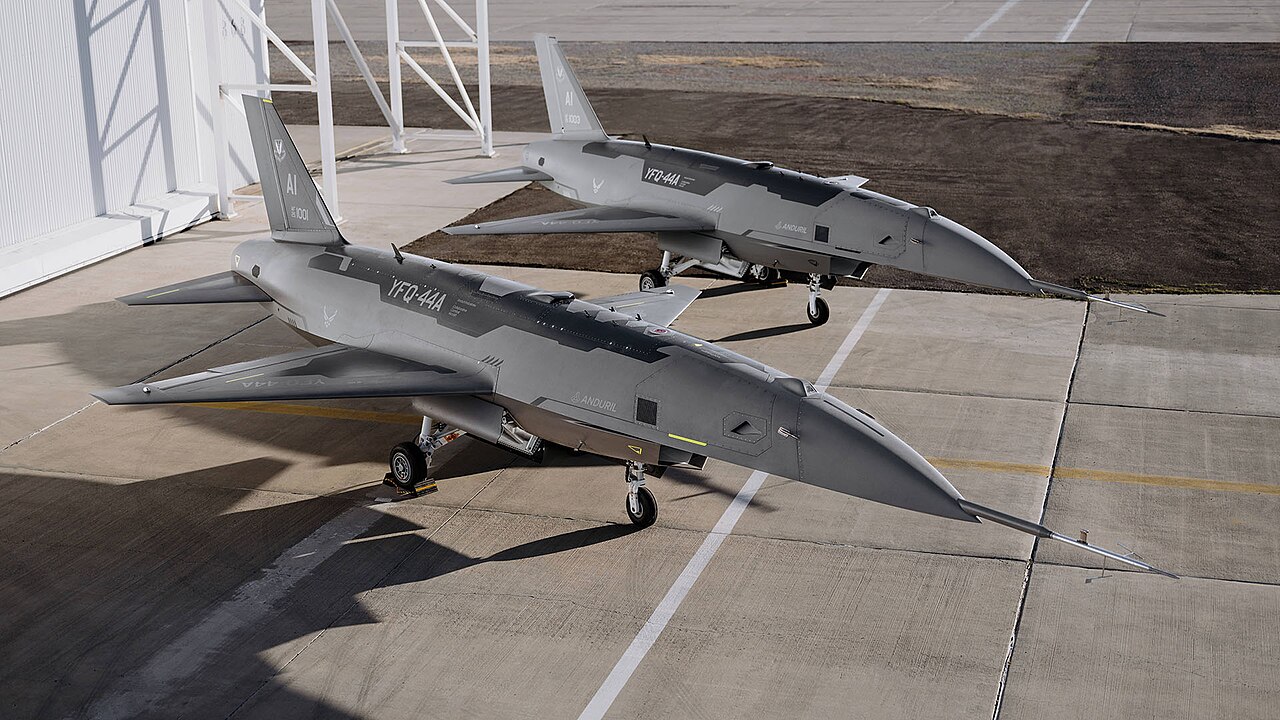
Shield AI’s Hivemind software flew two Anduril-built Collaborative Combat Aircraft in formation and directed them through a beyond-visual-range air combat engagement, which the company says is the first time aircraft in the US Air Force CCA programme have manoeuvred together as a team. The flight took place on October 26 and Shield AI announced it on November 9, 2026.
The test was flown at the Nevada Test and Training Range with no pilot in the air, according to Air & Space Forces Magazine. A ground operator gave high-level direction and Hivemind handled the tactics. The aircraft were Anduril’s FQ-44A Fury, the jet developed as the YFQ-44A for the US Air Force.
Hivemind Flies Two FQ-44A Jets in Formation
Shield AI said Hivemind let multiple CCAs fly a multi-ship formation and carry out collaborative beyond-visual-range counter-air tactics, operating as a coordinated team rather than as separate aircraft sharing the same airspace. The release did not give the number or type of aircraft; Air & Space Forces Magazine and FlightGlobal reported two Anduril jets.
“The difference here was, it was a full-on tactical air-to-air engagement,” Todd Wesley, Shield AI’s vice president of Hivemind engineering, told Air & Space Forces Magazine. In the company release he said the aircraft and mission systems are “reaching a level of integration to start showing what Hivemind can really do.” The two CCA designs and how they differ are covered in our YFQ-42A vs YFQ-44A explainer.
| Item | Detail |
|---|---|
| Date | October 26, 2026 |
| Announced | November 9, 2026 (Shield AI) |
| Location | Nevada Test and Training Range |
| Aircraft | Two Anduril FQ-44A Fury (YFQ-44A), as reported by Air & Space Forces Magazine and FlightGlobal |
| Autonomy software | Shield AI Hivemind |
| Demonstrated | Multi-ship formation; beyond-visual-range counter-air tactics against a virtual threat |
| Human role | Ground operator giving high-level direction; no pilot airborne |
| Programme | US Air Force Collaborative Combat Aircraft |
From F-22 Quarterback to Autonomous Two-Ship
The formation flight came less than three weeks after a single-aircraft test. On October 8 at Edwards Air Force Base, California, an F-22 pilot in flight acted as an airborne “quarterback”, issuing high-level directives to one FQ-44A. Hivemind interpreted them in real time and flew simulated combat tasks.
| Feature | October 8 test | October 26 test |
|---|---|---|
| Location | Edwards AFB, California | Nevada Test and Training Range |
| CCAs flown | One FQ-44A | Two FQ-44As (reported) |
| Who gave direction | F-22 pilot in flight | Operator on the ground |
| Task | Dynamic manoeuvres and simulated combat tasks | Formation flight and BVR air combat against a virtual threat |
| Company description | Pilot directing an autonomous teammate | Autonomous aircraft manoeuvring as a coordinated team |
Both flights build on Hivemind’s first YFQ-44A sortie on February 26, 2026, over the Mojave Desert. Shield AI said then that it was selected by the Air Force as a mission autonomy provider for the CCA programme’s Technology Maturity and Risk Reduction phase. FlightGlobal notes that the service is also trialling Collins Aerospace autonomy software.
Overnight Software Updates and the A-GRA Model
Shield AI’s pitch rests on speed of iteration. “Every flight gives us data that goes into the next software release,” Wesley said, adding that the combined Hivemind and aircraft release process is “nearing the point where the Air Force can fly a sortie, update the software overnight” and fly again the next day.
That depends on the Air Force’s Autonomy Government Reference Architecture, or A-GRA, which uses standard interfaces to separate mission software from aircraft-specific functions. The company said its core software has been integrated on more than 40 uncrewed systems across air, land, sea and space. Splitting the layers lets the Air Force buy autonomy and airframes from different vendors. That reading is analysis, not a company claim.
Shield AI’s $5.3 Billion Echodyne Radar Deal
The flight news landed days after Shield AI agreed on November 5 to buy Echodyne, the Kirkland, Washington, maker of electronically scanned radars. The deal is valued at up to $5.3 billion: $4.8 billion at closing plus up to $500 million tied to financial targets, according to Washington Technology. Closing is expected in early 2027.
Shield AI is also raising $2.5 billion, including a $1 billion Series H at a $28.8 billion post-money valuation. Echodyne radars are used for counter-drone and security work in more than 40 countries, and its chief executive, Eben Frankenberg, will stay on. Earlier this autumn the company also picked Kansas and Washington sites for X-BAT.
Shield AI Company Profile
| Item | Detail |
|---|---|
| Headquarters | San Diego, California |
| Founded | 2015 |
| CEO | Gary Steele |
| Valuation | $28.8 billion post-money (Series H, November 2026) |
| Business units | Autonomy software, autonomous systems, mission systems |
| Known programmes | Hivemind, V-BAT, X-BAT, CCA mission autonomy |
| Footprint | Nine offices and facilities in the US, Europe, the Middle East and Asia-Pacific (February 2026) |
Larger CCA Teams and the Air Force Budget
Wesley said Shield AI will keep raising the complexity of engagements and add more aircraft to live-fly events, working towards “teams of teams” and reassigning aircraft between teams in flight. Flights with live munitions will come later, he said, without giving a date. Air Force officials have talked about one manned fighter controlling two to five CCAs, and more recently up to eight.
The money is growing too. Defense News reported that the fiscal 2027 request for CCA totals $2.37 billion, including $996.5 million for procurement and $1.37 billion for research and development. The Air Force wants 500 combat-ready aircraft by 2032 within an overall fleet of 1,000, according to the same report.
Shield AI Hivemind CCA Formation FAQ
What did Hivemind do on October 26?
It flew two FQ-44A jets in formation through beyond-visual-range air combat tactics against a virtual threat.
Which aircraft took part?
Air & Space Forces Magazine and FlightGlobal reported two Anduril FQ-44A Fury jets, developed as the YFQ-44A. Shield AI’s release did not state the type or number.
Was a pilot involved?
No pilot was airborne on October 26. In the earlier October 8 test, an F-22 pilot in flight directed a single FQ-44A.
Is the Echodyne acquisition complete?
No. Shield AI agreed on November 5, 2026, to buy Echodyne for up to $5.3 billion, with closing expected in early 2027.
- Shield AI – “Shield AI Hivemind achieves two CCA firsts” (press release, November 9, 2026, via Joint Forces News): joint-forces.com
- Air & Space Forces Magazine – “In First, Two CCAs Fly Air Combat Maneuvers Using Autonomy Software” (November 9, 2026): airandspaceforces.com
- Defense News – “First-ever Collaborative Combat Aircraft fly in formation, demonstrate air combat maneuvers” (November 10, 2026): defensenews.com
- FlightGlobal – “Two Anduril YFQ-44A uncrewed fighters complete first formation flight with multiple autonomous jets” (November 10, 2026): flightglobal.com
- Washington Technology – “Shield AI to acquire radar maker Echodyne in $5.3 billion deal” (November 5, 2026): washingtontechnology.com
- Shield AI – “Hivemind successfully completes first CCA flight test aboard Anduril’s YFQ-44A aircraft” (February 26, 2026): shield.ai
- Fortune – Shield AI Series G funding report (March 26, 2026)