
US Signs $4B Loan Guarantee for Poland, Sixth FMF Deal

The United States has signed a $4 billion Foreign Military Financing loan guarantee for Poland, the sixth such facility between the two countries and one that pushes Washington’s cumulative credit support for Polish rearmament to nearly $20 billion.
The agreement was signed on 14 September. Polish Deputy Prime Minister and Defence Minister Władysław Kosiniak-Kamysz said it “strengthens the strategic partnership between Poland and the US” and would accelerate deliveries under Poland’s existing Apache helicopter contract.
Deputy Defence Minister Paweł Bejda said the new tranche is earmarked primarily for heavy transport helicopters, a capability Poland has lacked since retiring Soviet-era airlift. He framed the purchase in dual-use terms, noting the aircraft would serve humanitarian relief and disaster response as well as military transport — a politically useful argument in a country where flood response has become a recurring domestic issue.
How the Financing Works
Foreign Military Financing loan guarantees are not grants. Washington underwrites commercial borrowing that Warsaw then uses to pay for American equipment, which lowers Poland’s cost of capital and lets it front-load purchases it would otherwise have to spread across many budget years. The mechanism has become the financial backbone of Polish rearmament since 2022.
Previous FMF facilities have financed the Wisła air and missile defence programme built around Patriot, the modernisation of Poland’s F-16 fleet, the Apache attack helicopter buy, and Barbara — the tethered aerostat radar system Poland is fielding to watch low-altitude approaches along its eastern border.
That last programme has taken on unusual salience. Poland closed an airport and scrambled aircraft during Russian drone alerts earlier this month, and Warsaw invoked NATO’s Article 4 after a drone incursion in September 2025 that triggered the alliance’s Eastern Sentry reinforcement of its eastern flank. Persistent low-altitude surveillance is no longer a theoretical requirement.
The Apache Backlog
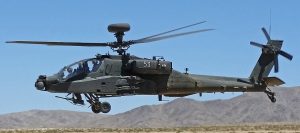
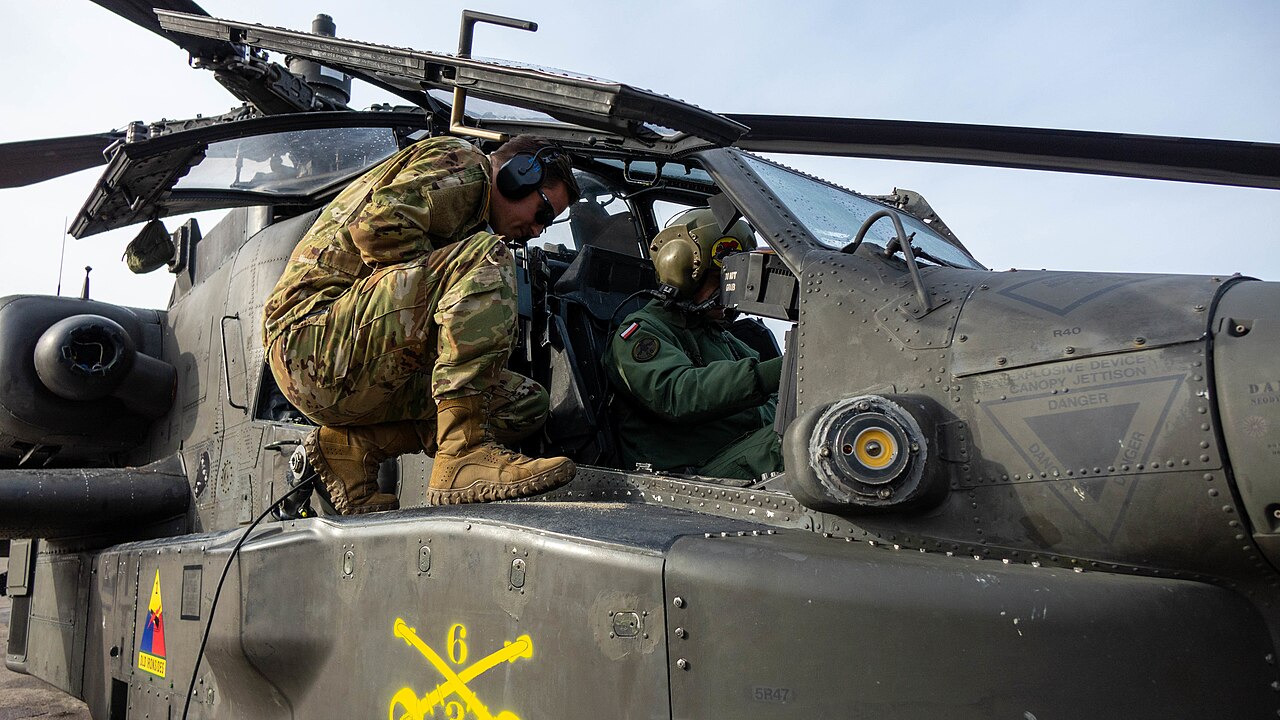
Kosiniak-Kamysz’s reference to accelerating Apache deliveries points at the single largest item in the FMF portfolio. Poland signed for 96 AH-64E Apache Guardians in August 2024 in a package valued at roughly $10 billion including training, munitions and sustainment — an order that makes Poland the largest Apache operator outside the United States.
Deliveries are not due to begin until 2028 and run into the early 2030s. In the interim, Polish crews have been training on US Army Apaches forward-deployed in Poland, and Warsaw leased eight AH-64Ds from the US Army to build an instructor cadre before its own aircraft arrive. Financing that shortens the wait is worth more to Warsaw than financing that simply lowers the price.
Spending at the Top of NATO
Poland has spent the post-2022 period buying at a pace no other European NATO member has matched, and from a wider range of suppliers. Alongside the American purchases — F-35s, Abrams tanks, HIMARS, Patriot — Warsaw has signed a series of very large contracts with South Korean industry covering K2 tanks, K9 howitzers, FA-50 light combat aircraft and K239 Chunmoo rocket launchers. The first 28 K2s under Poland’s second Hyundai Rotem contract arrived at the end of August.
Polish defence spending now sits at roughly 4.8 percent of GDP, the highest share in the alliance and well above the level most European members have committed to reach. Warsaw has also secured about €44 billion ($52 billion) from the European Commission’s Security Action for Europe instrument, the EU’s loan facility for defence industrial expansion.
The combination — American loan guarantees, EU credit, and a domestic budget at the NATO ceiling — is what has allowed Poland to run several major procurement programmes simultaneously. It has also created an obligation stream that will constrain Polish budgets well into the 2030s, a point Polish fiscal analysts have raised with increasing frequency.
Why Washington Keeps Lending
For the United States, the arrangement serves several purposes at once. It sustains American production lines, locks a frontline ally into US systems and sustainment chains for decades, and builds combat power on NATO’s eastern flank without requiring additional US forces to be permanently stationed there.
That last consideration has grown more important as Washington signals a longer-term shift of attention toward the Indo-Pacific. A Poland that can field 96 Apaches, three Patriot-based air defence layers and the largest armoured force in Europe is a Poland that needs less American presence to deter the same threat.
Whether the heavy-lift helicopters Bejda described will be Chinooks, King Stallions or something else was not specified. Poland has previously examined the CH-47F, and Boeing delivered the type to Egypt earlier this month, but no requirement document has been made public.
Sources
- The Defense Post, “Poland Secures New $4-Billion US Defense Financing,” 14 September 2026
- Statements by Polish Deputy Prime Minister and Defence Minister Władysław Kosiniak-Kamysz and Deputy Defence Minister Paweł Bejda, 14 September 2026
- Polish Ministry of National Defence, Apache procurement announcement, August 2024
- US Defense Security Cooperation Agency, Foreign Military Sales notification for AH-64E Apache to Poland
- European Commission, Security Action for Europe (SAFE) allocations
- NATO, Operation Eastern Sentry briefing materials