North Korea Tests New High-Speed Torpedo for 2027
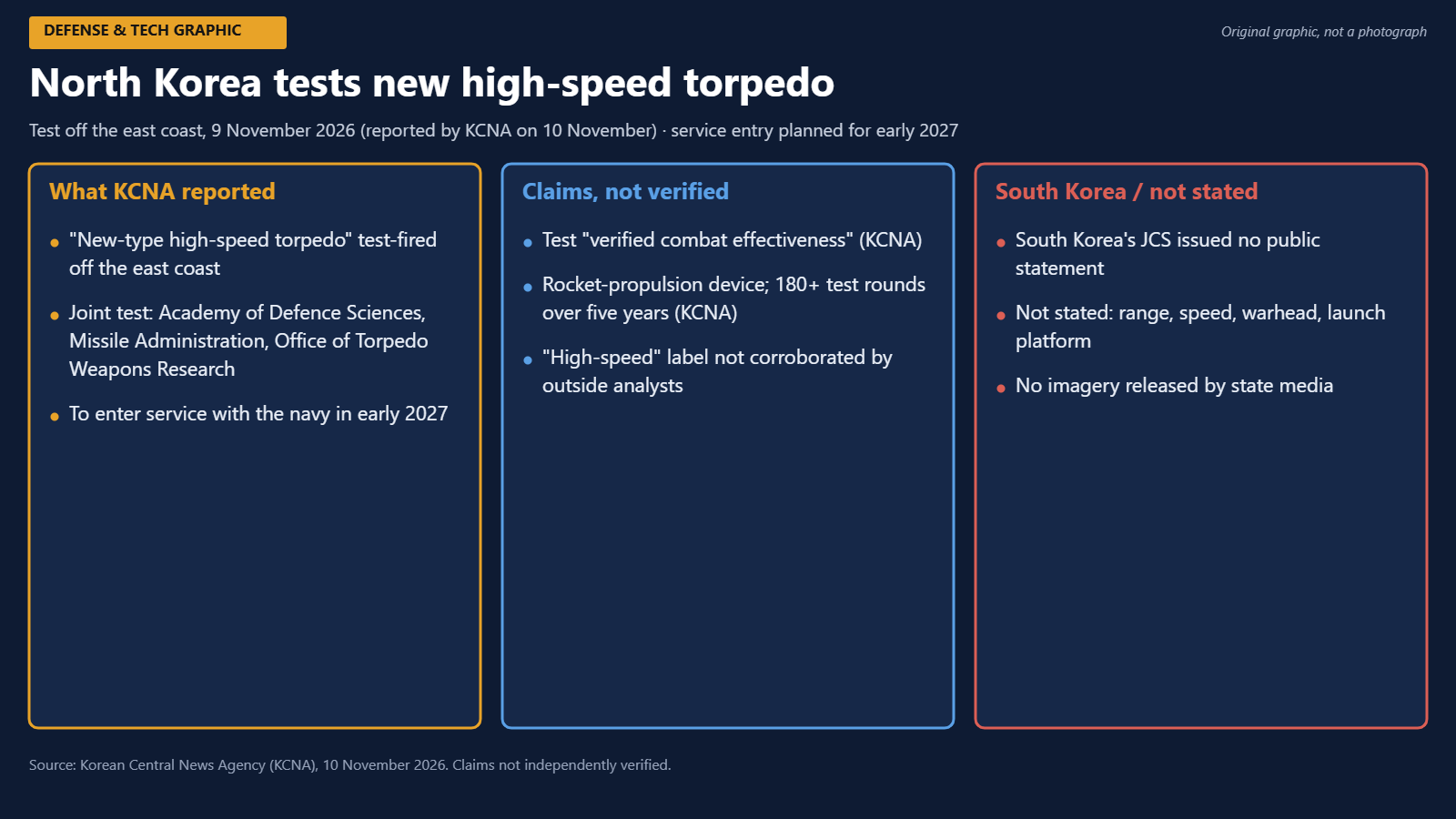
North Korea says it test-fired a new high-speed torpedo on November 9, 2026, and plans to put the weapon into naval service in early 2027, according to state media. The announcement is the latest in a string of underwater-weapons disclosures from Pyongyang this year, as Kim Jong Un pushes a broader naval modernization drive that also includes a nuclear-powered submarine and plans for 10,000-ton destroyers.
What Happened
North Korea’s official Korean Central News Agency (KCNA) reported on November 10 that a “new-type high-speed torpedo” had been test-fired in waters off the country’s east coast the previous day. According to KCNA, the test was carried out jointly by the Academy of Defence Sciences, the Missile Administration and the Office of Torpedo Weapons Research, and it verified the weapon’s “combat effectiveness.” State media said the design is scheduled to enter service with the navy in early 2027.
Pyongyang released no technical specifications — no stated range, speed, warhead size or launch platform — and no imagery beyond brief state-media descriptions. KCNA said the test confirmed “core technology” for improving propulsion efficiency and the performance of what it described as a rocket-propulsion device, the product of more than 180 rounds of testing conducted over five years. South Korea’s Joint Chiefs of Staff did not issue a public statement following the launch, a departure from its usual practice of confirming or disputing North Korean missile and torpedo claims within hours.
The claim could not be independently verified. South Korea’s military has previously accused Pyongyang of overstating the capabilities of new weapons systems, and no outside government or open-source analyst has yet corroborated the “high-speed” description.
The Program: An Underwater Weapons Push Running Since at Least 2021
This is not North Korea’s first torpedo disclosure this year. On October 15, 2026, KCNA announced a test of a separate system it called the Zam-2.0, described as a “super-speed, precisely guided” torpedo incorporating artificial intelligence for target detection and guidance. As with the November test, Pyongyang gave no technical detail on what “AI-guided” meant in practice, and some analysts have suggested the underlying technology may be a supercavitating design — a torpedo that generates a gas bubble around its nose to reduce drag and travel at very high underwater speeds, a principle used in Russia’s VA-111 Shkval.
It remains unclear whether the November 9 test and the October 15 Zam-2.0 test refer to the same weapon at different stages of development, two variants of one program, or genuinely separate systems. KCNA’s own language — “more than 180 rounds of related tests… over the past five years” — was used in connection with both announcements, suggesting overlap, but Pyongyang has not clarified the relationship. Readers should treat the “high-speed torpedo” and “Zam-2.0” as, at minimum, closely related programs rather than confirmed duplicates.
Where It Fits: Kim’s Naval Buildup
The torpedo test lands amid a broader, multi-year push to modernize North Korea’s navy, historically the weakest and most dated branch of its armed forces. Estimates of the submarine fleet range from roughly 64 to 86 boats, the large majority of them aging Romeo- and Sang-O-class designs dating to the Cold War.
In December 2025, state media showed Kim Jong Un inspecting what was described as North Korea’s first nuclear-powered submarine, with a displacement reported around 8,700 tonnes. Outside analysts, including at Naval News and Janes, have said Russian technical assistance is plausible given the leap in complexity involved, though this has not been confirmed by Moscow or Pyongyang. In June 2026, Kim told a ruling-party meeting that the navy would receive 10,000-ton destroyers and additional “underwater weapons systems” under a five-year modernization plan, and in September 2026 he said an unspecified “important plan” for the navy would be unveiled within eight months — a timeline that points toward mid-2027. North Korea commissioned the destroyer Choe Hyon in June 2026; its sister ship, Kang Kon, capsized during launch in May 2025 before being salvaged and refloated. North Korea also reported testing submarine-launched cruise missiles on October 14-15, 2026, its first disclosed underwater missile launches in nearly three years.
Taken together, the pattern described by Pyongyang’s own state media — new torpedoes, a nuclear submarine, submarine-launched cruise missiles and larger surface combatants — points to an effort to build a more credible undersea strike and deterrence capability, rather than any single weapon being presented as decisive on its own.
Why It Matters
A reliable high-speed or AI-assisted torpedo would improve North Korea’s ability to threaten surface ships and, if fitted to submarines, extend an underwater strike option against South Korean, Japanese or US naval assets in regional waters. Combined with the claimed nuclear-powered submarine, it would also mark a shift from North Korea’s traditional reliance on coastal defense and midget submarines toward systems meant to operate further from shore and survive longer underwater — a hallmark of the “underwater warfare” shift that Janes’ defense-intelligence analysts have said is reshaping the security picture in Northeast Asia.
The lack of independent verification is itself significant for how the story should be read. North Korea has a track record of announcing systems — including earlier claimed hypersonic missiles and “tactical nuclear” submarines — well ahead of any operational deployment, and sometimes without the capability ever being confirmed by outside observers. The gap between KCNA’s description and any confirmed test data, video or sea trial leaves open the possibility that “high-speed” and “AI-guided” are aspirational framing rather than demonstrated performance.
What Happens Next
KCNA’s own timeline points to the weapon entering naval service “in early 2027,” which would be the first concrete milestone to watch. Kim Jong Un’s September 2026 reference to an “important plan” for the navy due within eight months — around mid-2027 — may also be linked to the same underwater-weapons push, potentially coinciding with further torpedo trials, additional submarine-launched missile tests, or progress on the nuclear-powered submarine’s sea trials. South Korean and Japanese defense ministries, along with US Indo-Pacific Command, are likely to continue monitoring North Korean naval activity for confirmation of any of these claims, including any at-sea torpedo trial that independent observers could geolocate or image.
FAQ
Did North Korea reveal what the new torpedo is called?
No. State media described it only as a “new-type high-speed torpedo.” It is unclear whether this is the same system as the Zam-2.0, a torpedo Pyongyang separately announced testing on October 15, 2026.
Has South Korea confirmed the test took place?
South Korea’s Joint Chiefs of Staff did not issue a public statement on the November 9 launch, unlike its usual practice after North Korean missile tests. The claim rests solely on KCNA’s account.
Is this torpedo nuclear-capable?
North Korea’s state media did not describe the torpedo as nuclear-armed. Separately, Kim Jong Un has said he wants to build a “nuclear-armed” navy more broadly, including a reported nuclear-powered submarine shown in December 2025, but no official statement has linked this specific torpedo to a nuclear payload.
How does this fit into North Korea’s wider naval plans?
It follows a June 2026 party pledge to build 10,000-ton destroyers and new underwater weapons, the June 2026 commissioning of the destroyer Choe Hyon, and October 2026 tests of submarine-launched cruise missiles, all part of what Kim has called a five-year naval modernization effort.
Could this be a supercavitating torpedo?
Some analysts have speculated that the “high-speed” description and the related Zam-2.0 claims point toward supercavitating technology, similar in principle to Russia’s Shkval torpedo. This is analyst speculation, not something North Korea has confirmed.
Sources
- Stars and Stripes, “North Korea high-speed torpedo test,” Nov 10, 2026 — stripes.com — primary account of the Nov 9 test and 2027 deployment timeline.
- The Korea Times, “N. Korea tests new torpedo, eyes early 2027 deployment,” Nov 10, 2026 — koreatimes.co.kr — corroborating account citing KCNA.
- Korea JoongAng Daily, “North Korea tests new high-speed torpedo, targets 2027 Navy deployment,” Nov 10, 2026 — koreajoongangdaily.com — additional detail on the three agencies involved in testing.
- Korea JoongAng Daily, “North Korea conducts underwater test of new precision-guided torpedo: KCNA,” Oct 2026 — koreajoongangdaily.com — background on the Zam-2.0 AI-guided torpedo test.
- The Korea Times, “N. Korea tests new precision-guided torpedo using AI: KCNA,” Oct 17, 2026 — koreatimes.co.kr — detail on the 180-plus test rounds over five years and analyst skepticism.
- Naval News, “North Korea’s First Nuclear Powered Missile Submarine is Revealed,” Dec 2025 — navalnews.com — background on the nuclear-powered submarine program.
- The Jakarta Post, “North Korea’s Kim unveils plans for 10,000-ton warships, nuclear navy,” Jun 24, 2026 — thejakartapost.com — Kim’s five-year naval modernization pledge.
- Al Jazeera, “North Korea tests two submarine-launched missiles, state media reports,” Oct 15, 2026 — aljazeera.com — context on the parallel submarine-launched cruise missile tests.