Ukraine Says It Hit Russian Missile Ship Naro-Fominsk in the Gulf of Finland
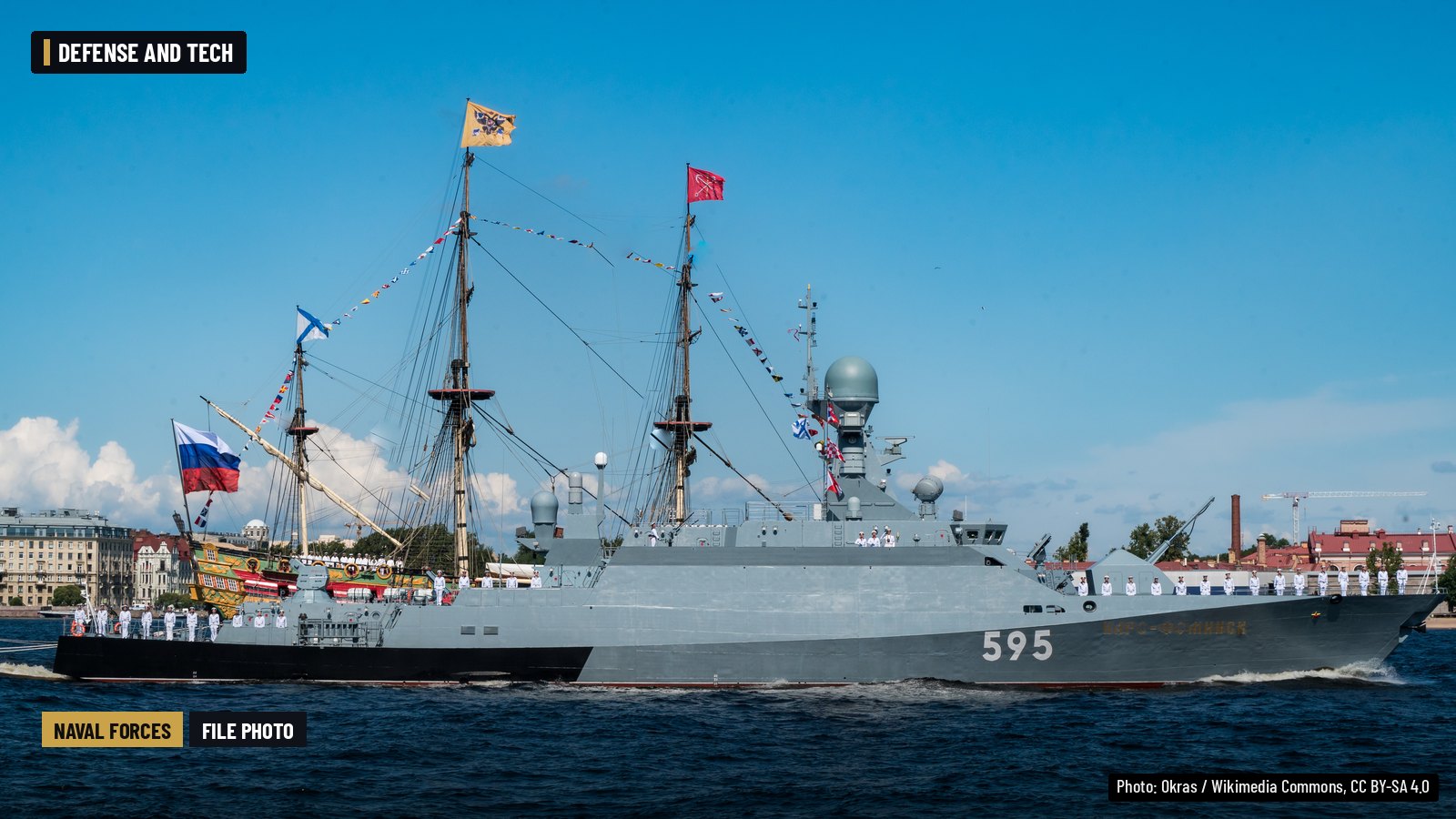
Ukraine’s Security Service (SBU) says it struck the Russian Navy’s small missile ship Naro-Fominsk in the Gulf of Finland overnight on 11 November 2026, during a wider drone attack on the oil port of Ust-Luga in Russia’s Leningrad region. In a statement on its official Telegram channel, the SBU said it had “planned and carried out” the strike on the Project 21631 Buyan-M ship, which it described as a carrier of Kalibr and Oniks cruise missiles. Finland’s armed forces have confirmed that they detected a strike on a Russian warship in the area. Neither the damage nor any casualties have been independently confirmed.
Update, 14 November 2026: Finnish Defence Minister Antti Häkkänen said on 13 November that Finland had contacted Ukraine about the strike. “We have told the Ukrainians this time, and a little earlier too, how sensitive this narrow stretch of the Gulf of Finland, right between us and Estonia, is in terms of environmental safety and the safety of civilian shipping,” he said, Yle reported. He added that the Baltic Sea remains safe. Russia’s defence ministry has still not commented on the ship.
Update, 13 November 2026: At the Estonian defence ministry’s regular Friday briefing, Col. Aron Kalmus, deputy commander of the Estonian Division, said Naro-Fominsk was hit by more than three Ukrainian drones and that there were deaths and injuries on board, ERR reported. He said the corvette first headed towards St Petersburg under its own power but then stopped, and continued only with an escort vessel. He gave no casualty figures. Russia’s defence ministry has still not commented, and the damage has not been independently confirmed.
- The SBU says it planned and carried out a strike on the Russian Buyan-M class small missile ship Naro-Fominsk overnight on 11 November 2026
- Finland’s Defence Forces say they detected a strike on a Russian warship in the Gulf of Finland and that there is no immediate threat to Finland
- Estonia’s defence minister says smoke came from the ship and that it sailed back towards St Petersburg
- Estonia’s military said on 13 November that the ship was hit by several drones, with deaths and injuries, and needed an escort; Russia has not commented and the damage is not independently confirmed
What Finland and Estonia have confirmed
The Finnish Defence Forces said in a statement emailed to Reuters that they had “detected… a strike on a Russian warship in the Gulf of Finland area” and had monitored the situation since. A spokesperson told Janes that Finland faced no immediate military threat and that the security situation in the Baltic Sea remained stable, but declined to say where or when the incident happened or how it was detected.
A senior Finnish official told public broadcaster Yle that the attack was detected near Gogland island (Suursaari in Finnish), about 40 km south of the Finnish coast and 55 km north of Estonia. Yle also reported that the Finnish Defence Forces imposed temporary restrictions on sea areas and airspace in the eastern Gulf of Finland as a precaution early on 11 November.
Estonia’s Defence Minister Martin Herem told broadcaster ERR, as quoted by the BBC, that the ship was hit at about 05:30 local time (03:30 GMT): “We know that smoke came from the ship afterwards. The ship itself went back towards St Petersburg.” He did not say what hit it. Finland’s Foreign Minister Elina Valtonen said the situation in the Baltic Sea remained stable and that there was no threat to shipping.
What remains a claim
The SBU has not said what weapon it used and has published no evidence of the damage. Some Ukrainian outlets described the ship as “destroyed”, but the Estonian minister’s account that it sailed back towards St Petersburg does not support that. Before the Estonian military’s briefing, reports of crew casualties came only from Telegram channels: Russian channel Zloy Moryachok, cited by The Insider, and Exilenova+, cited by Yle. The SBU also said it was “verifying information” about destroyed Russian combat helicopters. Russia’s defence ministry has not commented.
The Ust-Luga strike
The SBU said drones of its Alpha special operations centre hit several 30,000-tonne tanks at the Novatek-Ust-Luga terminal, causing a spill of petroleum products, and that a large fire broke out at the Ust-Luga Oil terminal. It also reported fires at the Factor terminal and at Luzhskaya railway station. Ukraine’s General Staff, as reported by the Kyiv Post, said five tanks with a combined capacity of 150,000 cubic metres were damaged, along with a hydrocracking unit, a pumping station and a berth. Leningrad region governor Aleksandr Drozdenko claimed that Russian air defences intercepted 150 drones over the region that night.
Herem said the drones flew mostly close to the Estonian border inside Russian airspace between midnight and about 06:00, and that one drone briefly entered Estonian airspace from Latvia before heading into Russia. Ukraine’s foreign ministry spokesman Heorhiy Tykhyy called Russian allegations that Kyiv had used Baltic airspace “baseless”, while acknowledging that incidents could happen when Russia diverts drones with electronic warfare.
The ship: a Buyan-M from the Baltic Fleet
Naro-Fominsk is a Project 21631 Buyan-M small missile ship, a compact corvette built to carry long-range missiles. The SBU says it was launched in 2022. According to Janes, it was commissioned on 23 December 2023 and serves with the Baltic Fleet; it is 74.1 m long with an 11 m beam, displaces 949 tonnes, reaches 25 knots and carries a 100 mm A-190 gun. Ships of the class have an eight-cell vertical launcher for Kalibr land-attack and Oniks anti-ship missiles, the weapons Russia has used against Ukraine from the Black Sea and the Sea of Azov. For the wider fleet picture, see our guide to the size of Russia’s navy.
Why the Baltic matters
According to the BBC, this is thought to be the first time Ukrainian drones have attacked a Russian ship in part of the Baltic Sea open to civilian traffic. Russian vessels have been hit repeatedly in the Black Sea, and Ukrainian drones have also reached the Caspian Flotilla’s base at Kaspiysk, but the Baltic Fleet had so far escaped. Emil Kastehelmi of the Finnish monitoring group Black Bird told the BBC that Ukraine had used “a window of opportunity” and that he did not see the strike as a serious escalation. The Gulf is a narrow waterway used by tankers and crossed by subsea data cables, and, according to Reuters, Estonia, Latvia and Lithuania issued shelter warnings over drones in their airspace on the same morning while NATO scrambled aircraft.
Sources: SBU (Telegram); Finnish Defence Forces via Reuters/Defense News and Janes; Yle; Martin Herem via ERR, quoted by the BBC; Ukrainian General Staff via the Kyiv Post.