Boxer vs Stryker, Which 8×8 Armored Vehicle Fits Which Mission
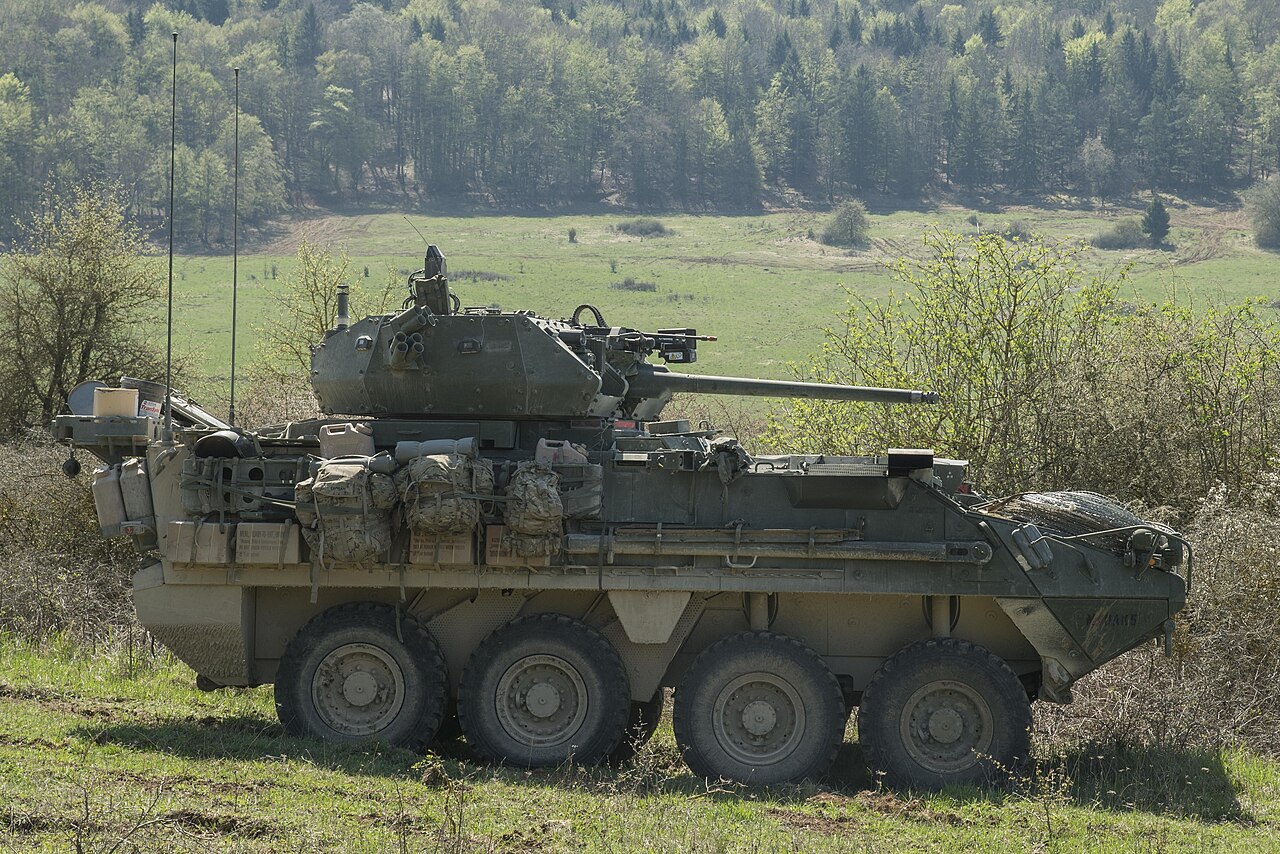
In the Boxer vs Stryker comparison, the Boxer is the heavier, more modular 8×8 at roughly 36 tonnes against the Stryker’s 17 to 21 tonnes, but the Stryker is easier to airlift and cheaper to field in expeditionary brigades. Both are wheeled armored vehicles built for the same broad job, carrying infantry quickly over long distances, and they reflect two different design philosophies.
Boxer vs Stryker side by side
| Item | Boxer | Stryker |
|---|---|---|
| Maker | ARTEC (KNDS and Rheinmetall) | General Dynamics Land Systems |
| Origin | Germany, Netherlands, UK program | United States, derived from the Swiss-designed LAV III family |
| Combat weight | About 36 to 38 tonnes | About 17 to 21 tonnes |
| Crew and troops | 2 plus up to 8 | 2 plus up to 9 |
| Engine | MTU diesel, around 530 kW (about 710 hp) | Caterpillar diesel, 350 to 450 hp depending on version |
| Top speed | About 100 km/h | About 97 km/h |
| Design concept | Drive module plus swappable mission modules | Fixed hull, variants built on a common chassis |
| In service since | Early 2010s | 2002 |
The headline difference is the Boxer’s modular architecture. Its drive module carries the engine and wheels, while a separate mission module holds troops, a command post or a weapon. Armies can swap modules in a workshop, which is an unusual design for a wheeled vehicle. The Stryker takes the opposite approach, with one rugged, proven hull adapted into many variants.
Which is better, Boxer or Stryker
Neither is better in every case, because they answer different questions. The Boxer is a heavier vehicle with more protection growth, more internal volume and a larger weapons potential, which suits European armies planning for high-intensity war. The Stryker is lighter, which makes it easier to move by air and sea, and it was designed around the US Army’s need to deploy brigades quickly.
| Mission | Better fit | Reason |
|---|---|---|
| Rapid expeditionary deployment | Stryker | Lower weight, easier transport by C-17 and ship |
| Mechanized brigade in high-intensity war | Boxer | More armor growth, payload and firepower options |
| Command, medical and support roles | Boxer | Modules and large interior volume |
| Budget-conscious fleet with a proven logistics chain | Stryker | Mature supply chain and lower weight |
| Long road marches across Europe | Boxer | Higher reported speed and range on roads |
Boxer and Stryker armor and protection
The Boxer’s extra weight buys a larger protection envelope, with add-on armor modules and mine-resistant design that can be scaled to the threat. The Stryker’s basic armor is modest, and crews have long relied on bolt-on slat armor and reactive panels to cope with rocket-propelled grenades. The double V-hull upgrade improved its resistance to mines and improvised explosives and raised its weight closer to 20 tonnes or more.
The trade-off is plain. More armor on a wheeled 8×8 means more weight, more fuel use and more strain on bridges and transport aircraft. The Stryker’s lower weight is exactly what keeps it deployable.
Boxer and Stryker variants and weapons
Boxer users field infantry carriers, ambulances, command vehicles and heavy weapon carriers, including turreted versions with 30 mm cannon and the RCH 155 self-propelled howitzer. The German and Dutch Schakal adds a 30 mm turret to give a wheeled fighting vehicle heavier firepower.
The Stryker family includes the infantry carrier, mobile gun system, reconnaissance, medical evacuation and engineer variants. The Stryker Dragoon adds a 30 mm cannon, and the army has tested air defense versions, including a laser-armed demonstrator. For a deeper look at the American design, see our Stryker guide.
Who uses the Boxer and the Stryker
Boxer operators include Germany, the Netherlands, the United Kingdom, Lithuania and Australia, and orders across these users run well over a thousand vehicles. It is built by ARTEC, a joint company of KNDS and Rheinmetall. The Stryker is used primarily by the US Army, built by General Dynamics, and has reportedly been supplied to Ukraine as well.
Boxer vs Stryker frequently asked questions
Is the Boxer heavier than the Stryker?
Yes. The Boxer typically weighs about 36 tonnes or more, roughly double the Stryker’s base weight.
Which is faster, Boxer or Stryker?
They are close, at around 100 km/h and 97 km/h on roads respectively.
Who makes the Boxer?
ARTEC, a joint venture of KNDS and Rheinmetall.
Does the US Army use the Boxer?
No. The US Army uses the Stryker, while the Boxer serves in European armies, the United Kingdom and Australia.
Can the Stryker carry a 30 mm cannon?
Yes. The Stryker Dragoon variant mounts a 30 mm cannon.
- Manufacturer product literature from ARTEC and General Dynamics Land Systems
- Wikipedia – Boxer and Stryker entries (accessed October 2026)
- National defense ministry announcements on Boxer procurement
- Defence & Tech reporting on armored vehicles