The F-47 and the Pacific: Why Range Decides a Taiwan Fight
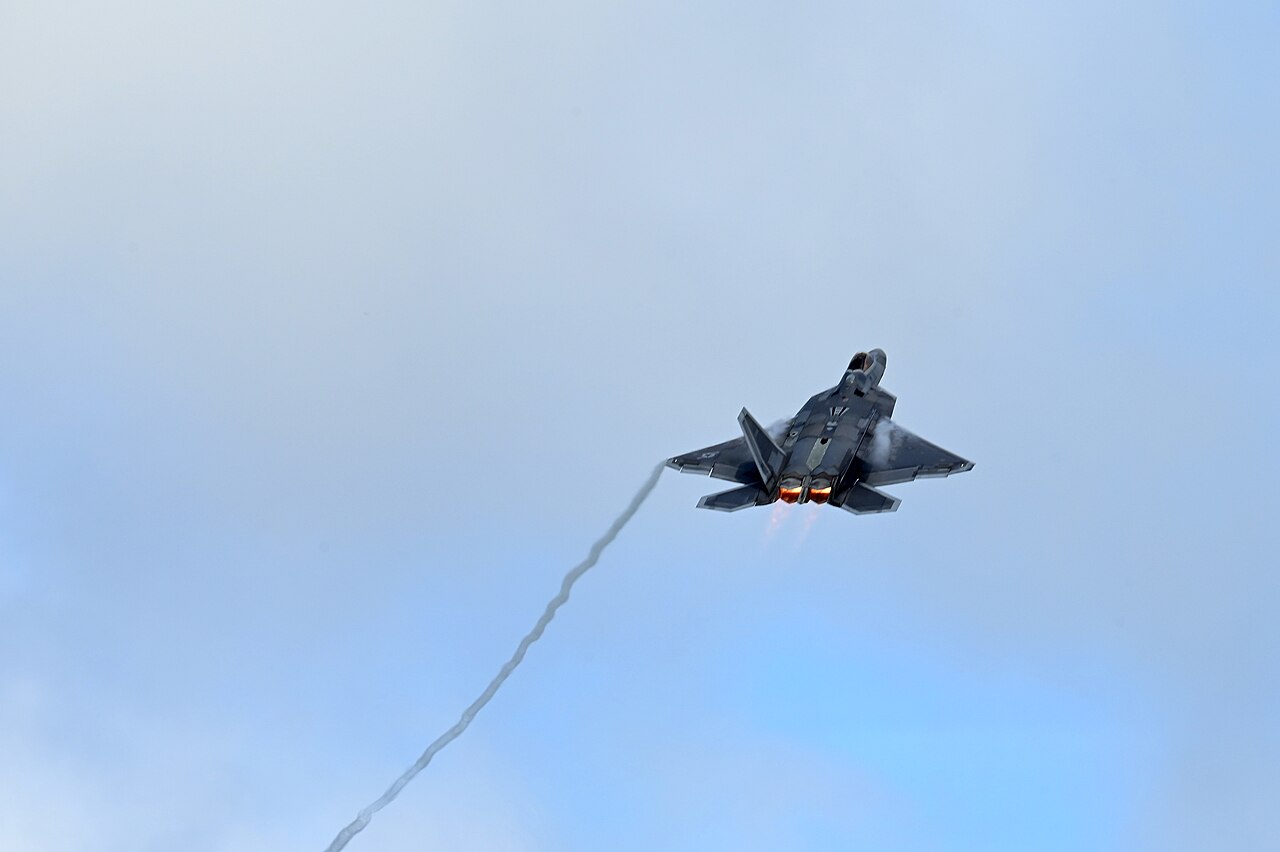
The F-47’s most important published number is its combat radius of more than 1,000 nautical miles, and the reason for that number is the geography of the western Pacific. American fighters designed for Europe have short legs by Pacific standards. The bases close enough for them to reach Taiwan are within range of thousands of Chinese missiles. The F-47 is the Air Force’s attempt to fight from farther back.
This analysis looks at the distances involved, the missile threat that drives them, what the F-47 changes and what it leaves unsolved. The distances are approximate straight-line figures, and the scenario is illustrative.
The distance problem
A combat radius is the distance an aircraft can fly out, fight and return without refuelling. The Air Force’s May 2025 graphic gives 590 nautical miles for the F-22, 670 for the F-35A and more than 1,000 for the F-47. Our F-47 range explainer covers how such figures are calculated.
| Base | Distance to Taiwan | F-22 | F-35A | F-47 |
|---|---|---|---|---|
| Kadena, Okinawa | About 350 nm (650 km) | Yes | Yes | Yes |
| Clark, Philippines | About 590 nm (1,090 km) | Marginal | Yes | Yes |
| Yokota, Japan | About 1,120 nm (2,080 km) | No | No | Marginal |
| Andersen, Guam | About 1,500 nm (2,760 km) | No | No | No |
The table shows the pattern. Today’s stealth fighters can reach the Taiwan Strait unrefuelled only from the closest bases. The F-47 brings the main Japanese islands into play and needs one refuelling from Guam, where the F-22 would need several.
Why the close bases are dangerous
The close bases are the ones China can hit hardest. Its rocket force fields large numbers of ballistic and cruise missiles able to reach Okinawa and the main Japanese islands, and the DF-26 is credited with enough range to strike Guam.
Wargames have put numbers on the risk. A widely cited series run by CSIS in 2023 found that the United States lost hundreds of aircraft in the opening weeks of a Taiwan conflict, most of them on the ground. Aircraft parked in the open are easier to destroy than aircraft in flight.
Protection has lagged. A January 2025 Hudson Institute study counted more than 3,000 aircraft shelters on Chinese airfields. It found that the United States had added only two hardened shelters and 41 unhardened ones at its own bases within 1,000 nautical miles of the Taiwan Strait since the early 2010s, excluding South Korea.
What the F-47 changes
Range gives commanders choices. An aircraft that can fight from 1,000 nautical miles away can use bases beyond the densest part of China’s missile coverage. It can also spread across more airfields, which is the idea behind the Air Force’s Agile Combat Employment concept.
It eases the tanker problem too. Tankers are large, unstealthy and essential, and China has built very long-range missiles such as the PL-17 that appear designed to hunt them. A fighter that needs less fuel in the air lets tankers stay farther from danger. We look at this in detail in the next articles in this series on refuelling.
The third change is survivability over the target. The Air Force rates the F-47’s stealth above the F-22’s, and it will direct Collaborative Combat Aircraft that can fly ahead and take the greater risk.
What it does not change
Range does not make bases safe. Guam and Japan are still fixed targets, and an F-47 destroyed on the ramp is as lost as an F-22. Shelters, air defences and dispersal remain necessary whatever aircraft is parked there.
Numbers are limited. The Air Force has spoken of at least 185 F-47s. Spread across training, testing, maintenance and other theatres, that would put a modest force in the Pacific on any given day. China is estimated to have several hundred J-20s already.
There is also a mismatch inside the formation. The Air Force graphic gives the first Collaborative Combat Aircraft a radius of more than 700 nautical miles, which is less than the F-47’s. Unless the drones are based closer or refuelled, they cannot follow the crewed fighter all the way.
Timing: after 2027
American officials have often cited 2027 as the year by which China’s leadership wants its forces ready for a Taiwan operation. That is a statement about readiness, not a forecast of war. Whatever its meaning, the F-47 will not be there. It is due to fly in 2028 and to enter service around the end of the decade.
For the rest of the 2020s, the air superiority mission in the Pacific belongs to the F-22 and F-35, supported by upgraded F-15s. The F-47 is a system for the 2030s, when the Pentagon expects China’s own sixth-generation aircraft, compared in F-47 vs J-36 and F-47 vs J-50, to be arriving.
Its near-term effect is on planning. A funded, long-range American fighter complicates Chinese calculations about the next decade, which is part of what deterrence means.
Frequently asked questions
Why does the F-47 need so much range?
Because bases close to China are within reach of large numbers of Chinese missiles. Longer range lets the aircraft operate from bases farther away.
Can the F-47 reach Taiwan from Guam?
Not unrefuelled. Guam is about 1,500 nautical miles from Taiwan, beyond the published combat radius. It would need at least one refuelling.
Can the F-47 reach Taiwan from Japan?
From Okinawa easily. From the main Japanese islands the distance is close to its published combat radius.
Will the F-47 be ready by 2027?
No. Its first flight is planned for 2028 and service entry around the end of the decade.
How many F-47s would be in the Pacific?
Unknown. The Air Force has spoken of a total fleet of at least 185.
Does the F-47 solve the air base problem?
No. It reduces dependence on the closest bases, but aircraft on the ground still need shelters, defences and dispersal.
- CSIS – The First Battle of the Next War: Wargaming a Chinese Invasion of Taiwan: csis.org
- Hudson Institute – Concrete Sky: Air Base Hardening in the Western Pacific: hudson.org
- Air Data News – Pentagon report on China’s sixth-generation fighters: airdatanews.com
- The Aviationist – U.S. Air Force Awards CCA Production Contracts: theaviationist.com
- The War Zone – First F-47 6th Generation Fighter Now Being Built: twz.com
- The War Zone – How Many J-20 Stealth Fighters Does China Actually Have? (F-22 inventory figures): twz.com