F-35B Explained: How Vertical Landing Works
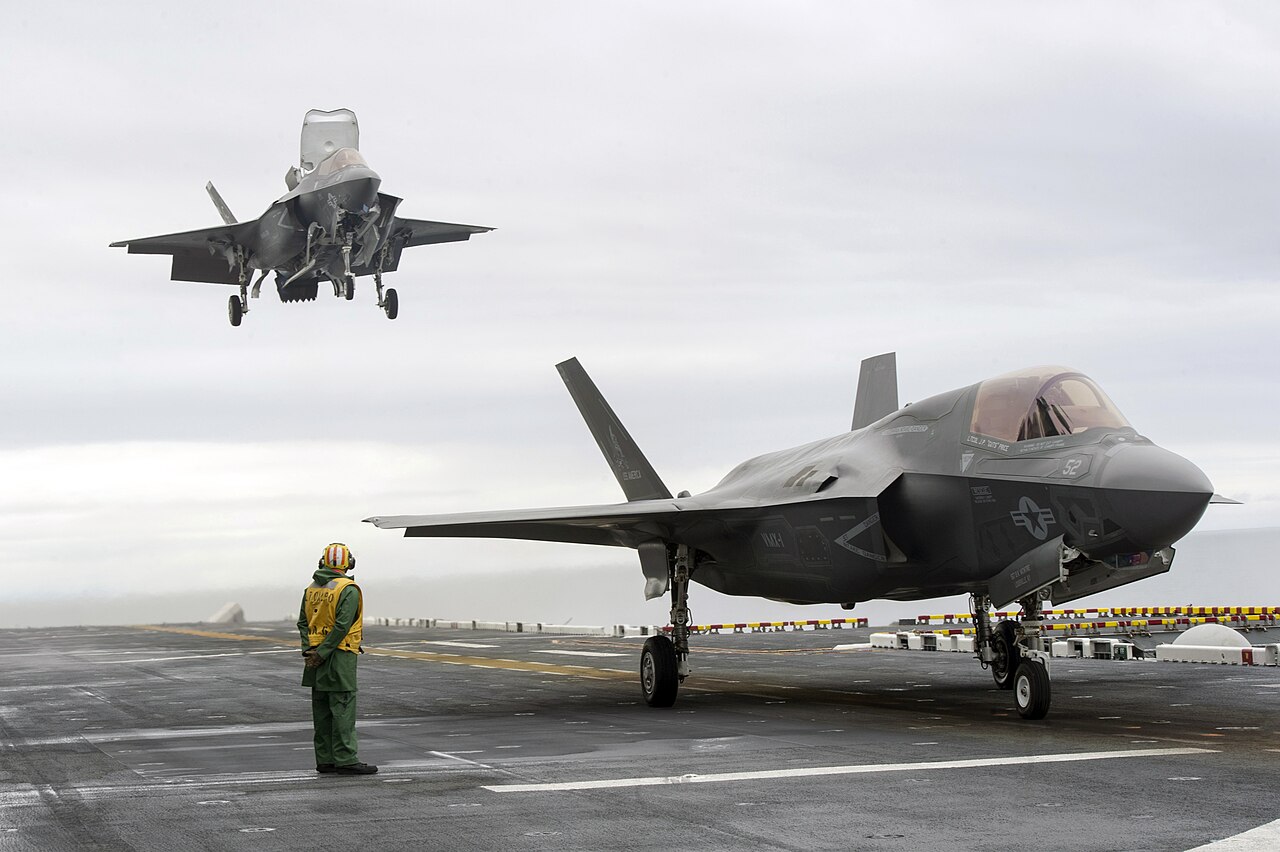
The F-35B lands vertically by pointing its engine exhaust at the ground and driving a large fan behind the cockpit, which together produce about 40,650 lbf of upward thrust. It is the only supersonic stealth aircraft that can do this, and the only fixed-wing jet available to navies without catapults.
The capability is not free. The lift system takes up space and weight that the other variants use for fuel and weapons. This guide explains how F-35B vertical landing works, how the aircraft is flown, where it operates and what is given up for it.
How does F-35B vertical landing work?
Four jets of air hold the aircraft up. At the back, the engine nozzle swivels downward through about 95 degrees. At the front, a fan mounted flat behind the cockpit blows cool air straight down. Under each wing, a small roll post bleeds engine air to keep the wings level.
The fan is the clever part. It is not a separate engine. When the pilot selects hover mode a clutch connects it to a shaft from the front of the main engine, which delivers roughly 29,000 horsepower. Doors open above and below the fan, behind it for extra engine air, and under the tail for the nozzle. The engine itself is described in the F-35 engine.
| Component | What it does | Share of hover thrust |
|---|---|---|
| Lift fan | Two-stage fan driven by a shaft from the engine; blows cool air down behind the cockpit | About 46% |
| Three-bearing swivel nozzle | Turns the engine exhaust from straight back to straight down | About 46% |
| Roll posts | Two small nozzles under the wings for balance | About 8% |
| Doors | Open over the fan, the auxiliary intake and the nozzle bay | None |
How do pilots fly the F-35B in the hover?
With one button and far less effort than in a Harrier. The pilot presses the conversion switch and the flight computer opens the doors, engages the fan and balances the thrust. In the hover the right-hand stick moves the jet up, down and sideways and the left-hand lever moves it forward and back. If the pilot lets go, the aircraft holds its position.
The Harrier demanded constant work on three controls at once and had a poor safety record as a result. The F-35B’s automation is the main reason Marine and Royal Navy pilots can qualify for deck landings in a fraction of the time. The helmet helps too: the camera view lets the pilot look down through the floor at the deck, as explained in the F-35 helmet.
Does the F-35B take off vertically?
Rarely. It can, but only with little fuel and no weapons, so it is not done on operations. The normal method is a short rolling takeoff with the nozzle and fan angled part of the way down, which lets the wing share the load. From the flat deck of a US assault ship the run is a few hundred feet. British and Italian carriers add a ski-jump ramp at the bow to launch heavier loads.
Landing is vertical because the jet is lighter after burning fuel and dropping weapons. Britain has also developed the shipborne rolling vertical landing, in which the jet touches down at low forward speed so the wing still provides some lift. That lets it bring unused weapons back to the ship instead of jettisoning them.
Which ships and countries operate the F-35B?
Four countries fly it and a fifth has ordered it. All except Singapore take it to sea.
| Country | Planned F-35Bs | Ships |
|---|---|---|
| United States (Marine Corps) | 280 | America-class and Wasp-class assault ships |
| United Kingdom | 138 planned over the programme, mostly B | HMS Queen Elizabeth and HMS Prince of Wales |
| Italy | 40, split between navy and air force | Cavour and Trieste |
| Japan | 42 | Izumo and Kaga, converted helicopter carriers |
| Singapore | 12 | Land-based |
Japan is the newest sea-going user. Its ship Kaga carried out F-35B trials off California in late 2024 and the first Japanese F-35B was delivered in 2025. For those countries the jet turns a helicopter carrier into a small aircraft carrier, which is the reason the variant exists. The full list of users is in which countries have the F-35.
What does the F-35B give up?
The lift fan sits where the F-35A has a fuel tank. The B carries 13,500 lb of fuel against 18,250 lb, so its combat radius is about 505 nautical miles instead of 669. Its weapons bays are shorter and take 1,000 lb class bombs, not 2,000 lb. Its structure is rated to 7 g, not 9 g, and it has no internal gun.
It is also the most expensive variant, at about $121.4 million in the latest lots, and the most complex to maintain. In the early 2010s weight growth nearly ended the programme and the B was put on formal probation for a year. The comparison with the other variants is set out in F-35A vs F-35B vs F-35C, and the basics of the aircraft in what the F-35 is.
Frequently asked questions
Can the F-35B take off vertically?
Yes, but only at light weight. In service it makes short rolling takeoffs and lands vertically.
How does the F-35B hover?
A shaft-driven lift fan behind the cockpit and a downward-swivelling engine nozzle each provide about 46% of the thrust, with small roll posts under the wings for balance.
Which countries have the F-35B?
The United States, the United Kingdom, Italy and Japan operate it. Singapore has ordered 12.
Is the F-35B slower than the F-35A?
No. All three variants have the same Mach 1.6 top speed. The B has less range and a lower g limit.
What ships can carry the F-35B?
US America-class and Wasp-class assault ships, Britain’s Queen Elizabeth-class carriers, Italy’s Cavour and Trieste, and Japan’s Izumo and Kaga.
When did the F-35B first land vertically?
On 18 March 2010, at Naval Air Station Patuxent River.
- Wikipedia – Pratt & Whitney F135: en.wikipedia.org
- Wikipedia – Lockheed Martin F-35 Lightning II: en.wikipedia.org
- Wikipedia – Lockheed Martin F-35 Lightning II operators: en.wikipedia.org
- Air & Space Forces Magazine – What an F-35 costs right now (3 September 2026): airandspaceforces.com