
AGM-158 JASSM, America’s Stealth Cruise Missile Explained
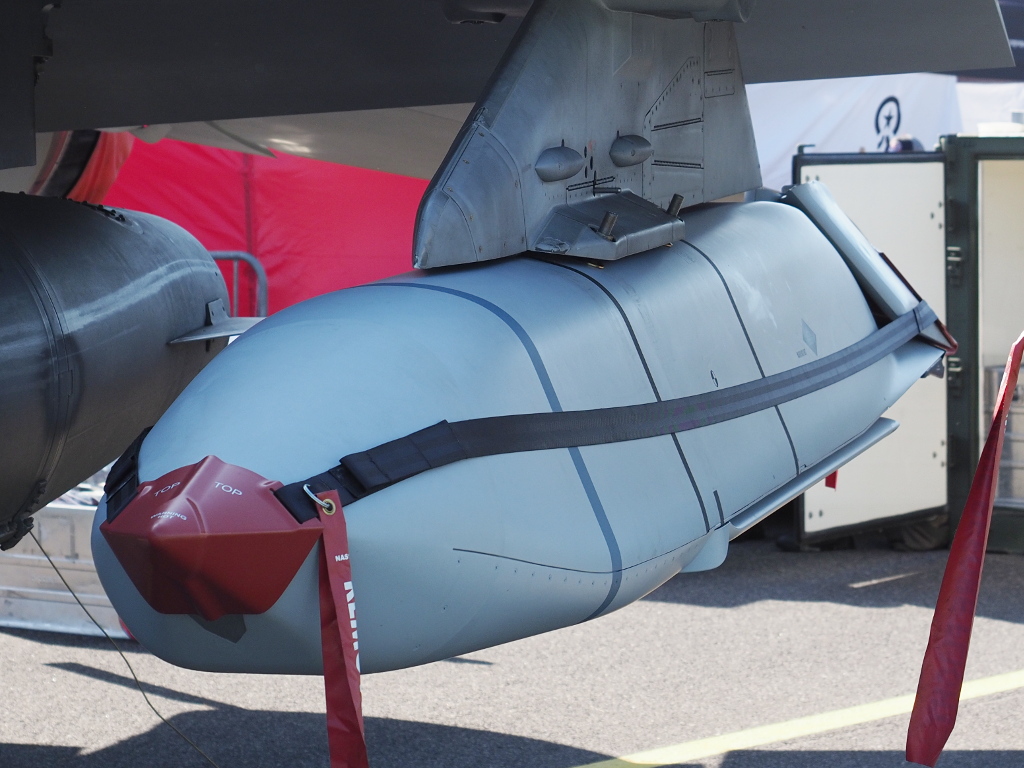
The AGM-158 JASSM is the US Air Force’s stealthy standoff cruise missile, and its extended-range version flies more than 925 kilometers to deliver a 1,000-pound penetrating warhead with near-precision-bomb accuracy. Combat-proven over Syria in 2018 and now pouring off Lockheed Martin’s expanding production lines, it has become the standard against which Western strike missiles are measured.
AGM-158 JASSM specifications
| Specification | Value |
|---|---|
| Type | Low-observable air-launched cruise missile |
| Manufacturer | Lockheed Martin |
| Length | About 4.3 m |
| Launch weight | Roughly 1,000 kg class |
| Warhead | WDU-42/B, about 450 kg (1,000 lb) penetrating blast-fragmentation |
| Range (AGM-158A) | More than 370 km |
| Range (AGM-158B JASSM-ER) | More than 925 km |
| Guidance | Jam-resistant GPS/INS midcourse, imaging infrared seeker terminal |
| Unit cost | Reported around $1.5 million for recent JASSM-ER lots |
JASSM variants from baseline to extreme range
The baseline AGM-158A entered service in 2003 after a famously rocky test history. The AGM-158B JASSM-ER kept the same stealthy airframe but swapped the turbojet for an efficient Williams turbofan and more fuel, stretching stated range from over 370 km to over 925 km. Later lots, sometimes labeled B-2, add wiring and software growth, and the AGM-158D XR program stretches the wing and fuselage for a reported reach approaching 1,900 kilometers, a figure that would let bombers strike from outside most air defense umbrellas entirely.
The family also spawned the anti-ship AGM-158C LRASM, which grafts an autonomous maritime targeting suite onto the ER airframe, covered separately on this site.
How JASSM finds its target
JASSM cruises on jam-resistant GPS-aided inertial navigation, following a preplanned low-observable routing that exploits terrain and radar shadows. In the terminal phase an imaging infrared seeker matches the scene against a stored target model and steers to a designated aimpoint, giving accuracy good enough to put the warhead through a chosen wall or ventilation shaft. The stealth airframe does the rest, unlike the older Tomahawk, JASSM was shaped from the start to be hard to detect, which compresses the reaction time of any defense that finally sees it.
Which aircraft carry JASSM
| Platform | Load |
|---|---|
| B-1B Lancer | Up to 24 internally |
| B-52H | Up to 20 across bay and pylons |
| B-2A Spirit | 16 internally |
| F-15E Strike Eagle | Up to 5 reported |
| F-16C/D | 2 |
| F/A-18E/F Super Hornet | 2 (JASSM-ER integration for allied and US use) |
| F-35A | External carriage integration in progress |
JASSM operators and combat record
The US Air Force is the anchor customer, with multi-thousand-round inventory objectives and production pushed above a thousand missiles a year across the JASSM/LRASM line. Export users and customers include Australia, Finland, Poland, the Netherlands and Japan, with more NATO members queued since 2022. Missiles built by Lockheed Martin at Troy, Alabama now feed both US war reserve and allied stockpile rebuilding.
Combat use came on April 14, 2018, when two B-1Bs fired 19 JASSM-ERs at Syrian chemical weapons facilities in the type’s operational debut. US officials described the strike as successful; it remains the weapon’s only publicly confirmed combat employment, and the lessons fed directly into later software and routing improvements.
Demand since 2022 has transformed the program’s economics. Poland alone requested hundreds of JASSM-ERs for its F-16 and F-35 fleets, Japan selected the missile to bridge its own standoff gap while domestic weapons mature, and US budget documents now treat JASSM as a munition to be stockpiled in the thousands rather than bought in boutique lots. Multi-year procurement contracts, the same tool applied to AMRAAM production, have been extended to the family to lock in suppliers of engines, seekers and fuzes. The bottleneck conversations that once centered on airframes now center on solid rocket motors, titanium castings and seeker focal planes, the quiet subcomponents that decide how fast any missile line can really grow.
AGM-158 JASSM frequently asked questions
What is the range of the JASSM missile?
More than 370 km for the baseline AGM-158A and more than 925 km for the JASSM-ER; the developmental XR variant is reported to approach 1,900 km.
Has JASSM been used in combat?
Yes. Nineteen JASSM-ERs were launched by two B-1Bs against Syrian chemical weapons sites on April 14, 2018.
How much does a JASSM cost?
Recent JASSM-ER lots have been reported around $1.5 million per missile, cheap by standoff-weapon standards.
Which countries have JASSM?
The US plus Australia, Finland, Poland and the Netherlands, with Japan and additional NATO members in the pipeline.
What is the difference between JASSM and LRASM?
LRASM (AGM-158C) is the anti-ship derivative, adding an autonomous multi-mode seeker for moving warships to the JASSM-ER airframe.
- US Air Force budget documents and program disclosures
- Lockheed Martin product literature
- Wikipedia – AGM-158 JASSM (accessed October 2026)
- Defence & Tech reporting on standoff strike inventories