
DF-17, the Chinese Hypersonic Glide Missile Explained
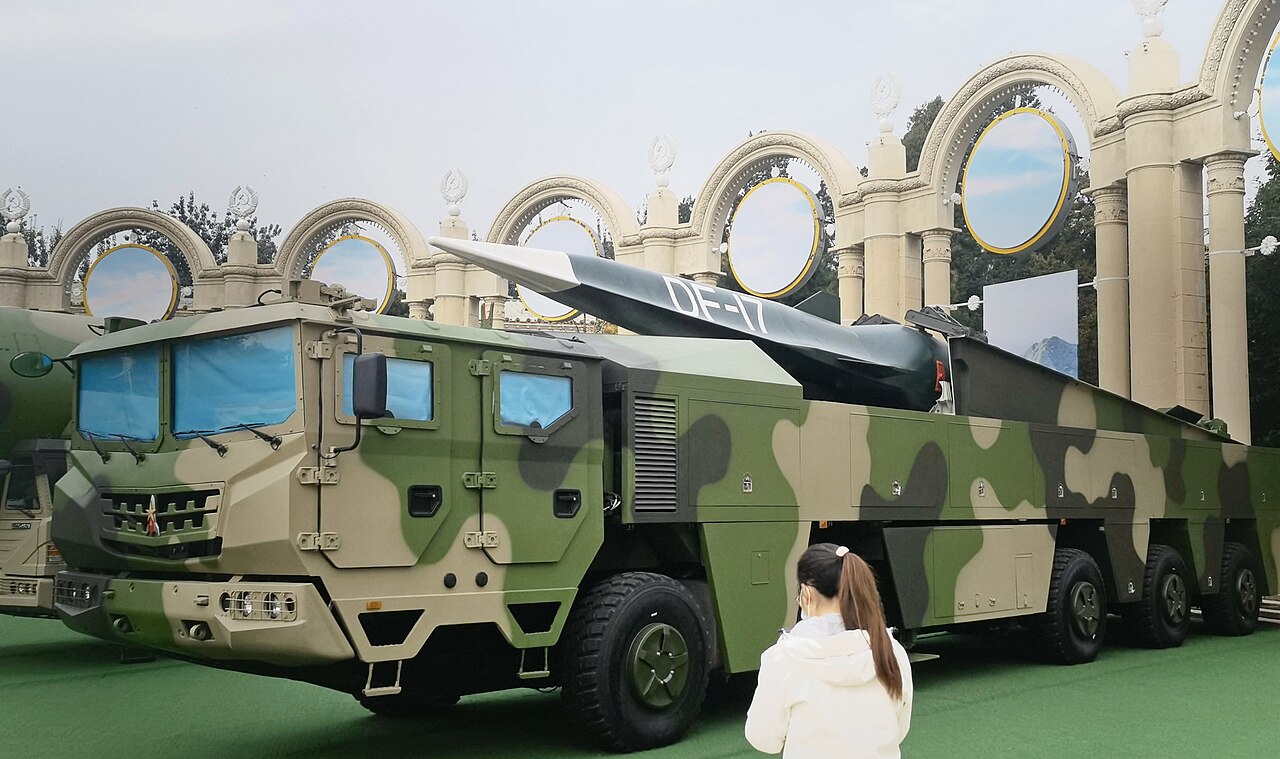
The DF-17 is China’s first operational hypersonic glide vehicle missile, unveiled with 16 launchers at the October 2019 Beijing parade and credited by Western analysts with a range of roughly 1,800–2,500 kilometers. It pairs a conventional ballistic booster with the DF-ZF glide vehicle, a weapon designed less for raw speed than for flying where interceptors struggle to reach.
What is the DF-17
The DF-17 (Dongfeng-17) is a road-mobile, solid-fuel missile of the PLA Rocket Force that swaps the usual ballistic warhead for a wedge-shaped hypersonic glide vehicle, the DF-ZF. The booster lofts the vehicle to the edge of the atmosphere, after which it detaches and glides at hypersonic speed along a flattened, maneuvering trajectory. US officials had tracked DF-ZF test flights since around 2014, and the system is generally assessed to have entered service around 2019–2020, making it the first weapon of its kind fielded anywhere.
Its purpose is regional. With an estimated reach covering Taiwan, Japan, the Korean Peninsula and US bases in the western Pacific, the DF-17 exists to put runways, ports, command sites and missile defense radars at risk in the opening hours of a conflict, before defenses can organize. For the broader technology picture, see our explainer on how hypersonic missiles work.
DF-17 missile range and speed
No verified performance figures exist in the public domain, so every number deserves a label. Chinese state media has described the glide vehicle reaching speeds up to around Mach 10, while Western estimates, including the CSIS Missile Threat project, place range between roughly 1,800 and 2,500 kilometers. Accuracy claims of meters-scale precision circulate in Chinese commentary and remain unverified. What is not disputed is the flight profile, a depressed, maneuvering glide at 20–60 kilometers altitude that compresses defender reaction time.
DF-17 specifications
| Item | Detail |
|---|---|
| Type | Medium-range missile with hypersonic glide vehicle (HGV) |
| Payload | DF-ZF glide vehicle, conventional; possible nuclear option unconfirmed |
| Range | Roughly 1,800–2,500 km, analyst estimates |
| Speed | Mach 5–10 in glide, per Chinese state media |
| Propulsion | Solid-fuel booster, road-mobile TEL |
| Length | Around 11 m, estimated from parade imagery |
| Service entry | Assessed around 2019–2020 |
| Operator | PLA Rocket Force |
How the DF-ZF glide vehicle works
A glide vehicle trades the predictable arc of a ballistic warhead for lift. Released at high altitude and hypersonic speed, the wedge-shaped DF-ZF generates aerodynamic lift that lets it skip and steer through the upper atmosphere, flying lower than a ballistic reentry vehicle and appearing over the radar horizon far later. Maneuver makes the impact point ambiguous until late in flight, which is the entire strategic argument, defenses must protect everything the vehicle might reach rather than a computed ellipse.
The price is brutal engineering, sustained heating in the thousands of degrees, plasma effects on guidance, and control surfaces that must work across wildly changing air densities. That China fielded the DF-17 at scale is why it is taken more seriously than the many hypersonic programs that exist as test articles, a contrast with the anti-ship DF-21D and the longer-ranged DF-26, which keep classic ballistic profiles.
Who operates the DF-17
| Missile | Estimated range | Role |
|---|---|---|
| DF-17 | 1,800–2,500 km | Hypersonic glide strike against regional bases and defenses |
| DF-21D | Around 1,500 km | Anti-ship ballistic missile, the original carrier killer |
| DF-26 | Around 4,000 km | Dual-capable strikes to Guam distance |
| DF-27 | Reported 5,000–8,000 km | Newer long-range system, HGV payload reported |
The sole operator is the PLA Rocket Force. Open-source reporting has associated DF-17 brigades with China’s eastern and southern theater commands, the sectors facing Taiwan and the South China Sea, though Beijing does not publish deployments. Production numbers are unknown; the Pentagon’s annual China military power reports describe continued expansion of the Rocket Force’s conventional missile inventory without public unit counts for the type. No export has been offered or reported.
Can the DF-17 be intercepted
Today’s fielded defenses were built for ballistic arcs. Midcourse interceptors engage above the atmosphere where a glide vehicle spends little time, while terminal systems like Patriot get compressed engagement windows against a maneuvering target arriving low and fast. US counter-hypersonic work, the Glide Phase Interceptor and new space-based tracking layers, is aimed exactly at this gap but remains years from maturity. Against the DF-17 in 2026, defense rests more on dispersal, hardening and counterstrike deterrence than on interception.
DF-17 frequently asked questions
How fast is the DF-17 missile?
Chinese state media cites glide speeds up to around Mach 10; independent verification does not exist in public sources.
What is the range of the DF-17?
Western analyst estimates cluster around 1,800–2,500 kilometers, enough to cover Taiwan, Japan and US bases in the region.
Is the DF-17 nuclear?
It is assessed as primarily conventional; a nuclear option is speculated in some analyses but unconfirmed.
Was the DF-17 the first hypersonic glide weapon in service?
It is generally credited as the first operationally fielded HGV system, entering service around 2019–2020.
Can Patriot or THAAD stop the DF-17?
Current systems were designed for ballistic trajectories; a low, maneuvering glider severely compresses their engagement windows, which is driving new US interceptor programs.
- CSIS Missile Threat project, DF-17 entry (accessed October 2026)
- US Department of Defense annual reports on Chinese military power
- Wikipedia – DF-17 (accessed October 2026)
- Chinese state media claims as noted in text
- Defence & Tech reporting on hypersonic weapons