
Gepard, the Retired Flak Tank That Became Ukraine’s Drone Killer
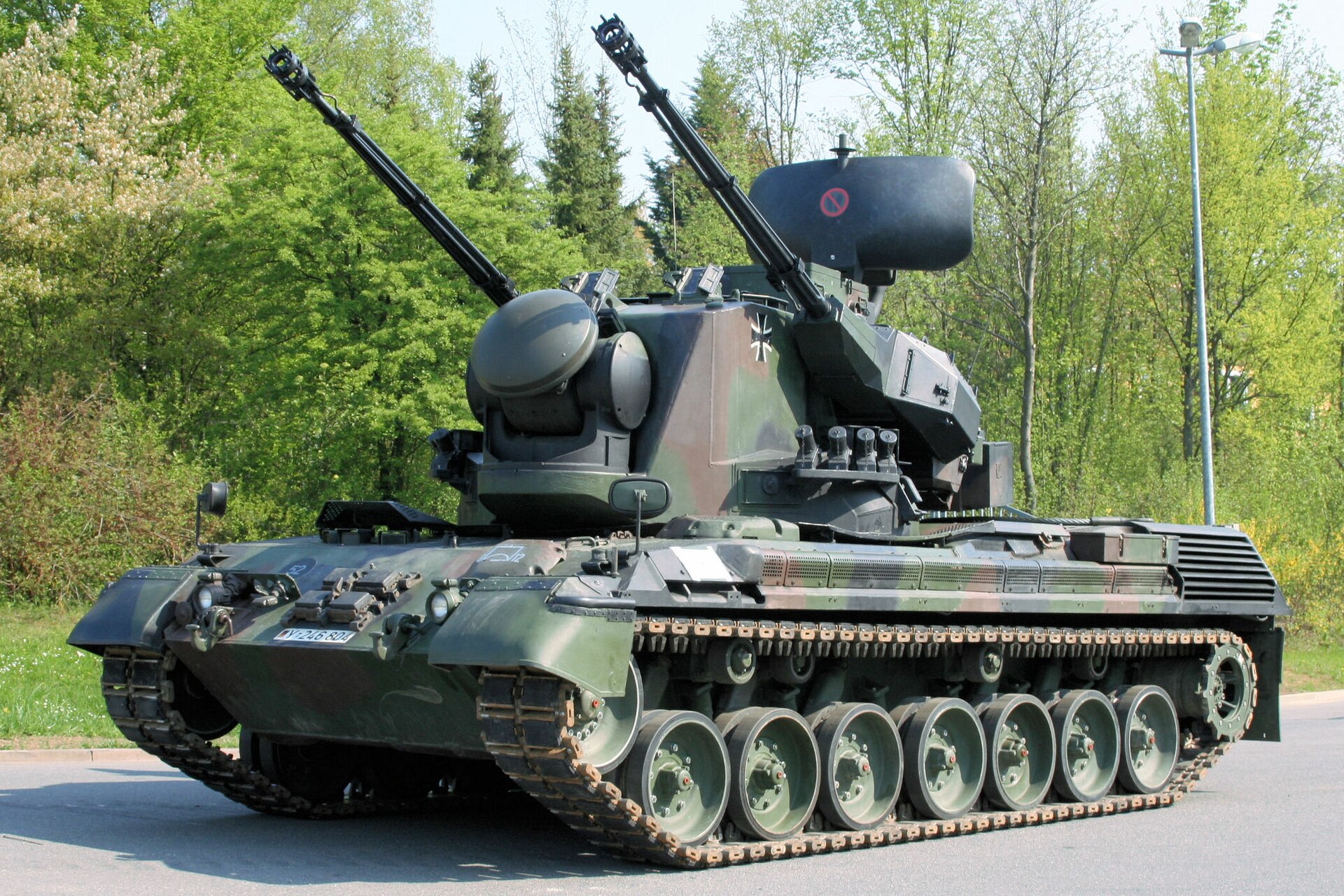
The Gepard was a retired Cold War relic in 2021; by 2024 it was the most cost-effective drone killer in Ukraine’s arsenal. Germany’s twin-35mm flak panzer, pensioned off in 2012, came back to shoot down Shahed drones for a fraction of a missile’s price, and in doing so rewrote every army’s assumptions about gun-based air defense.
What is the Gepard
The Flakpanzer Gepard is a self-propelled anti-aircraft gun: a Leopard 1 hull carrying a turret of two 35mm Oerlikon autocannons with its own search and tracking radars. Designed by Swiss Oerlikon-Contraves with Siemens radars and built by Krauss-Maffei from 1976, it protected German armored columns for three decades before rising missile fashion and maintenance bills retired it. History has since ruled the retirement premature: gun systems are precisely what the drone era’s bottom layer demands.
How a 1970s design works
The concept is elegant self-sufficiency. An S-band search radar sweeps to 15 kilometers; on detection the Ku-band tracker locks, a computer generates the lead solution, and the guns fire timed bursts whose rounds shred anything within 5.5 kilometers. Everything, radars, computer, guns, ammunition, rides one tracked chassis that keeps pace with tanks. Against a 180 km/h Shahed, a two-second burst costing a few thousand euros does what a six-figure missile otherwise must, the entire economic argument of gun air defense in one engagement.
Gepard specifications
| Item | Detail |
|---|---|
| Chassis | Leopard 1 hull, 47 tonnes class |
| Armament | 2 x 35mm Oerlikon GDF, 1,100 rds/min combined, 5.5 km effective range |
| Radars | S-band search to 15 km; Ku-band tracking (Dutch Cheetah variant used X-band) |
| In service | 1976-present; Germany retired its final 94 in 2012 |
| Ukraine deliveries | About 130 vehicles from German and reacquired stocks, 2022-2024 |
| Crew | Three |
The Ukraine comeback
Berlin authorized refurbished Gepards for Kyiv in April 2022, an offer initially mocked as museum aid, and the type became a star of the drone war: guarding power plants and grain ports, with single vehicles credited with ten-plus Shahed kills apiece and crews praising exactly the traits, autonomy, cheap shots, deep magazines, that had aged out of fashion. The lesson generalized fast: Skyranger turrets, gun-armed Rheinmetall revivals and every NATO short-range program since 2023 are, functionally, Gepard’s grandchildren.
The ammunition saga
The comeback nearly died of Swiss neutrality: Bern blocked re-export of Oerlikon 35mm rounds, and Ukraine’s Gepards ran short through 2022-23 until Rheinmetall stood up a new German production line, delivering hundreds of thousands of rounds since. The episode became Europe’s case study in ammunition sovereignty, cited in every debate about where shells and propellant must be made, and a warning label now attached to any procurement whose consumables cross a neutral border.
What Gepard taught the West
Three doctrinal lessons now travel under the Gepard’s name. Cost-per-kill decides sustainable air defense, so guns and cheap effectors belong under every missile umbrella. Radar-on-the-mount autonomy beats network dependence at the bottom layer, where reaction windows are seconds. And fleets in storage are strategic assets: the vehicles Germany sold off had to be bought back from Qatar and industry lots at premium prices. Procurement staffs from Warsaw to Seoul have since re-opened gun-system lines, and the laser trials chasing the same economics are, conceptually, Gepard’s heirs with photons for tungsten.
Who still operates it
Ukraine is the major user with roughly 55 active of 130 delivered; Romania fields 41, Brazil 34, and Jordan and Qatar took earlier batches. Germany itself keeps none, a fact German commentators note with some irony as the Bundeswehr shops for Skyranger to fill the hole Gepard left. For buyers the type’s afterlife carries the durable moral: air defense fleets age out of politics faster than out of usefulness.
Frequently asked questions
What is the Gepard’s range?
About 5.5 kilometers effective against air targets, with search radar to 15 kilometers.
Why is the Gepard good against drones?
Cheap gun rounds, onboard radar and instant reaction suit slow, low drones, at cost per kill far below any missile.
How many drones has it downed in Ukraine?
Totals are not centrally published; individual vehicles have exceeded ten Shahed kills, and the type guards critical infrastructure nationwide.
Why did ammunition run short?
Switzerland barred re-export of Oerlikon rounds; Rheinmetall built a German line from 2023 to replace it.
Who uses the Gepard today?
Ukraine (~55 active), Romania (41), Brazil (34), plus Jordanian and Qatari fleets from earlier transfers.
- Wikipedia – Flakpanzer Gepard (accessed October 2026)
- Public reporting on Ukraine deliveries and engagements
- Reporting on the Swiss ammunition dispute and Rheinmetall line