
Pantsir, Russia’s Gun-Missile Defender Under Fire
Pantsir is Russia’s point-defense workhorse, the gun-and-missile hybrid that guards S-400 batteries, Moscow rooftops and export customers across three continents, and also one of the most frequently destroyed air defense systems of the drone era. Few weapons better illustrate both sides of modern short-range air defense: indispensable in concept, exposed in practice.
What is Pantsir
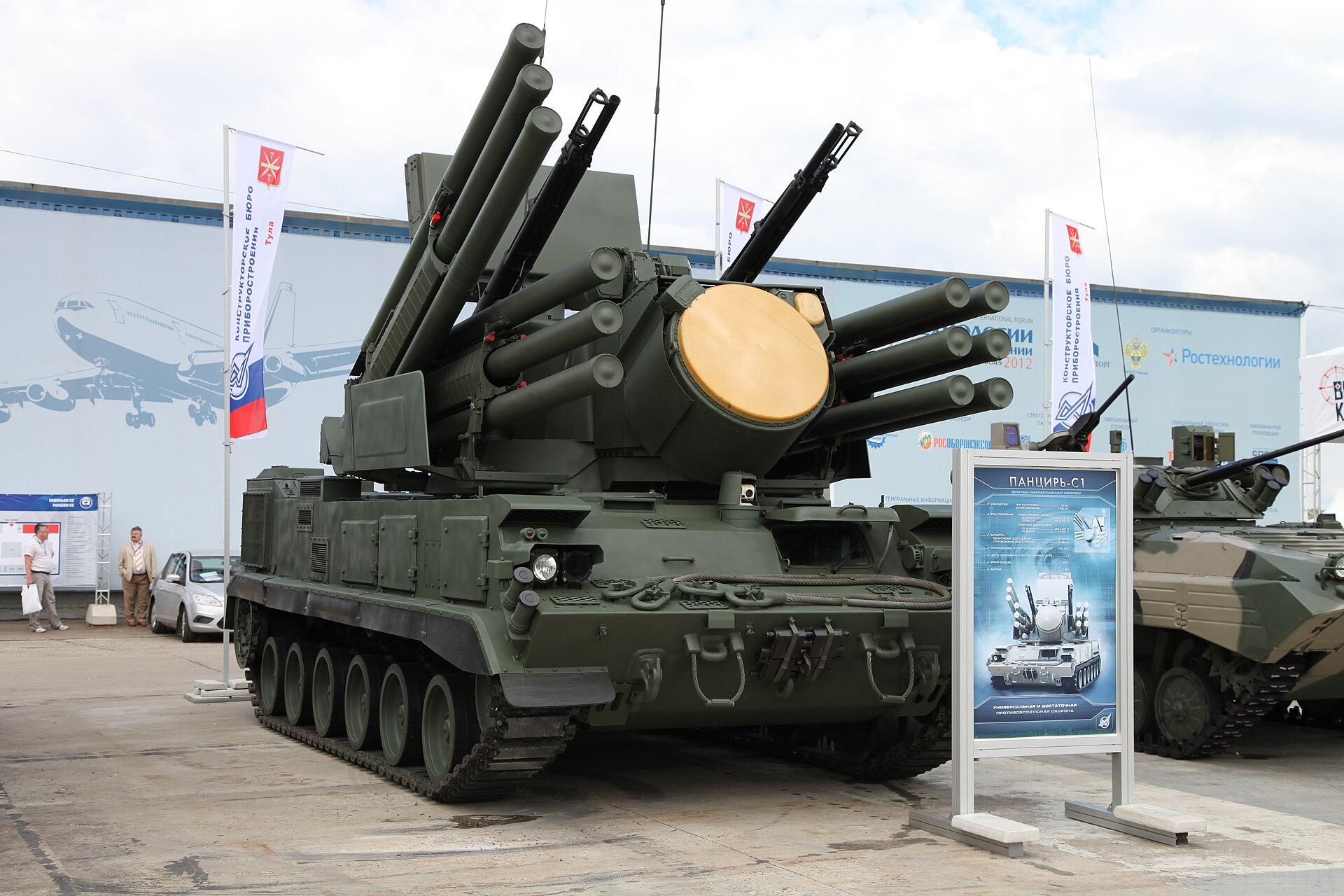
Pantsir, built by Tula’s KBP Instrument Design Bureau as successor to the tracked Tunguska, is a self-propelled short-range air defense system combining twelve 57E6 missiles with two 30mm autocannons on one truck, with its own search and tracking radars aboard. NATO calls the original Pantsir-S1, in service since 2008, the SA-22 Greyhound. Its designed role is the bottom layer of the Russian network: killing the cruise missiles, drones and precision bombs that leak past systems like the S-400 it typically escorts.
Pantsir specifications and variants
| Item | Detail |
|---|---|
| Armament | 12 x 57E6 missiles plus 2 x 2A38M 30mm autocannons |
| Missile range / altitude | About 18-20 km / 15 km; Mach 3.8 boost |
| Radars | Search to 32-36 km, tracking to 24-28 km; engages up to 4 targets, 4-6 second reaction |
| Pantsir-S1 | Baseline, fielded 2008 |
| Pantsir-S2 / SM | Upgraded radars; SM extends detection toward 75 km with new missiles |
| Pantsir-M | Naval version with AO-18KD gun mounts |
| Export price | About $13-15 million per vehicle, per public reporting |
How the gun-missile mix works
The two-weapon logic is cost-per-kill layering on a single chassis: missiles for aircraft and standoff weapons at kilometers, guns for whatever closes inside the missile’s minimum range, including small drones a $100,000 missile wastes money on. The 57E6 is command-guided, steered by the vehicle’s radar rather than a seeker, which keeps each round cheap but ties every engagement to the vehicle’s own emissions and tracking capacity, a limitation that matters against saturation attacks, as the last decade has demonstrated repeatedly.
Combat record, Syria to Moscow’s rooftops
Pantsir has seen more combat than almost any contemporary, and the ledger is instructive. Syrian crews claimed the type’s first kill, a Turkish RF-4 in 2012, and Russian Pantsirs at Hmeimim have downed large numbers of rockets and drones attacking the base since 2015, the mission the system genuinely fits. But Turkish drones destroyed Pantsirs in numbers over Syria and Libya in 2020, footage that built the Bayraktar legend; Ukraine reported at least 27 destroyed by late 2024; and captured examples reached Western analysts. Most tellingly, since January 2023 Pantsirs have stood on Moscow ministry rooftops against Ukrainian drones, the manufacturer’s home city relying on the system for exactly the leaker-defense role it was designed for, with mixed public results.
The drone-war verdict
Pantsir’s decade tells the short-range story in miniature. Against the threats of its design brief, rockets, slow drones, lone munitions approaching a fixed site, its record at Hmeimim is genuinely strong. Against coordinated attacks that pair decoys, standoff missiles and drones hunting the launcher itself, the system’s own emissions and four-target ceiling become the weakness; Bayraktar footage from 2020 and Ukraine’s loss tallies since document the outcome. Russia’s answer is the SM upgrade and dispersal doctrine; the West’s, visible in our rankings, is layered networks in which no single vehicle is asked to survive alone. Both answers concede the same point: the one-vehicle fortress era that Pantsir embodied is over.
Who operates Pantsir
Russia is the main operator across all services, with export fleets in Algeria (about 38), the UAE (about 42), Iraq, Serbia, and several others including Syria’s former arsenal and reported deliveries in Africa and Asia. The UAE’s buy, paired with Western systems, shows the type’s niche appeal: a mobile, self-contained bottom layer no Western vendor offered in one vehicle when the deals were signed, a gap Western industry is only now closing with programs like Skyranger, covered in our air defense rankings.
Frequently asked questions
What is the range of Pantsir?
About 18-20 kilometers for its 57E6 missiles and roughly 4 kilometers for its 30mm guns; the SM variant extends detection toward 75 km.
Why does Pantsir carry both guns and missiles?
Layering on one chassis: missiles for aircraft and standoff weapons, cheap gunfire for close-in drones and munitions.
How many Pantsirs have been destroyed in Ukraine?
Ukraine reported at least 27 Pantsir-S1s destroyed as of December 2024; Russia does not publish losses.
Which countries use Pantsir?
Russia, Algeria, the UAE, Iraq, Serbia and others; it also protects high-value Russian sites including Moscow government buildings.
Is Pantsir effective?
Against rockets and slow drones defending a point, yes, with a long Syrian record; against modern standoff weapons and coordinated drone attacks its losses show clear limits.
- Wikipedia – Pantsir missile system (accessed October 2026)
- Public reporting on Syria, Libya, Ukraine and Moscow deployments
- KBP/Rosoboronexport figures, labeled as manufacturer data