Thailand Selects Hanwha Ocean’s OCEAN-40F for New Frigate
What Happened
The Royal Thai Navy (RTN) has selected Hanwha Ocean’s OCEAN-40F design as the preferred platform for its next-generation frigate program, South Korean and Thai outlets reported in mid-September 2026. Thai Prime Minister Anutin Charnvirakul endorsed the evaluation results, which the Permanent Secretary for Defence had approved, and the Royal Thai Navy held a formal briefing on the selection on September 18 after a statutory appeal period closed. Hanwha Ocean’s own announcement, dated September 9, put the value of the initial package — one frigate plus integrated logistics support — at roughly THB 16.73 billion (about US$508 million).
Six bidders from four countries competed for the contract: Hanwha Ocean and HD Hyundai Heavy Industries of South Korea, Turkiye’s ASFAT and TAIS, Spain’s Navantia, and Singapore’s ST Engineering. Hanwha Ocean’s proposal ultimately prevailed, marking the company’s first export win for a surface combatant since 2023.
Officials and Hanwha Ocean have been careful to describe the announcement as preferred-bidder status, not a signed contract. Reporting on the process notes it is “a procedural step toward discussing specific terms, including detailed technical specifications and the scope of the programme, ahead of signing a final contract.” Unresolved items reportedly include final propulsion details, missile loadouts and possible unmanned-systems integration, meaning the eventual combat configuration is not yet fixed.
The Product/System
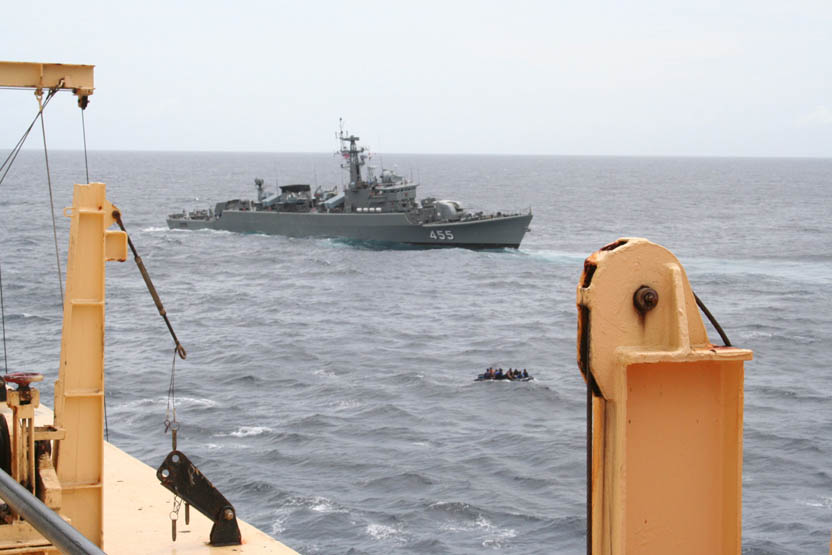
The OCEAN-40F is Hanwha Ocean’s export-oriented evolution of the design it used to build HTMS Bhumibol Adulyadej, a 3,700-tonne frigate delivered to the Royal Thai Navy in 2018 by Hanwha’s predecessor, Daewoo Shipbuilding & Marine Engineering. The new design grows the hull to roughly 4,000 tonnes fully loaded, with a length of about 124 meters, a beam of 14.4 meters and a draft of 4.3 meters. Reported performance figures put top speed at 27-28 knots with a range in the 4,500-5,000 nautical mile band, and a crew of around 145.
The proposed weapons fit draws heavily on European suppliers rather than an all-Korean combat system. Air defense is provided by a 16-cell vertical launch system for MBDA’s VL MICA NG surface-to-air missiles, backed by SIMBAD RC launchers carrying Mistral missiles fore and aft for close-in defense. For anti-ship and land-attack roles, the design carries MBDA’s Exocet MM40 Block 3C missiles, alongside a 76mm main gun and 30mm remote weapon stations. Sensors reportedly include Hensoldt’s TRS-4D radar and an ES-3601 electronic-support system, tied together by Naval Group’s SETIS combat management system, with four SYLENA decoy launchers for self-protection. Hanwha Ocean has described the design’s philosophy as “Larger, Lethal, and Legendary” — larger scale and operational presence, multi-domain combat readiness, and a platform intended to remain relevant for decades of Thai naval service.
Who Uses It
No OCEAN-40F has been built yet, so there is no operator beyond the Royal Thai Navy’s pending order — and even that is not yet a signed contract, only a preferred-bidder selection. The closest fielded relative is HTMS Bhumibol Adulyadej, the 2018-delivered Hanwha-built frigate that has served as the Royal Thai Navy’s benchmark for the newer design’s improvements in size, endurance and weapons capacity.
Export/Procurement History
The tender for Thailand’s next frigate closed on April 21, 2026, after Hanwha Ocean had already showcased the OCEAN-40F concept publicly at the Defense & Security exhibition in Bangkok in November 2025. The current deal is explicitly framed as the first of a larger program: Thailand is reported to be pursuing up to four new frigates by 2037 to grow its high-end frigate force from four to eight hulls, split between the Gulf of Thailand and the Andaman Sea. The Royal Thai Navy has reportedly allocated around THB 35 billion for an initial pair of ships under its 2026-2032 budget, with the two frigates tendered separately due to budget constraints.
The deal also carries an industrial-participation requirement: at least 20% of the first ship’s structural work must be carried out in Thailand, rising to 30% if a second vessel is ordered, alongside a technology-transfer component. That local-build condition echoes Hanwha’s approach elsewhere in the region and is a recurring feature of recent South Korean naval-export deals, where shipbuilders have offered domestic construction shares to win contracts against European and other Asian rivals.
Global Competitors
The runner-up in the Thai competition was HD Hyundai Heavy Industries, offering its HDF-3600/HDF-3600TH design, in what Korean media described as a bruising contest between the country’s two largest shipbuilders — a rivalry sharp enough that it reportedly split South Korea’s “K-defense” shipbuilding cooperation on the bid. Navantia offered its smaller Alfa 3000 design, while ASFAT and TAIS put forward MILGEM- and Bora-class-derived Turkish proposals, and ST Engineering leaned on its prior experience building a landing platform dock for the Royal Thai Navy. Thailand’s decision extends a broader pattern in Southeast Asian frigate competitions this year, where South Korean, European and Turkish yards have been competing head-to-head for orders as regional navies expand blue-water and dual-coast capabilities — a contest Hanwha Ocean and HD Hyundai are also waging separately over a potential U.S. Navy frigate requirement.
Why It Matters
For the Royal Thai Navy, the OCEAN-40F selection addresses a long-standing need to secure both the Gulf of Thailand and the Andaman Sea coastlines with modern, larger-hulled combatants as older vessels age out of service. For Hanwha Ocean, ending a three-year drought in surface-combatant exports with a repeat customer — after already delivering the Bhumibol Adulyadej — reinforces South Korea’s growing footprint in Southeast Asian naval markets, where Seoul’s shipbuilders are competing aggressively against European and other Asian suppliers on price, technology transfer and local-build terms. The heavy reliance on French-sourced MBDA missiles and a Naval Group combat system, rather than an all-domestic Korean weapons fit, also signals how export frigate designs increasingly blend suppliers to meet a customer’s specific interoperability and political preferences.
What Happens Next
Hanwha Ocean and the Royal Thai Navy are now expected to move into detailed contract negotiations covering final technical specifications, program scope, and the still-unresolved propulsion, missile-loadout and unmanned-systems questions, before a definitive contract is signed. If those talks conclude on the terms reported so far, construction would need to satisfy the mandated 20% Thai industrial-work share on the first hull. Whether Thailand proceeds to order the second frigate under the same THB 35 billion program — which would raise the local-content requirement to 30% — is likely to depend on how the first contract and build proceed, and has not yet been confirmed by either side.
FAQ
Has Thailand signed a final contract with Hanwha Ocean?
Not yet. As of the most recent reporting, Hanwha Ocean holds preferred-bidder status following a Royal Thai Navy briefing on September 18, 2026, but the two sides are still negotiating final technical specifications and program scope before signing a definitive contract.
How much is the Thailand frigate deal worth?
The reported value for the first ship and its integrated logistics support is approximately THB 16.73 billion, or roughly US$508 million. Some Korean reporting suggests the total program, including a potential second frigate, could eventually be worth up to US$3 billion.
What is the OCEAN-40F based on?
It is an enlarged, re-armed evolution of the 3,700-tonne HTMS Bhumibol Adulyadej, the frigate Hanwha Ocean’s predecessor Daewoo Shipbuilding & Marine Engineering delivered to the Royal Thai Navy in 2018.
Who did Hanwha Ocean beat for this contract?
Five other bidders: South Korea’s HD Hyundai Heavy Industries, Spain’s Navantia, Turkiye’s ASFAT and TAIS, and Singapore’s ST Engineering.
What weapons will the new Thai frigate carry?
Reported armament includes a 16-cell VL MICA NG air-defense missile system, Exocet MM40 Block 3C anti-ship missiles, SIMBAD RC point-defense launchers with Mistral missiles, a 76mm gun and 30mm remote weapon stations — a mix drawn mainly from European suppliers MBDA and Naval Group.
Sources
- Naval News, “Hanwha Ocean Selected as Preferred Bidder for Thailand’s Next-Generation Frigate Program,” September 2026 — navalnews.com — primary specialist trade confirmation of contract value and specifications.
- Defence Security Asia, “Thailand Picks Hanwha OCEAN-40F, Reshaping Southeast Asia’s Naval Balance,” September 2026 — defencesecurityasia.com — detailed specifications, competing bidders and fleet-expansion context.
- Asian Military Review, “Thailand selects Hanwha Ocean to build it a new frigate,” September 2026 — asianmilitaryreview.com — timeline, local-content requirements and program budget.
- Khaosod English, “Thai Navy picks Hanwha Ocean for 16.73 billion baht frigate,” September 18, 2026 — khaosodenglish.com — Thai domestic confirmation of the briefing date and contract value.
- Korea JoongAng Daily, “Hanwha Ocean named preferred bidder for Thai Navy frigate contract,” September 2026 — koreajoongangdaily.com — South Korean corporate and industry-context confirmation.