Bell Starts Production of Nigeria’s First AH-1Z Viper Helicopters
Lead
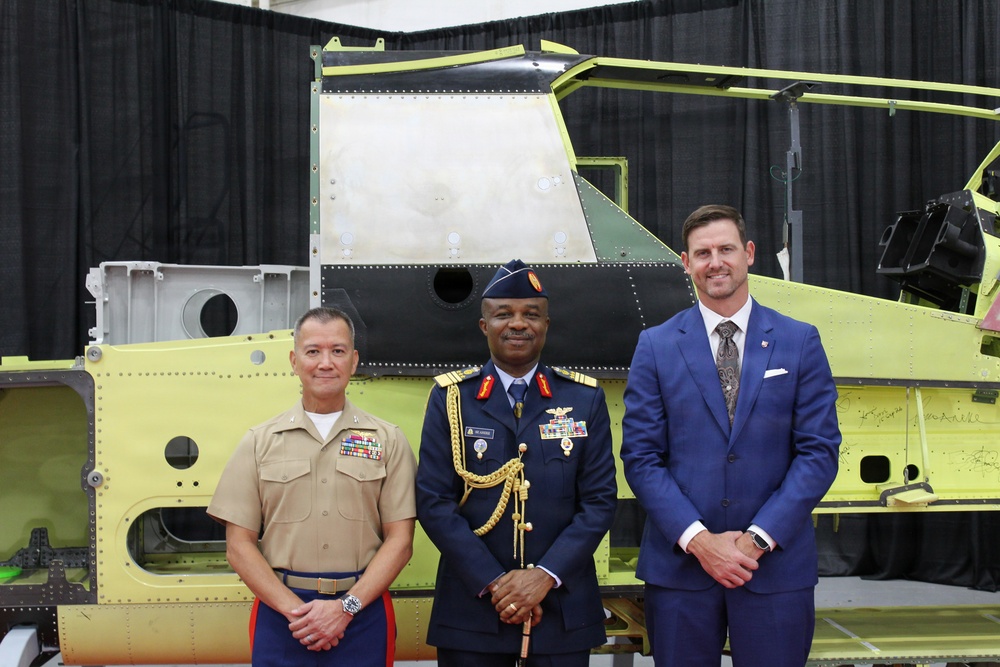
The U.S. Marine Corps Light/Attack Helicopters Program Office (PMA-276) and Bell Textron have begun manufacturing Nigeria’s first AH-1Z Viper attack helicopter, the companies confirmed on September 22, 2026. The milestone, marked by a beam-signing ceremony at Bell’s Amarillo, Texas facility, starts the clock on a Foreign Military Sale that will eventually put a dozen of the twin-engine gunships into the Nigerian Air Force’s inventory to reinforce its long-running counterinsurgency campaign against Boko Haram and the Islamic State West Africa Province (ISWAP).
What Happened
According to an official release published by the Defense Visual Information Distribution Service (DVIDS), representatives from the Nigerian Air Force, PMA-276 and Bell Textron gathered at Bell’s Amarillo production line for a beam-signing event, a traditional aerospace-manufacturing milestone in which program officials sign the airframe’s structural beam before assembly proceeds. Attendees included Nigerian Air Force Chief of the Air Staff Air Marshal Sunday Kelvin Aneke, PMA-276 Program Manager Col. Jason Duke, and Bell H-1 Program Director Scott Sims.
“Integrating the AH-1Z Viper into the Nigerian Air Force introduces an advanced attack platform capable of employing lethality in highly contested environments,” Col. Duke said in the DVIDS release. Sims added that “the beam of the first production Viper for Nigeria will forever carry the names, hopes, and commitment of those who brought this aircraft to life.”
Nigerian Air Force spokesperson Air Commodore Ehimen Ejodame said the Viper “will play an important role in strengthening our counterterrorism and counterinsurgency operations and enhancing our ability to protect citizens,” according to The Defense Post. Air Marshal Aneke separately described the acquisition as a “major milestone” in the Nigeria-U.S. defense cooperation program, Vanguard reported.
Bell says the full 12-aircraft fleet is scheduled for completion by early 2029, with PMA-276 overseeing engineering, program management and long-term logistics support for the life of the contract.
The Product/System
The Bell AH-1Z Viper is a twin-engine attack helicopter developed for the U.S. Marine Corps as the latest evolution of the Cobra/Super Cobra family. It is powered by two General Electric T700-GE-401C engines rated at roughly 1,800 horsepower each, giving it a top speed of about 222 knots (411 km/h) and a combat range near 370 nautical miles (685 km) with a service ceiling of 20,000 feet. The airframe is built around a 10,000-hour design life and features a four-blade composite rotor system, a glass cockpit and TopOwl helmet-mounted sighting for its two-person crew.
Nigeria’s Vipers are equipped for the multi-role strike mission: an M197 20mm three-barrel rotary cannon in a chin turret, 70mm Hydra guided rockets, AGM-114 Hellfire and AGM-179 Joint Air-to-Ground Missiles for precision strike, and AIM-9 Sidewinder missiles for self-defense. That mix is built specifically for irregular-warfare environments — precision strike against dispersed insurgent formations rather than high-end air-to-air combat.
Who Uses It
The AH-1Z is the U.S. Marine Corps’ primary attack helicopter. Bahrain is the only prior foreign operator, having received Vipers under an earlier Foreign Military Sale. Nigeria will become the second confirmed foreign customer once deliveries begin, and the first in Africa.
Export/Procurement History
The program traces back to April 2022, when the U.S. State Department approved a possible $997 million Foreign Military Sale covering 12 AH-1Z helicopters along with Hellfire and Sidewinder missiles, spare engines, sighting and night-vision systems, and training support, according to Defense Security Cooperation Agency notification details reported by DefenceWeb. Bell Textron was subsequently awarded a $455 million production contract for the airframes, and NAVAIR added an approximately $18 million award in August 2026 covering an AH-1Z flight-training device and an initial spares package, with that element scheduled for completion by January 2029. A separate $25 million allocation supports a Nigerian pilot and gunner targeting-training program.
The Viper buy sits alongside other recent Nigerian Air Force rotary-wing acquisitions, including 12 MD 530F Cayuse Warrior light attack helicopters from MD Helicopters and T129 ATAK helicopters delivered by Turkish Aerospace Industries, reflecting a deliberate diversification of Nigeria’s attack-helicopter fleet beyond its Soviet-era Mi-24/Mi-35 Hinds.
Global Competitors
In the light-to-medium attack helicopter class competing for African and Middle Eastern export orders, the AH-1Z’s main rivals include Turkish Aerospace’s T129 ATAK (already in Nigerian and several African air forces), Russia’s Mi-35/Mi-28 family, and China’s Z-10, all of which are priced and supported differently for militaries balancing counterinsurgency needs against limited defense budgets and Western export controls.
Why It Matters
Nigeria’s air force has leaned heavily on light attack aircraft, armed trainers and a growing indigenous drone and counter-drone fleet to prosecute a counterinsurgency fight against Boko Haram and ISWAP in the northeast, alongside banditry in the northwest. A dedicated attack helicopter platform with the AH-1Z’s Hellfire/JAGM precision-strike suite gives the Nigerian Air Force a more survivable, better-sensored close-support option than its aging Hind fleet, and deepens a U.S.-Nigeria defense relationship that had been slowed for years by human-rights-linked congressional scrutiny before the 2022 sale approval.
What Happens Next
Bell’s Amarillo line will build out the remaining airframes through the 2026-2029 window, with the first delivery expected once the initial aircraft completes production, flight testing and acceptance. PMA-276 and Bell have not published a detailed year-by-year delivery schedule; based on the current timeline, deliveries are likely to begin in the second half of the decade with the full fleet fielded by early 2029, alongside the separately funded simulator and spares package.
FAQ
How many AH-1Z Viper helicopters is Nigeria buying?
Twelve, under a Foreign Military Sale approved by the U.S. State Department in 2022.
When will Nigeria receive its AH-1Z Vipers?
Bell Textron has begun production, with the full order scheduled for completion by early 2029; no public delivery date has been set for the first aircraft.
What weapons does the Nigerian AH-1Z carry?
An M197 20mm cannon, 70mm Hydra rockets, AGM-114 Hellfire and AGM-179 JAGM precision missiles, and AIM-9 Sidewinder air-to-air missiles.
Who else operates the AH-1Z Viper?
The U.S. Marine Corps and Bahrain currently operate the Viper; Nigeria will be the first African and second foreign customer.
How much does the program cost?
The original Foreign Military Sale was valued at up to $997 million; Bell’s production contract for the airframes is worth $455 million, with additional smaller contracts for training and spares.
Sources
- Defense Visual Information Distribution Service, “AH-1Z Viper Production Underway for Nigeria,” September 22, 2026 — official U.S. government release confirming the beam-signing ceremony and program details. dvidshub.net
- The Defense Post, “Bell Textron Starts Viper Helicopter Build for Nigeria,” September 18, 2026 — weapons fit, specifications and official quotes. thedefensepost.com
- DefenceWeb, “Nigerian AH-1Z Viper production moving ahead” — Foreign Military Sale value, timeline and related contracts. defenceweb.co.za
- FlightGlobal, “Nigeria’s first Bell AH-1Z attack helicopter enters production,” September 17, 2026 — production contract value confirmation. flightglobal.com
- Vanguard, “Acquisition of 12 AH-1Z viper attack helicopters major milestone — Army chief,” September 2026 — Nigerian Air Force leadership comment. vanguardngr.com