China Confirms H-6N Bomber Carries Nuclear JL-1 Missile
Lead
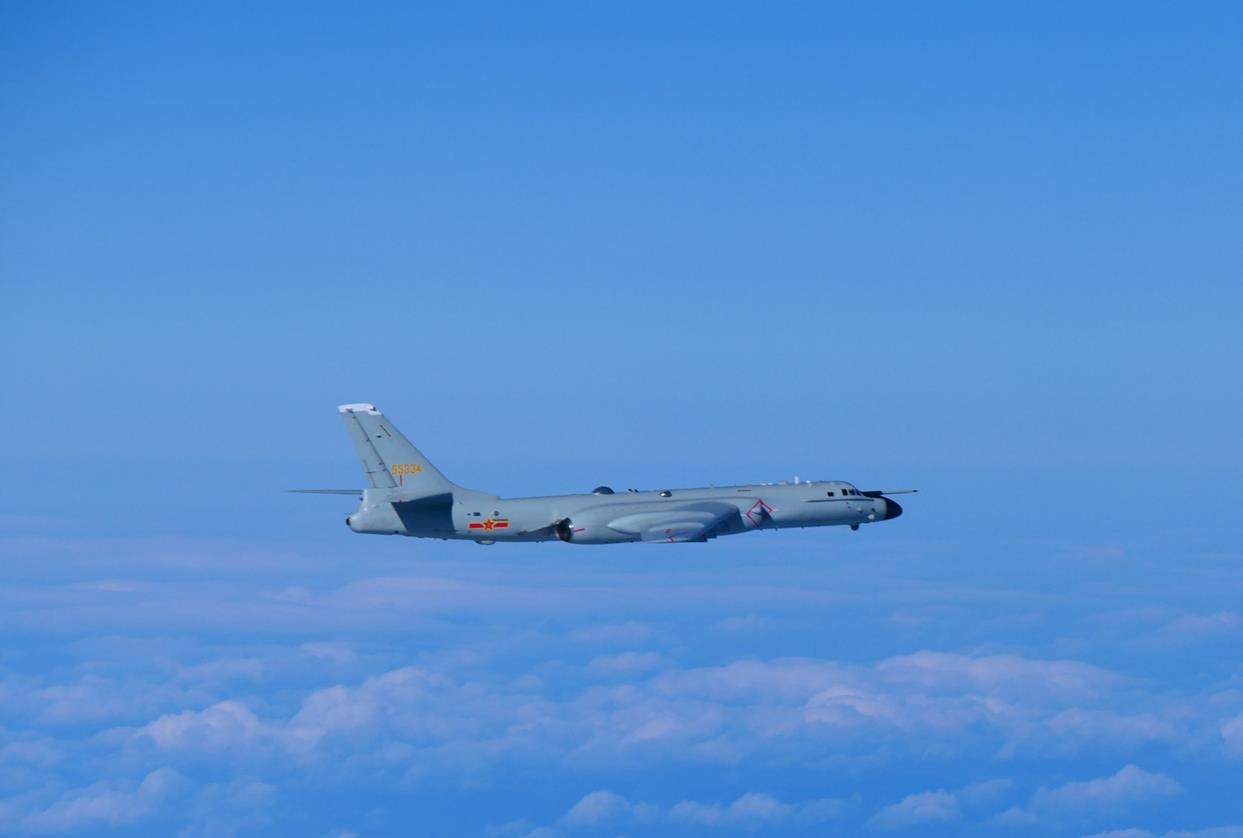
Chinese state television has, for the first time, officially identified the nuclear-capable ballistic missile carried by the People’s Liberation Army Air Force’s H-6N bomber, giving Beijing a confirmed airborne leg to complement its land- and sea-based nuclear forces. The confirmation came not from a Ministry of National Defense statement or a test announcement, but from the final episode of a CCTV documentary marking the PLA’s 99th anniversary, broadcast on August 4, 2026, which showed an H-6N carrying the missile — identified on-screen as the Jing Lei-1, or JL-1 — under J-20 stealth fighter escort during a simulated joint anti-ship exercise.
What Happened
The documentary, titled Zhisheng (“Victory”), aired footage of an H-6N flying with a large missile slung beneath its centerline hardpoint, flanked by two J-20s. Chinese state media named the weapon the JL-1 in the broadcast — the first time Beijing has officially attached a name and an operational context to a system Western analysts have tracked since roughly 2018–2020 under the NATO reporting designation CH-AS-X-13, according to China-Arms.
The JL-1 itself was not new to public view: it had already been displayed, without a missile-carrying aircraft, at China’s September 2025 Victory Day parade. What changed in August 2026 is that state television placed the missile on its intended launch platform, in a scenario depicting a coordinated bomber-fighter-strike package rather than a static parade display, according to Army Recognition, which first reported the footage on August 4.
Independent Chinese-military trackers and English-language defense outlets, including the South China Morning Post, continued to publish fresh analysis of the reveal through mid-September, underscoring that the story is still being assessed by regional military-affairs specialists rather than treated as a closed matter.
The Product/System
H-6N: A Modernized Cold War Airframe
The H-6N is a modernized variant of the Xi’an H-6, itself a licensed derivative of the Soviet Tu-16 that first flew in China in the 1960s. The N-variant introduced two structural changes that make the current reveal possible: a reinforced, recessed centerline hardpoint capable of carrying a single large weapon semi-conformally, and an aerial-refueling probe that extends the bomber’s operational radius. Unlike the H-20 stealth bomber China is still developing, the H-6N is not low-observable, and it depends on tanker support, airborne early-warning coverage, and fighter escort to survive in contested airspace.
Analysts note that Beijing appears to have deliberately chosen the faster path: rather than wait for the H-20, whose development is expected to span fifteen to twenty years, Chinese planners adapted an existing production line to field a nuclear-capable standoff weapon years earlier.
JL-1: An Air-Launched Ballistic Missile
The JL-1 is widely assessed to be an air-launched derivative of the DF-21 medium-range ballistic missile family, redesigned with lighter composite materials to permit carriage by an aircraft rather than launch from a ground-based transporter erector launcher. Unofficial range estimates published by Western analysts and cited in the JL-1 Wikipedia entry and by China-Arms range from roughly 3,000 to 8,000 kilometers, with the higher figures attributing extended reach to the launch aircraft’s own speed and altitude at release. China has not published official specifications, and the true performance envelope remains an estimate rather than a confirmed figure.
Who Uses It (Confirmed Operators)
The H-6N and JL-1 combination is operated exclusively by the People’s Liberation Army Air Force (PLAAF). No export version exists or has been discussed, and the platform is not comparable to any system currently offered on the international arms market. This is a purely indigenous strategic system tied to China’s own nuclear deterrent posture.
Strategic Context: Completing the Triad
Until this reveal, China’s confirmed nuclear delivery systems consisted of land-based intercontinental ballistic missiles operated by the PLA Rocket Force (including road-mobile DF-41s) and submarine-launched ballistic missiles carried aboard Type 094 and, eventually, Type 096 ballistic-missile submarines. The H-6N/JL-1 pairing supplies the third, airborne leg that Western nuclear powers have maintained since the Cold War.
Army Recognition defense analyst Teoman S. Nicanci wrote that the footage “suggests Beijing is developing a protected launch architecture for its airborne nuclear deterrent, a capability that could complicate U.S. and allied detection, interception and escalation planning,” adding that it “adds a more flexible airborne layer to China’s nuclear triad, strengthening strategic signaling while reflecting the broader shift toward integrated, multi-domain force employment.”
The comparison to established triads is instructive rather than flattering to Beijing’s new capability. The United States relies on stealthy B-2 and forthcoming B-21 bombers that are designed to penetrate defended airspace, while Russia’s Tu-160 and Tu-95 bombers launch long-range cruise missiles from well outside enemy air defenses. China’s approach — a non-stealth bomber carrying a ballistic missile designed for standoff release — is a different engineering compromise, built for speed of fielding rather than platform survivability. Nicanci’s analysis notes the airborne leg “is unlikely to match the readiness and scale of the land-based missile force or the concealment of ballistic-missile submarines,” but offers advantages in “flexibility, visibility and political control” — meaning Beijing can surge, disperse, or visibly signal bomber activity in ways that are harder to do with silos or submarines at sea.
That flexibility carries a vulnerability. Because the H-6N is not stealthy, its combat radius and survivability depend on a wider support package: tanker aircraft, airborne early-warning and control planes, secure data links, and ground-based radar and command infrastructure — all of which are, in principle, detectable and targetable assets in their own right.
Why It Matters
For a publication tracking military developments outside the US-Europe news cycle, this story matters on two levels. First, it is a genuine capability milestone: China joins the United States and Russia as the only powers with a demonstrated, if evolving, three-domain nuclear delivery architecture. Second, the way the news surfaced — buried in a documentary anniversary broadcast rather than a formal announcement — is itself characteristic of how Beijing manages strategic messaging, confirming capabilities through curated state media rather than press conferences or arms-control declarations. That pattern means outside analysts, not PLA spokespeople, are left to interpret range, readiness, and intent, which is why nearly every technical figure in circulation is attributed to unofficial estimates.
The broader signal for regional air forces and planners in the Indo-Pacific is that China’s bomber fleet is being positioned for longer-range, escorted strike missions rather than purely regional patrol duties — a trajectory already visible in earlier H-6 activity, including a July 2024 joint patrol with Russian Tu-95 bombers near Alaska that prompted a U.S.-Canadian fighter response.
What Happens Next
Neither the Ministry of National Defense nor PLAAF has issued a formal statement beyond the documentary footage itself, and no operational deployment timeline, unit assignment, or stockpile figure has been disclosed. Analysts are likely to watch for further PLAAF exercises pairing H-6N sorties with J-20 escort and tanker support, which would indicate the package shown in the documentary is being rehearsed as a standard mission profile rather than staged once for television.
FAQ
What is the JL-1 missile?
The JL-1 (Jing Lei-1) is a nuclear-capable, air-launched ballistic missile believed to be derived from China’s DF-21 medium-range ballistic missile family, adapted for carriage and release from the H-6N bomber. Western analysts previously tracked it under the NATO designation CH-AS-X-13.
Does China now have a complete nuclear triad?
China has demonstrated all three legs — land-based ICBMs, submarine-launched ballistic missiles, and now an officially confirmed air-launched ballistic missile carried by the H-6N — but analysts caution the airborne leg is an interim, non-stealth solution rather than a mature, survivable bomber force comparable to the U.S. or Russian triads.
How does the H-6N/JL-1 differ from U.S. or Russian bombers?
The U.S. B-2/B-21 are designed to penetrate defended airspace using stealth; Russia’s Tu-160/Tu-95 launch cruise missiles from standoff range. China’s H-6N is not stealthy and instead carries a ballistic missile for standoff release, prioritizing rapid fielding over platform survivability.
Has China published official specifications for the JL-1?
No. China has not released official range, payload, or warhead data. Publicly cited figures, including range estimates between roughly 3,000 and 8,000 kilometers, come from Western open-source analysts and are not confirmed by Beijing.
When was the H-6N/JL-1 pairing first identified?
Open-source and Western intelligence analysts had tracked the missile since approximately 2018–2020, prior to any Chinese acknowledgment. The JL-1 was first publicly displayed, without a carrier aircraft, at China’s September 2025 Victory Day parade; the August 2026 CCTV documentary was the first time state media showed it mounted on the H-6N in an operational scenario.
Sources
- Teoman S. Nicanci, “China Reveals H-6N Bomber Carrying Nuclear-Capable JL-1 Ballistic Missile Under J-20 Stealth Escort,” Army Recognition, August 4, 2026. Link — first English-language report on the CCTV footage, with analyst commentary used above.
- “For China, H-6N bomber enhances nuclear deterrence and second-strike capability,” South China Morning Post, September 13, 2026. Link — regional strategic-analysis follow-up confirming the story remained live through September.
- “H-6N and JL-1: Official Confirmation of a Missile Tracked Since 2018,” China-Arms, September 16, 2026. Link — background on the CH-AS-X-13 tracking history and technical detail on the H-6N airframe.
- “JL-1 (air-launched ballistic missile),” Wikipedia, accessed September 2026. Link — background on development timeline and the September 2025 parade unveiling.
Related Reading
- What is a Submarine-Launched Ballistic Missile (SLBM)? The Apex of Nuclear Deterrence — the sea-based leg of the triad the JL-1 now complements.
- China Builds Suspected XXLUUV Mothership in Shanghai — another recent under-the-radar Chinese strategic-systems development.
- Uzbekistan Becomes China’s Second J-10CE Export Customer — on China’s fighter-export ambitions, for context on PLA airframes discussed here.