
Pakistan’s HIT Opens Drone Factory, Enters Serial Loitering-Munition Production


Pakistan’s state-owned Heavy Industries Taxila (HIT) opened a purpose-built Unmanned Aerial Systems Factory (UASF) to local media on September 6, confirming that a family of long-range loitering munitions and VTOL drones it unveiled a month earlier has moved from prototype display into serial production. The facility, which HIT says is organized around four drone families — surveillance drones, interceptor drones, loitering munitions and training platforms — marks the country’s largest tank-and-armor manufacturer’s most significant push yet into unmanned systems, an area so far dominated in South Asia by private Pakistani startups and by India’s DRDO-led programs.
What Happened
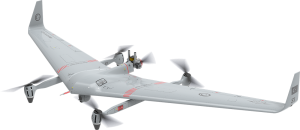
According to defense-industry outlet Quwa, HIT invited journalists on September 6, 2026 to tour the new UASF, where it displayed the R-020 and R-040 vertical-take-off-and-landing (VTOL) drones, a tailless delta-wing loitering munition, the P-905 interceptor-drone-based counter-UAS system, and a strike platform resembling Turkey’s YIHA family of loitering munitions. The tour followed HIT’s public unveiling a month earlier, at the 2026 Indus Robotics and Autonomous Systems (RAS) Expo, of the D-248 and S-369 — one-way-attack loitering munitions that Quwa and multiple Pakistani outlets, including ProPakistani and Daily Pakistan, described as the country’s longest-ranged munitions of their kind.
HIT has not issued an English-language press statement of its own confirming the UASF opening or disclosing production volumes, so the reporting rests on the September 6 media tour and specifications HIT representatives provided to attending journalists. No unit costs, annual output targets or delivery timelines to the Pakistan Army have been officially disclosed.
The Product/System
HIT is the backbone of Pakistan’s armored-vehicle industry, best known for co-developing the Al-Khalid main battle tank with China’s Norinco and for decades of tank overhaul and license production at its Taxila complex. The UASF represents a deliberate diversification into unmanned systems as loitering-munition warfare, driven globally by conflicts in Ukraine and the Middle East, becomes a standard element of ground-forces doctrine.
Per Quwa’s specifications from the Indus RAS Expo reveal, the D-248 uses a tailless delta-wing airframe — the same broad configuration as Iran’s Shahed-136 — with a maximum take-off weight of roughly 240 kg, a 3.3-meter wingspan, a 30-50 kg payload, a cruise speed near 185 km/h, an endurance of 12-14 hours, a service ceiling up to 4,500 meters, and a reported operational range of 2,200-3,000 km. The S-369, built on an arrow-delta layout, carries a similar 30-50 kg payload on a 4-meter wingspan with a stated range of 1,500-2,000 km. The R-020 and R-040 are VTOL platforms shown at the UASF tour; Quwa describes the R-040 as a dual intelligence-and-strike design, while detailed specifications for both have not been publicly released. The P-905 is an interceptor-drone-based counter-UAS system intended to engage hostile loitering munitions and quadcopters, a capability the Pakistan Army had signaled it was developing as early as May 2026.
Who Uses It
The systems are being developed for the Pakistan Army; no other confirmed operator exists at this stage. HIT is a state-owned entity whose primary customer is Pakistan’s own armed forces, so the UASF’s output should be read as an in-house production line rather than a commercial sale — no foreign buyer, co-production partner or export customer has been named in connection with the D-248, S-369, R-020, R-040 or P-905.
Export/Procurement History
HIT’s move follows a broader pattern across Pakistan’s state-run defense sector — which also includes the Pakistan Ordnance Factories and Global Industrial Defence Solutions — of unveiling Shahed-style, long-range loitering munitions through 2026, a trend Quwa has linked to a Pakistan Army goal of fielding 2,000-3,000 km low-cost strike reach comparable to Iran’s Shahed program and Ukraine’s FP-1. The September 6 tour is the first indication that HIT has moved beyond static displays and prototypes toward an assembly line, but Pakistan’s Ministry of Defence Production has not disclosed a formal procurement contract, unit quantities or a production ramp-up schedule.
Global Competitors
The D-248’s Shahed-136-style delta-wing design places it in a lineage that includes Iran’s own Shahed-136/131 family, Russia’s license-built Geran-2, and Ukraine’s FP-1 — all long-endurance, propeller-driven one-way-attack drones prized for their low unit cost relative to cruise missiles. In South Asia specifically, India’s DRDO has fielded the shorter-range Nagastra-1 loitering munition and continues to expand its own loitering-munition and counter-drone programs, meaning HIT’s UASF output positions Pakistan to narrow, rather than lead, a capability gap that has widened since large-scale loitering-munition use became common in Ukraine from 2022 onward.
Why It Matters
A dedicated factory line — as opposed to a one-off prototype reveal — signals that Pakistan intends to industrialize low-cost, long-range strike capability rather than treat it as a niche program. If the reported 2,200-3,000 km range of the D-248 is accurate and the type reaches operational service, it would extend Pakistan’s strike reach well beyond its immediate border regions, a development regional analysts and at least one Indian outlet, NewsX, have already begun weighing against India’s S-400 air-defense coverage. The parallel unveiling of the P-905 interceptor system also suggests HIT is building matching offense-defense drone capacity rather than pursuing strike systems in isolation.
What Happens Next
Key unknowns remain: whether the Pakistan Army has placed a formal production order, what annual output the UASF is designed to reach, and whether any of these systems will be offered for export, as Pakistan’s state-run manufacturers have done previously with armored vehicles and small arms. HIT and Pakistan’s Ministry of Defence Production have not announced a follow-up disclosure date, and independent verification of the D-248 and S-369’s claimed ranges — none of which has been demonstrated in a publicized long-range test — has not been reported.
FAQ
What is Heavy Industries Taxila’s UASF?
The Unmanned Aerial Systems Factory (UASF) is a new production facility at Pakistan’s Heavy Industries Taxila complex, dedicated to building loitering munitions, VTOL surveillance and strike drones, interceptor drones and training UAS platforms. HIT opened it to media on September 6, 2026.
What is the range of Pakistan’s D-248 loitering munition?
Pakistani defense-industry reporting citing HIT specifications puts the D-248’s operational range at roughly 2,200-3,000 km, with a 30-50 kg payload and 12-14 hours of endurance. This figure comes from manufacturer-provided specifications shown at the 2026 Indus RAS Expo and has not been independently verified through a publicized flight test.
Is the D-248 based on Iran’s Shahed-136?
The D-248 shares the Shahed-136’s tailless delta-wing configuration, a design lineage also visible in Russia’s Geran-2 and Ukraine’s FP-1. Pakistani sources describe it as a domestically developed system rather than a licensed Shahed derivative, though HIT has not detailed its design origin.
Has Pakistan exported any of these drones?
No export customer, co-production partner or foreign sale has been announced for the D-248, S-369, R-020, R-040 or P-905. All confirmed activity to date concerns production for Pakistan’s own armed forces.
How does this compare to India’s loitering-munition programs?
India’s DRDO has fielded the Nagastra-1 loitering munition, which has a shorter reported range than Pakistan’s claimed D-248 figures, and continues to develop longer-range strike and counter-drone systems. Neither country has published directly comparable, independently verified performance data, making head-to-head range comparisons provisional.
Sources
- Quwa, “Pakistan’s Heavy Industries Taxila (HIT) Showcases New Drone Production Facility,” September 2026 — quwa.org — primary report on the September 6 UASF media tour and product lineup.
- Quwa, “Heavy Industries Taxila Reveals D-248 and S-369, Pakistan’s Longest-Range Loitering Munitions,” August 2026 — quwa.org — detailed specifications for the D-248 and S-369 from the Indus RAS Expo reveal.
- ProPakistani, “Pakistan Unveils Two New Long-Range Kamikaze Drones,” August 6, 2026 — propakistani.pk — independent domestic confirmation of the D-248/S-369 unveiling.
- Daily Pakistan, “Pakistan boosts Strike Capability with New 3,000-km D-248, S-369 Drones,” August 6, 2026 — en.dailypakistan.com.pk — corroborating domestic coverage of range and payload figures.
- NewsX, “Pakistan’s D-248 Kamikaze Drone Vs India’s S-400,” 2026 — newsx.com — Indian-media framing of the strategic implications.