China Tests HQ-9B Against Maneuvering Ballistic Missile

Lead
China’s state broadcaster CCTV reported on November 2, 2026, that an air-defense battalion of the People’s Liberation Army (PLA) Central Theater Command Air Force intercepted two “new-type” missile targets simultaneously during a weapons-verification exercise, including one that maneuvered and changed altitude mid-flight. Global Times identified the system involved as the HQ-9B long-range surface-to-air missile, though CCTV’s own broadcast did not name the interceptor, and other outlets have described the unit’s inventory differently. No independent technical data on the targets’ speed, altitude or maneuver profile has been released, and the test comes against the backdrop of unresolved questions about the HQ-9B’s performance during the May 2025 India-Pakistan clash.
What Happened
According to CCTV’s report, the Shenwei Missile Battalion, a PLA Central Theater Command Air Force unit, carried out a live weapons-verification mission in which it engaged two missile targets at once. One target was described as a ballistic missile; the second reportedly changed direction and dropped sharply as it approached the unit’s defended airspace, prompting crew members to order an urgent launch. Battalion personnel told CCTV that the engagement window was narrow — “if you fail to act for two seconds, or even one second, and do not launch in advance, you could miss the window,” one crew member, identified as Shi Shidong, said — and that the unit was not informed in advance which targets it would face. Another battalion member, Hu Yang, said the time from receiving a target-warning cue to completing an interception could be as short as two minutes.
Global Times, the Communist Party-affiliated outlet, attributed the system to the HQ-9B and quoted military commentator Song Zhongping saying the result demonstrated an integrated command network capable of assigning the nearest available interceptor to a target and sharing tracking data in real time. Song said intercepting a maneuvering ballistic missile places extra demands on a system’s guidance and seeker, since the interceptor must keep radar lock as the target changes course and respond with its own rapid maneuvering, potentially including thrust-vector control.
The reporting leaves significant gaps. CCTV’s own broadcast did not identify either the missile system or the specific target types. The South China Morning Post described the unit only as equipped with “Hongqi” (HQ) family interceptors without confirming the HQ-9B specifically, and other outlets covering the same Shenwei Battalion have referenced the HQ-9, HQ-19 and HQ-29 in connection with separate drills. No flight data, radar tracks or video confirming the interception have been made public. Janes, the defense-intelligence publisher, noted that CCTV did not identify the targets or the system used in the engagement. The claim should accordingly be treated as a PLA/state-media assertion pending independent confirmation, not as an established fact about the HQ-9B’s demonstrated capability.
The Product/System
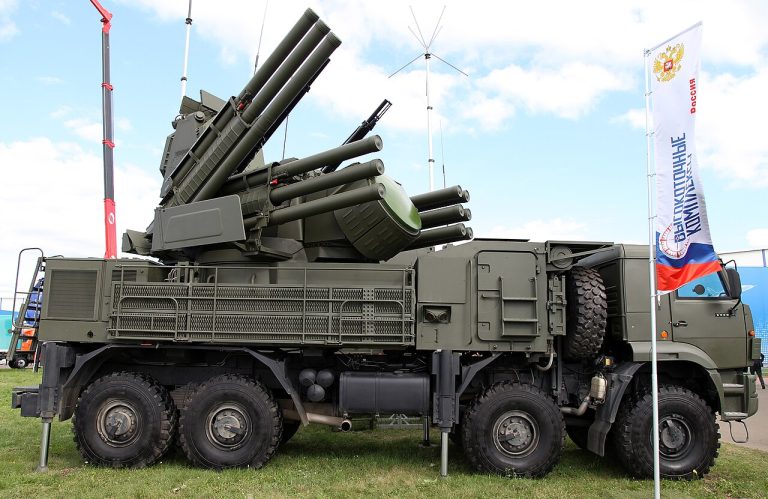
The HQ-9 is a long-range, road-mobile surface-to-air missile system developed by the state-owned China Aerospace Science and Industry Corporation (CASIC), with design lineage tracing in part to Russia’s S-300 family. The baseline HQ-9 entered service around 2001. The HQ-9B variant, fielded roughly from 2015, added a passive infrared seeker alongside the system’s semi-active radar homing, giving it a dual-mode terminal guidance capability intended to improve performance against low-flying and electronically jammed targets. A further variant, the HQ-9C, is reported to add active radar homing and hit-to-kill terminal intercept technology aimed at ballistic-missile defense roles. China has also fielded the longer-range HQ-19, described as an upper-tier interceptor with anti-ballistic-missile and possible anti-satellite applications, and the HQ-29, both of which were displayed at China’s September 2025 military parade alongside the HQ-9 family as part of what Chinese officials describe as a layered air and missile defense architecture.
The Shenwei Missile Battalion, identified in CCTV’s report as the unit that conducted the exercise, sits under the PLA Central Theater Command Air Force, one of the PLA’s five theater commands and the one responsible for the defense of the Beijing-Tianjin-Hebei region among other areas. The battalion’s exact equipment holdings are not publicly itemized by the PLA; CCTV and Global Times reporting on the unit over time has referenced more than one missile type.
Who Uses It
Within the PLA, HQ-9-family systems form part of China’s integrated national air-defense network, alongside Russian-supplied S-400 batteries that China has also purchased. Confirmed export customers of the HQ-9 or its export variant, the FD-2000, include Pakistan, which has fielded the system as part of its national air-defense inventory, and Turkmenistan, which has been reported as an operator. Uzbekistan and Azerbaijan have also been named in open-source reporting and specialist outlets such as Quwa and Military Watch Magazine as HQ-9 or related-variant operators, though procurement details for some of these customers have not been comprehensively confirmed through government-to-government disclosures. No new export customer or additional sale was announced in connection with the November exercise.
Export/Procurement History
Pakistan’s acquisition and operational use of HQ-9B batteries drew close scrutiny after the brief but intense India-Pakistan military clash in May 2025. Open-source and media analysis following that conflict suggested Pakistani HQ-9B units did not prevent Indian aircraft from penetrating and striking targets deep inside Pakistani territory, and analysts pointed to possible vulnerabilities including radar susceptibility to Indian electronic warfare, a limited number of fielded batteries, and difficulty engaging fast, low-flying or maneuvering threats. That episode, described by some outlets as a “poor show” for the system, forms the immediate backdrop against which China’s November 2026 interception claim is being read by regional defense commentary, including Indian outlet Eurasian Times, which framed the test explicitly as an attempt to answer lingering doubts about HQ-9B performance.
There is no confirmed record in this reporting cycle of a new HQ-9-family export contract, delivery, or customer announcement tied to the Shenwei Battalion exercise. The test appears to be a PLA internal training and capability-demonstration event rather than a marketing or procurement milestone.
Global Competitors
The HQ-9B occupies a capability tier comparable to Russia’s S-300/S-400 family, from which it partly descends, and the United States’ Patriot (PAC-2/PAC-3) system, both of which are also marketed and fielded as long-range, multi-target air and missile defense systems. The question the November exercise is implicitly addressing — whether a given interceptor can reliably engage a ballistic missile that maneuvers in its terminal phase — has become a live concern across all of these systems. A Financial Times analysis cited by Eurasian Times, based on Ukrainian Air Force data compiled by the Center for Information Resilience, reported that Patriot’s measured interception rate against Russian ballistic missiles fell from roughly 37% in August 2025 to about 6% in September after Russia began adding terminal-phase maneuvering to its missiles, illustrating that maneuvering reentry vehicles are a documented challenge for Western interceptors as well, not one unique to Chinese systems.
Why It Matters
If the HQ-9B, or whichever system was actually used, can reliably and repeatably intercept a maneuvering ballistic-missile target, it would mark a meaningful step for China’s layered air-defense architecture and for the marketability of its SAM exports at a time when Pakistan’s 2025 combat experience raised doubts among potential buyers. Chinese commentators have also floated, cautiously, that the result raises the possibility of eventual hypersonic-missile defense applications, though experts quoted in the same reporting stressed this depends heavily on a specific weapon’s flight trajectory and that true hypersonic interception has not been demonstrated. Given the absence of released flight data, independent verification, or even a confirmed system identification from CCTV itself, the claim is best understood for now as a signal of PLA messaging and training emphasis rather than a verified leap in Chinese air-defense capability.
What Happens Next
Independent analysts and regional defense publications are likely to continue probing which system was actually used and what the “new-type” targets were, particularly given the inconsistency between Global Times’ HQ-9B attribution and other outlets’ more general “Hongqi family” descriptions. Any future PLA disclosure of additional detail, or any shift in Pakistani, Turkmen, Uzbek or Azerbaijani procurement posture toward HQ-9-family systems, would be the next concrete indicator of whether this test translates into renewed export confidence. Absent that, the story is likely to remain in the realm of contested claim rather than confirmed capability.
FAQ
What exactly did China claim to intercept?
CCTV reported that a PLA Central Theater Command Air Force unit, the Shenwei Missile Battalion, simultaneously intercepted two “new-type” missile targets during a weapons-verification exercise on or around November 2, 2026, including one described as a ballistic missile and a second that changed direction and dropped sharply mid-flight.
Was the HQ-9B confirmed as the system used?
Not independently. Global Times attributed the test to the HQ-9B, but CCTV’s own broadcast did not name the system, and other outlets have described the unit’s equipment more generally as part of the “Hongqi” (HQ) missile family, which also includes the HQ-19 and HQ-29.
Does this mean the HQ-9B can intercept hypersonic missiles?
No. Chinese commentators said the result raises that possibility, but they also cautioned it depends on the specific weapon’s flight trajectory, and no hypersonic-missile interception was tested or claimed in this exercise.
Why does this matter for Pakistan’s use of the HQ-9B?
Pakistan’s HQ-9B batteries faced scrutiny after Indian aircraft reportedly operated inside Pakistani airspace during the May 2025 clash between the two countries, raising questions about the system’s effectiveness that this test is being read, by some regional commentary, as an attempt to address.
Has any country placed a new order for HQ-9-family systems as a result of this test?
No new export contract or customer has been reported in connection with this exercise. Confirmed or reported operators remain Pakistan, and reportedly Turkmenistan, Uzbekistan and Azerbaijan.
Sources
- Global Times, “CHINA / MILITARY” report on the Shenwei Missile Battalion interception exercise, published November 2, 2026 (globaltimes.cn) — primary state-media account naming the HQ-9B and carrying expert commentary from Song Zhongping and Zhang Xuefeng.
- South China Morning Post, “China’s HQ-series intercepts 2 new missile types, PLA tests weapon platform,” reporting on the same exercise with a more general “Hongqi family” attribution and noting the lack of independent verification.
- Janes, defense-intelligence insight on the simultaneous interception report, noting CCTV did not identify the targets or system involved.
- Eurasian Times, “After poor show against IAF jets, China claims double success with HQ-9B SAMs against maneuvering missiles,” published November 6, 2026 — context on the May 2025 India-Pakistan clash and HQ-9B performance concerns.
- Financial Times analysis (via Eurasian Times), citing Ukrainian Air Force data compiled by the Center for Information Resilience, on Patriot interception-rate declines against maneuvering Russian ballistic missiles.