US Army Picks Lockheed Martin for $1.08bn Future Interceptor Prototype Deal
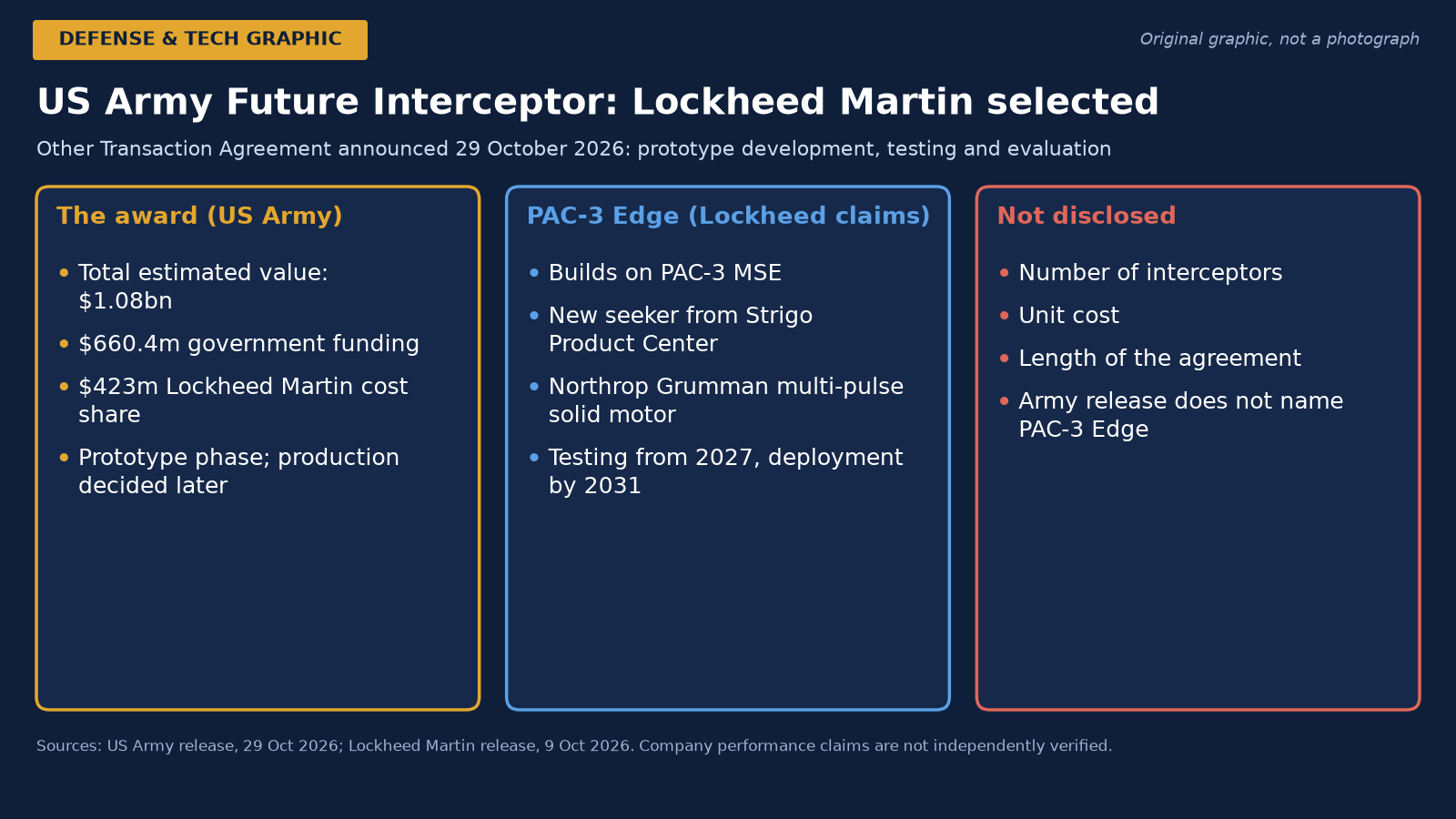
The US Army has selected Lockheed Martin to develop its Future Interceptor, a next-generation air and missile defence interceptor, under an Other Transaction Agreement with a total estimated value of $1.08bn. In a release dated 29 October 2026 from Huntsville, Alabama, the Army said the figure combines $660.4m of government funding with a $423m cost-sharing commitment from Lockheed Martin (US Army).
- The US Army awarded Lockheed Martin an Other Transaction Agreement (OTA) for the Future Interceptor on 29 October 2026
- Total estimated project value: $1.08bn, made up of $660.4m in Army funding and a $423m cost share from Lockheed Martin
- The agreement covers prototype development, testing and evaluation; production decisions will come later
- Lockheed Martin’s candidate is PAC-3 Edge, which the company says will start testing in 2027 for deployment by 2031; the Army release does not name the design
What the Army has bought
This is a prototyping deal, not a production contract. Under the agreement the Army will work with Lockheed Martin on prototype development and on testing and evaluation against “established operational requirements”. The service said future development and production decisions “will be informed by prototype performance, operational requirements, available resources and applicable acquisition processes” (US Army).
According to the Army, the Future Interceptor is meant to improve on current interceptors in engagement range, altitude, velocity and manoeuvrability, and to complement the Army’s existing Integrated Air and Missile Defense (IAMD) systems rather than replace them. Neither the Army nor Lockheed Martin has published interceptor quantities, a unit cost, a test schedule tied to the award or the length of the agreement.
General Christopher LaNeve, Vice Chief of Staff and Acting Chief of Staff of the Army, linked the award to the service’s new warfighting guidance, How the Army Fights, saying the Army is “pursuing a mix of exquisite and low-cost munitions”. Brent Ingraham, Assistant Secretary of the Army for Acquisition, Logistics and Technology, called it “an important step forward”, while Lt Gen Frank Lozano, Portfolio Acquisition Executive for Fires, said the programme leverages “proven technologies” (US Army).
The candidate: PAC-3 Edge
The Army’s release does not name the interceptor design. Lockheed Martin, however, unveiled PAC-3 Edge in Dallas on 9 October as its entry for the Future Interceptor programme. The company says PAC-3 Edge builds on the PAC-3 MSE, with a new seeker designed by its Strigo Product Center, a multi-pulse solid rocket motor designed by Northrop Grumman and upgraded control systems for better performance at range and altitude. Lockheed Martin says it has invested $250m in the Strigo Product Center (Lockheed Martin).
Lockheed Martin says it will begin testing PAC-3 Edge in 2027 to prepare for deployment by 2031, and that the missile is designed to work with the Integrated Battle Command System (IBCS), the M903 launcher, containerised launchers and HIMARS Flex. The company also says the interceptor is designed to counter air, missile and hypersonic threats at higher altitudes and longer ranges. These are manufacturer claims; no test results have been published (Lockheed Martin).
Why it matters
The PAC-3 family is the main hit-to-kill interceptor of the Patriot system, and the US Army provides much of the US military’s ground-based air and missile defence. DefenseScoop noted that PAC-3 missiles have recently played a significant role in the conflicts involving Iran and in the war in Ukraine (DefenseScoop). Demand for the current PAC-3 MSE remains high: on 31 October Defense and Tech reported a US approval of 500 PAC-3 MSE missiles for Ukraine. For how Patriot fits alongside THAAD, Aegis and other layers, see our guide to US air defence systems.
The cost-sharing structure is also worth watching. Lockheed Martin is putting up roughly 39% of the estimated project value itself, so the company carries part of the development risk. Whether that investment turns into a production programme depends on how the prototypes perform from 2027.
Sources: US Army release, 29 October 2026; Lockheed Martin release, 9 October 2026; DefenseScoop.