Iran Designates Royal Navy and RAF as ‘Terrorist Organisations’, Labels MI6 a Hostile Group
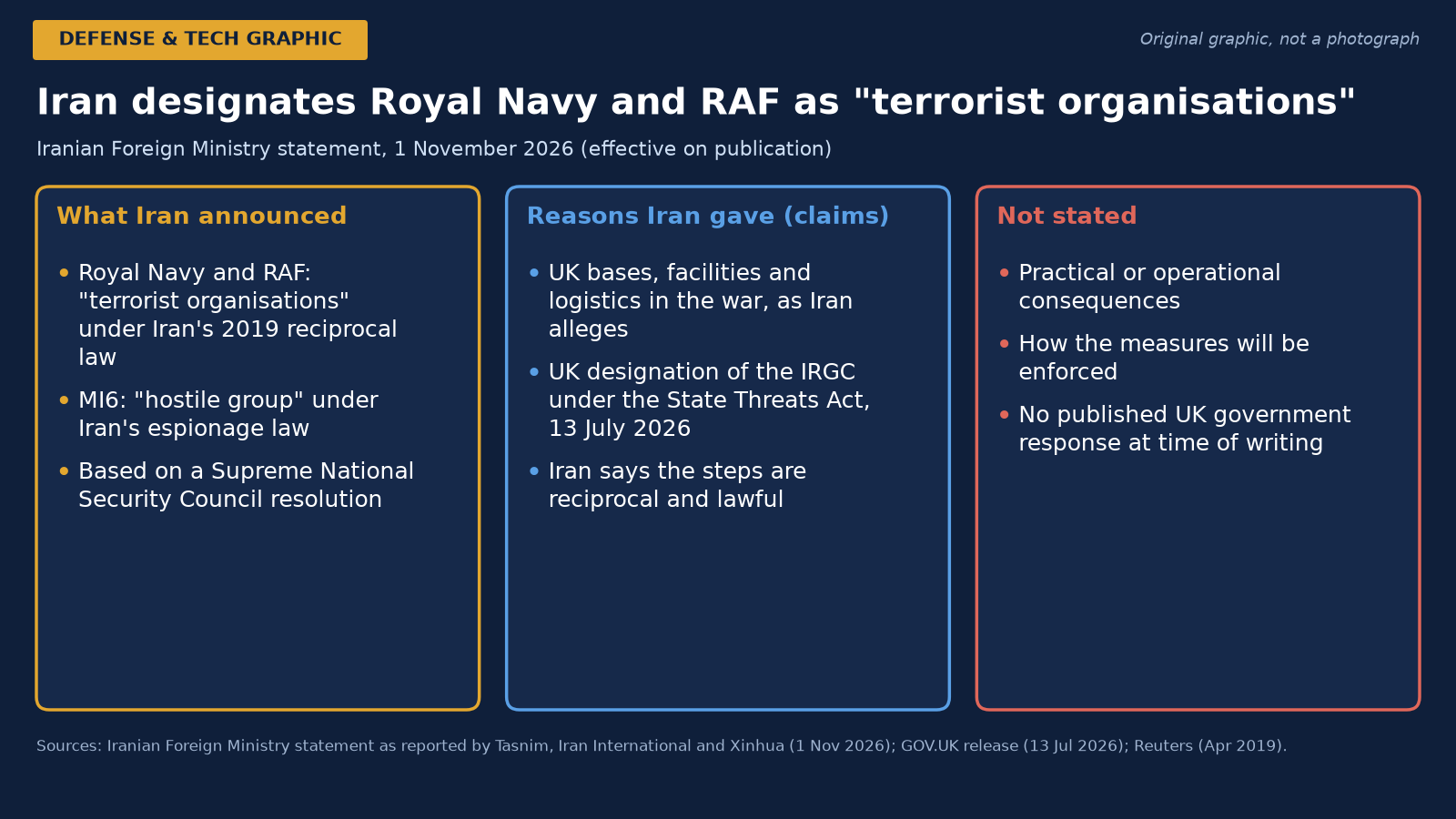
Iran has designated Britain’s Royal Navy and Royal Air Force as “terrorist organisations” and classified the UK’s foreign intelligence service, MI6, as a “hostile group”, the Iranian Foreign Ministry said in a statement on Sunday, 1 November 2026. The measures took effect when the statement was published, according to the semi-official Tasnim news agency (Tasnim, Iran International).
- Iran’s Foreign Ministry said the Royal Navy and Royal Air Force are now treated as terrorist organisations under Iranian law
- Britain’s Secret Intelligence Service (MI6) was classified as a “hostile group” under Iran’s espionage law
- Tehran described the steps as reciprocal, citing UK support in the war and Britain’s July 2026 designation of the IRGC
- The ministry did not say what the designations mean in practice; no UK government response had been published at the time of writing
What Iran announced
According to the statement, the decision is based on a resolution of Iran’s Supreme National Security Council. MI6 is placed under Note 2 of Article 1 of Iran’s law on tougher penalties for espionage and cooperation with Israel and “hostile countries”. The Royal Navy and the RAF are brought under Iran’s law on reciprocal action against the United States’ designation of the Islamic Revolutionary Guard Corps (IRGC), and are “accordingly recognised as terrorist organisations” (Tasnim). China’s Xinhua news agency carried the same points (Xinhua).
The reasons Tehran gave
The Foreign Ministry called British policy towards Iran “hostile and unlawful”. It said the steps respond to UK actions over the past year, including what it described as Britain’s involvement in the “US-Israeli war of aggression” against Iran through the provision of military bases, facilities and logistical support, and the UK decision of 13 July 2026 to bring the IRGC under its State Threats Act. The ministry said the measures were consistent with international law and the principle of reciprocity, and that London would bear responsibility for the consequences (Tasnim, Iran International). These are Iran’s characterisations; the UK government had not published a response when this article was prepared.
What the UK did in July
On 13 July 2026 the UK government announced that the IRGC, the Islamic Movement of Companions of the Right (IMCR) and Russia’s GRU Volunteer Corps would be the first bodies designated under the new National Security (State Threats) Act 2026. London said supporting or assisting a designated group could bring up to 14 years in prison, and that it had already sanctioned the IRGC in its entirety along with more than 550 Iranian-linked individuals and entities (GOV.UK).
Previous developments
Tehran has used the same legal tool before. In April 2019, after Washington designated the IRGC a foreign terrorist organisation, Iran’s parliament passed a law declaring US Central Command and US forces in the Middle East terrorist entities, which President Hassan Rouhani signed at the end of that month (Reuters). Sunday’s statement extends that reciprocal approach to two branches of the British armed forces.
Why it matters
The designation is mainly a legal and political step, and the ministry did not spell out any operational consequences for British ships or aircraft. It comes at a tense moment for maritime security in the Gulf region, where US Central Command has been publicising its operations around the Strait of Hormuz (our report), and a day after an Iranian Army spokesman said Russian Su-35 fighters would be delivered only after the war (our report). Whether the move affects British naval or air activity in the region will depend on how Tehran applies it, which it has not yet set out.
Sources: Iranian Foreign Ministry statement of 1 November 2026 as reported by Tasnim, Iran International and Xinhua; UK Home Office/FCDO release, 13 July 2026; Reuters (April 2019).