US Approves $832M Javelin Missile Sale to Egypt

The US State Department approved a possible Foreign Military Sale of up to 2,020 FGM-148F Javelin anti-tank missiles and 200 launch units to Egypt on October 2, 2026, a deal valued at as much as $832 million that would give Cairo’s infantry its first Javelins after decades of relying on older European and Soviet-designed anti-armor systems. The approval, still subject to congressional review and contract negotiation, arrived one day after Washington waived human-rights-linked restrictions on $320 million in separate military financing for Egypt.
What Happened
The US Defense Security Cooperation Agency notified Congress on October 2 of a possible sale to the Government of Egypt covering up to 2,020 Javelin FGM-148F missiles, including 20 missiles reserved for test firing, and up to 200 Javelin Lightweight Command Launch Units (LWCLUs). The package also includes trainers, battery coolant units, simulation rounds, spare parts, technical documentation, and life-cycle logistics support, according to the notification reported by DefenceWeb, Army Recognition, Militarnyi, and other specialist defense outlets.
Lockheed Martin, based in Orlando, Florida, and RTX Corporation, based in Arlington, Virginia, are named as the principal contractors; the two companies co-produce the Javelin through the Javelin Joint Venture. As with all US Foreign Military Sale notifications, the approval sets a ceiling on value and quantity rather than a signed contract — the final numbers, delivery schedule, and recipient unit will depend on a subsequent Letter of Offer and Acceptance (LOA) negotiated between Washington and Cairo, and on congressional review of the notification.
Egypt has never previously fielded the Javelin. US troops fired the system on Egyptian soil during the Bright Star 2018 joint exercise, but Cairo’s own infantry has not operated it. If the sale proceeds roughly as notified, Egypt’s ratio of about ten missiles per launcher would be notably higher than Morocco’s 2024 Javelin purchase (612 missiles for 200 launchers) and above the ceilings historically approved for Jordan and Lithuania.
The Product/System
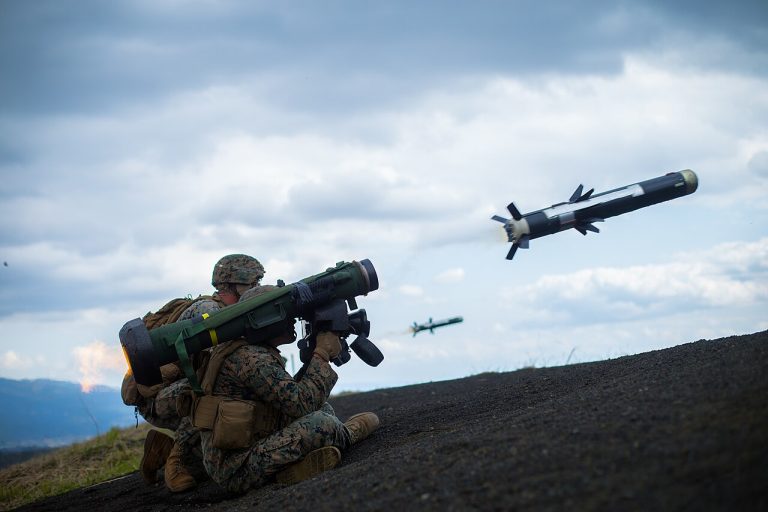
The FGM-148 Javelin is a shoulder-fired, fire-and-forget anti-tank guided missile developed jointly by Lockheed Martin and Raytheon (now part of RTX) and fielded by the US Army and Marine Corps since the mid-1990s. Its imaging-infrared seeker locks onto a target before launch and tracks independently in flight, letting the gunner relocate or reload immediately rather than maintaining a line of sight to the target, a significant tactical difference from older wire- or laser-guided systems such as TOW or Milan.
The newest variant offered to Egypt, the FGM-148F, carries an 8.4 kg tandem-shaped-charge warhead designed to defeat explosive reactive armor, with penetration reported above 760 mm of rolled homogeneous armor equivalent, though actual effectiveness depends on the target’s armor type and protective systems. The missile can fly a top-attack profile, climbing to roughly 150 meters before diving onto a vehicle’s thinner top armor, or a flatter direct-attack profile for bunkers and other targets. Paired with the Lightweight Command Launch Unit, dismounted range extends to about 4 km, up from 2.5 km with earlier command units, while vehicle-mounted launches can reach 4.75 km. Lockheed Martin has said annual Javelin production capacity is being expanded from roughly 2,400 missiles toward a target of 3,960 by late 2026, partly in response to sustained demand from Ukraine and new export orders.
Who Uses It
The Javelin is fielded by the US armed forces and more than 20 other confirmed operators, including Ukraine, Jordan, Lithuania, Taiwan, Qatar, the United Arab Emirates, Oman, and, more recently, Morocco and Tunisia, which received separate approvals in 2024. Egypt would become the newest confirmed operator if the current notification results in a signed contract, joining a growing list of Arab and North African militaries diversifying their anti-armor arsenals with US-made systems.
Export/Procurement History
Egypt’s armed forces currently field a broad and largely non-American mix of anti-tank guided weapons, including Franco-German Milan II, British Swingfire, US-made TOW II (Cairo received a separate TOW 2A sale approval in 2022), Soviet-era Malyutka and Konkurs, Russian Metis-M and Skif, French Akeron MP (formerly MMP), South African Raybolt, and Chinese HJ-8/HJ-73 missiles. The Javelin notification would add to, rather than replace, this inventory, continuing a pattern in which Cairo hedges across US, European, Russian, and Chinese suppliers rather than standardizing on a single system — a posture also visible in Egypt’s combat aircraft fleet, which mixes US F-16s, French Rafales, and Russian MiG-29M/M2s.
Regionally, Morocco requested 612 Javelin missiles and 200 launchers for about $260 million in March 2024, and Tunisia requested 184 missiles in December 2024, according to DSCA notifications cited by DefenceWeb. Jordan’s 2009 approval covered 1,808 missiles and 162 command units, while Lithuania’s cumulative purchases total 871 missiles and 144 units — figures against which Egypt’s prospective 2,020-missile, 200-unit ceiling stands out as one of the largest single Javelin requests among non-NATO Middle Eastern and African buyers.
Global Competitors
Egypt’s existing inventory already includes several Javelin rivals. Russia’s Kornet-E, a laser-beam-riding missile with tandem and thermobaric warhead options, remains in wide regional service and has also turned up in the hands of militant groups in Sinai, according to past Egyptian media reporting. France’s MBDA-built Akeron MP (MMP), which Egyptian special forces have displayed since 2023, offers a comparable fire-and-forget infrared seeker and multi-target engagement modes. Israel’s Spike-LR2, built by Rafael, is fielded by several of Egypt’s neighbors and partners, while South Africa’s Ingwe offers a lower-cost laser-guided alternative used by several African militaries. The Javelin’s main selling points against these rivals are its combat record — extensively proven in Ukraine — and the maturity of its US logistics and training pipeline, rather than a decisive technical edge in any single category.
Why It Matters
The timing is notable: the Javelin notification followed by one day the State Department’s decision to waive human-rights-linked conditions on $320 million in Foreign Military Financing for Egypt, underscoring how military sales remain tightly bound to the broader US-Egypt security relationship. For Cairo, a large Javelin order would mark a tangible deepening of defense ties with Washington at a moment when Egypt has also been negotiating a possible expansion of its Rafale fleet with France and continuing deliveries of Chinese-origin drones, illustrating the multi-vector procurement strategy that increasingly defines Egyptian defense planning. For the US defense industrial base, an Egyptian order approaching 2,000 missiles would represent a substantial addition to a Javelin production line already stretched by sustained Ukrainian demand and other recent export approvals.
What Happens Next
The notification must clear the statutory congressional review period before a formal Letter of Offer and Acceptance can be negotiated between the two governments. Only after an LOA is signed will Egypt’s actual missile and launcher quantities, delivery schedule, and final contract value be fixed; historically, Foreign Military Sale ceilings are scaled down from the notified maximum during final negotiations. Given current Javelin production constraints, any eventual contract would likely be delivered over several years rather than as a single shipment.
FAQ
Is this a signed contract or just an approval?
It is a State Department and DSCA approval for a possible sale, not a signed contract. Egypt and the US must still negotiate a Letter of Offer and Acceptance that will set the final quantities and price.
Has Egypt used Javelin missiles before?
No. US troops fired Javelins on Egyptian territory during the 2018 Bright Star exercise, but this would be the first time Egypt’s own armed forces acquire and operate the system.
What does the $832 million cover?
Up to 2,020 FGM-148F missiles, up to 200 Lightweight Command Launch Units, trainers, simulation rounds, spare parts, technical data, and US government and contractor logistics support — not a per-missile price.
Why did the US also waive human rights restrictions on Egypt aid the same week?
The State Department waived conditions on $320 million in Foreign Military Financing for Egypt on October 1, one day before the Javelin notification, a decision Washington has made in previous years citing US national security interests tied to the Egypt-Israel peace treaty and regional security cooperation.
What anti-tank missiles does Egypt currently use?
Egypt’s existing inventory includes Milan II, Swingfire, TOW II, Soviet-era Malyutka and Konkurs, Russian Metis-M and Skif, French Akeron MP, South African Raybolt, and Chinese HJ-8/HJ-73 missiles.
Sources
- DefenceWeb, “Egypt seeking to buy $800 million worth of Javelin missiles,” October 12, 2026 — defenceweb.co.za — primary figures and regional comparison data.
- Army Recognition (Jérôme Brahy), “US approves first Javelin missile sale to Egypt to modernize its anti-tank forces,” October 7, 2026 — armyrecognition.com — technical specifications, existing Egyptian inventory, production capacity figures.
- Militarnyi, “USA Approves Sale of 2,000+ Javelin Missiles to Egypt” — militarnyi.com — independent confirmation of DSCA notification.
- Defence Industry Europe, “U.S. approves potential $832 million sale of Javelin anti-tank missiles to Egypt” — defence-industry.eu — independent confirmation of contract value and contractors.
- Ulusavunma, “Egypt to Purchase Up to 2,020 Javelin Anti-Tank Missiles” — ulusavunma.com — additional confirmation of quantities.