WHAT IS A UAV? WHAT IS A UCAV? DECODING THE STRATEGIC DIVIDE IN UNMANNED SYSTEMS

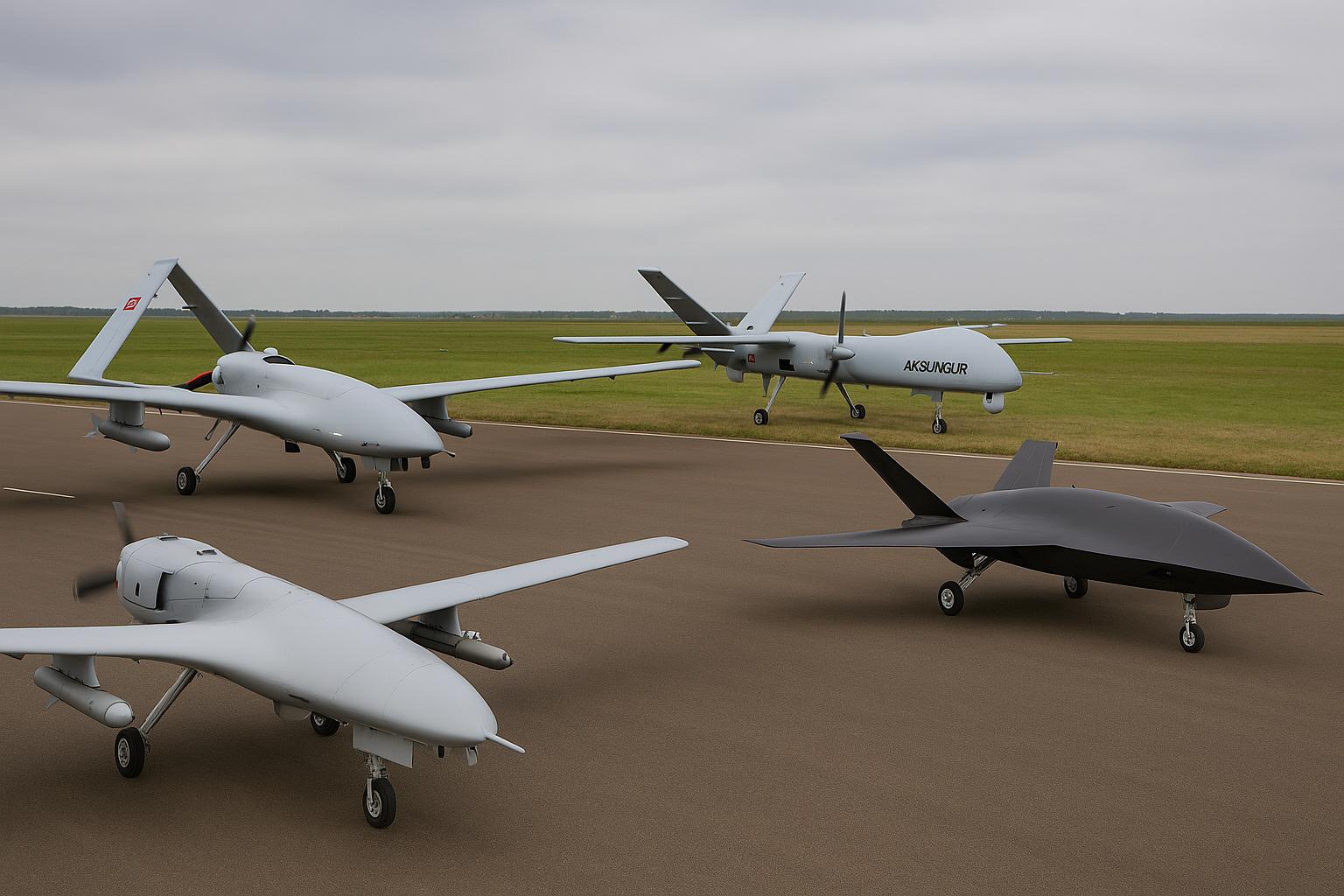

STRATEGIC ANALYSIS — The landscape of aerial warfare has been permanently altered by the rise of unmanned systems. However, as these technologies advance, the terminology used to describe them is often conflated. Understanding the distinction between a UAV (Unmanned Aerial Vehicle) and a UCAV (Unmanned Combat Aerial Vehicle)—known in Turkish as İHA and SİHA—is essential for grasping modern defense doctrine.
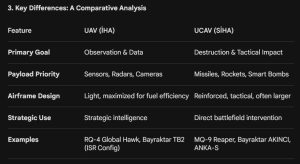
While both platforms share the same technological “DNA,” their mission profiles, internal architectures, and psychological impacts on the battlefield are worlds apart.
1. What is a UAV (İHA)?
A UAV (Unmanned Aerial Vehicle) is any aircraft capable of flight without a human pilot on board. In the defense sector, these are primarily utilized for ISR (Intelligence, Surveillance, and Reconnaissance).
-
The Mission: To be the “eyes in the sky.” A UAV’s primary goal is data collection.
-
The Payload: High-definition EO/IR (Electro-Optical/Infrared) cameras, SAR (Synthetic Aperture Radar), and signals intelligence (SIGINT) equipment.
-
Technical Characteristic: UAVs are often optimized for Endurance ($T_{endurance}$) and high-altitude flight to monitor vast areas for extended periods without detection.
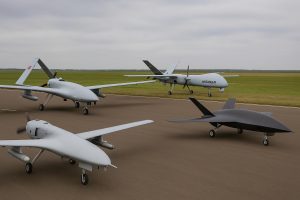
2. What is a UCAV (SİHA)?
A UCAV (Unmanned Combat Aerial Vehicle) is a specialized sub-category of UAVs designed specifically for kinetic operations. A UCAV does not just watch the target; it neutralizes it.
-
The Mission: Precision strike, suppression of enemy air defenses (SEAD), and close air support.
-
The Payload: Hard points for precision-guided munitions (PGMs), such as the Turkish MAM-L, MAM-T, or Hellfire missiles.
-
Technical Characteristic: UCAVs require more robust structural integrity to handle the weight of munitions and the G-forces of combat maneuvers.
The Golden Rule: Every SİHA (UCAV) is an İHA (UAV), but not every İHA is a SİHA. A surveillance drone becomes a combat drone only when it is integrated with a weapon control system and reinforced pylons.
4. The 2026 Horizon: Autonomous Lethality
In 2026, the line between these two is blurring further due to AI Integration. We are now seeing “Hybrid Systems” that can switch roles mid-mission. Furthermore, the rise of jet-powered UCAVs like the Bayraktar KIZILELMA and ANKA-3 has introduced a new variable: Low Observability (Stealth).
When a UCAV gains stealth and high-subsonic speed, its performance metrics ($V_{max}$) begin to rival traditional fighter jets, leading to the “Loyal Wingman” doctrine where UCAVs fly alongside manned 5th-gen fighters like the KAAN or F-35.