US Air Force Adds $826M to Lockheed JASSM, LRASM Deal Past $10B
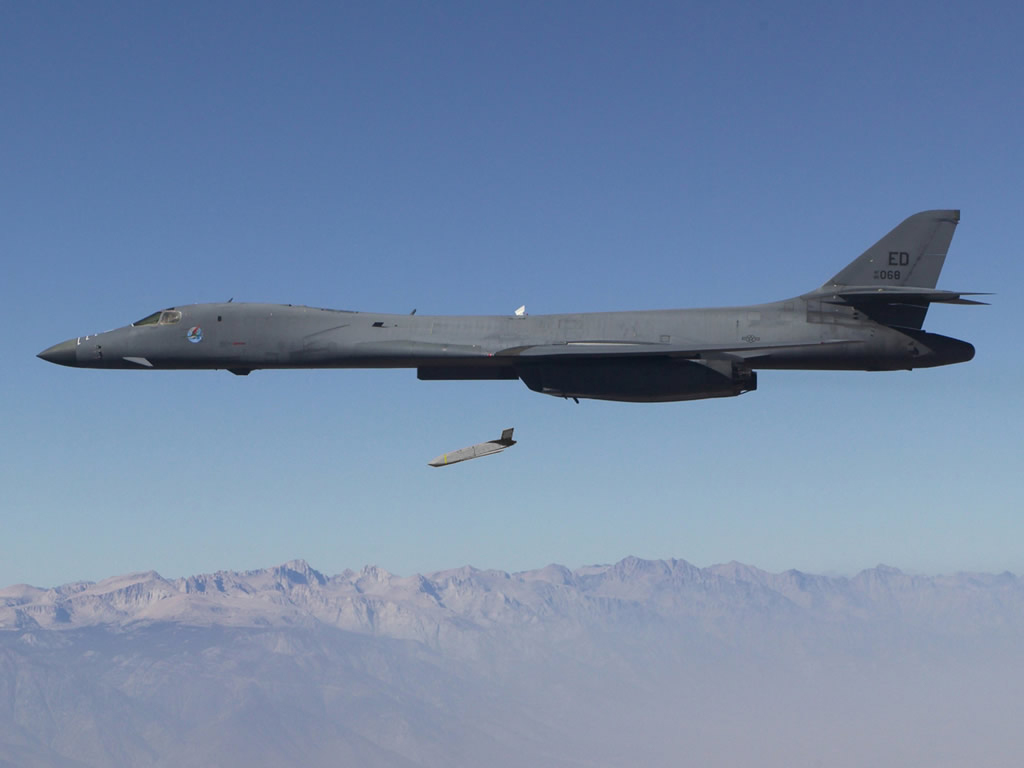
The U.S. Air Force has added $825,975,480 to its large-lot production contract with Lockheed Martin for the AGM-158 Joint Air-to-Surface Standoff Missile (JASSM) and the AGM-158C Long Range Anti-Ship Missile (LRASM), pushing the cumulative value of the agreement past $10 billion for the first time.
The modification, announced in the Pentagon’s daily contract listing, was issued by the Air Force Life Cycle Management Center at Eglin Air Force Base, Florida, against contract FA8682-24-C-B001. It raises the deal’s total face value to $10,480,052,550 from $9,654,077,070. Work will be performed at Lockheed Martin Missiles and Fire Control’s plant in Orlando, Florida, and is expected to be completed by 31 July 2030.
An existing line, running longer
The award is a continuation rather than a new start. The same contract crossed $9.485 billion in August 2025, when the Air Force added roughly $4.3 billion covering JASSM production lots 22 through 26 and LRASM lots 9 through 12. Deliveries under that tranche were earmarked not only for U.S. squadrons but for Poland, the Netherlands, Japan and Finland through Foreign Military Sales channels.
The latest $826 million keeps that line moving instead of opening a second one — a distinction that matters in a missile sector where the binding constraint is rarely the order book and almost always the supply chain. Solid rocket motors, seekers and precision machining capacity have been the recurring bottlenecks across Western standoff-weapon programmes since 2022.
Funding for the modification is drawn from fiscal 2024, 2025 and 2026 missile procurement accounts, Navy weapons procurement funds, research and development money, operations and maintenance funds, and Foreign Military Sales money. That patchwork is itself a description of the programme: a single production line now financed simultaneously by two U.S. services and a growing list of allied customers.
Two missiles, one airframe family
JASSM is a low-observable cruise missile designed to strike heavily defended fixed and relocatable targets from outside the engagement envelope of most modern air defences. The baseline AGM-158A reaches roughly 370 kilometres; the extended-range AGM-158B (JASSM-ER), now the dominant configuration in U.S. Air Force inventories, roughly 1,000 kilometres. The weapon has been in service since 2009 and is cleared on the F-15E, F-16, F/A-18, B-1B and B-52, giving several very different aircraft a common long-range strike round.
LRASM is the anti-ship derivative of the JASSM-ER airframe, fitted with a multi-mode seeker and a roughly 450-kilogram warhead and built to find and prioritise targets in a contested electromagnetic environment rather than fly to a pre-briefed point. It is fielded today on U.S. Navy F/A-18E/F Super Hornets and U.S. Air Force B-1B bombers, with integration work under way to widen the carrying fleet.
The shared airframe is the commercial logic behind the large-lot approach. Buying land-attack and anti-ship variants in one multi-year batch lets the Pentagon smooth the production rate rather than ordering in smaller annual increments that force a factory to expand and contract with the budget cycle.
Allied demand keeps widening
The four named export customers on the current contract are no longer the full picture. The U.S. State Department cleared a potential $842 million JASSM-ER sale to Denmark for its F-35 fleet in June 2026 and approved a separate JASSM-ER case for Italy in December 2025. Australia and Finland have carried JASSM on their F/A-18 fleets for years. Poland remains the only operator outside the United States fielding the longer-range JASSM-ER, integrated on its F-16C/D fleet after a 2016 order.
That pattern reflects a specific European lesson from the past four years: air forces that cannot reach deep behind an adversary’s front line are dependent on someone else’s magazine. Standoff cruise missiles have become the capability NATO members buy first once they decide to invest in offensive depth, ahead of new airframes and often ahead of ground-based fires.
Why it matters
For the U.S. Air Force and Navy, the immediate significance is inventory. Both services have spent the past several years drawing down precision-munitions stocks faster than industry could replace them, and the multi-year structure of the JASSM/LRASM buy is the mechanism intended to reverse that. Crossing $10 billion on a single procurement vehicle signals that the Pentagon is treating standoff strike as a sustained industrial commitment rather than a series of annual top-ups.
For allied buyers, the same contract is the supply route. Every export case added to the line competes for the same motors and seekers, which is why delivery slots — not price — have become the decisive variable in recent JASSM negotiations. Countries that placed orders early are receiving weapons; those still negotiating are largely queuing behind a production schedule that now runs to 2030.
For adversaries, the message is about geometry. A 1,000-kilometre air-launched cruise missile carried by tactical fighters, and an anti-ship version of the same weapon flying from bombers, together compress the value of forward air defences and push naval forces further from contested coastlines. That is the effect the U.S. and its partners are buying, and this modification is what paying for it looks like in contract language.
Sources
- U.S. Department of War daily contract announcements, 9 September 2026 (contract FA8682-24-C-B001, modification P00020)
- Defence Blog, “Lockheed’s cruise missile contract crossed $10 billion,” 10 September 2026
- Defence Industry Europe, “Lockheed Martin secures $826 million U.S. missile contract for JASSM-ER and LRASM,” 13 September 2026
- U.S. Defense Security Cooperation Agency FMS notifications, Denmark (June 2026) and Italy (December 2025)