IRIFI: Morocco Signs Deal for a 2,000km GPS-Free Strike Drone

Morocco has signed a letter of intent with French defense-AI company Harmattan AI to develop and locally produce IRIFI, a deep-strike drone the company says can fly up to 2,000 kilometers without relying on satellite navigation. The agreement, signed on the sidelines of the Marrakech Air Show on October 7, 2026, does not commit either side to a specific order quantity or program value. It builds on a broader strategic partnership signed in June 2026 under which Harmattan AI pledged to set up manufacturing and an AI research center inside Morocco. If the program advances from paper to production, it would give the Royal Armed Forces a long-range, GNSS-independent strike capability built partly on Moroccan soil — another step in a North African buildup that has already brought Morocco its own F-16 Block 72s and a Chinese-American drone fleet assembled through EDGE Group.
What Happened
At the Marrakech Air Show on October 7, 2026, representatives of Morocco’s Ministry of National Defense and Harmattan AI signed a letter of intent covering the joint development, procurement and local production of the IRIFI strike drone, according to Le Desk and confirmed by Militarnyi’s October 8 report. A letter of intent is a statement of mutual interest, not a binding supply contract: the number of drones Morocco might eventually buy, the program’s cost and a production timeline have not been disclosed by either party.
The signing follows a June 17, 2026 strategic partnership between Harmattan AI and the Royal Armed Forces, announced on the company’s own site, under which Harmattan AI committed to three things: setting up manufacturing capacity in Morocco for autonomous defense systems, building an AI-focused defense research and development center in the country, and establishing partnerships with Moroccan universities. “Morocco has made a strategic choice in favor of strategic autonomy and technological sovereignty,” Harmattan AI co-founder and CEO Mouad M’Ghari said at the time, calling the deal “the foundation of a long-term partnership with Morocco.”
The Product: IRIFI
IRIFI is described by Harmattan AI as a deep-strike drone designed to deliver precision strikes at long range relatively cheaply and in large numbers. According to specifications the company disclosed at Marrakech and reported by Militarnyi and the drone-focused outlet DroneXL:
- Range: up to 2,000 kilometers, well beyond the roughly 1,000-kilometer range typically cited for comparable one-way-attack drones such as Iran’s Shahed-136.
- Navigation: an onboard system that does not depend on GNSS satellite signals for most of the flight, switching to optical guidance in the terminal phase. Harmattan AI claims this combination resists jamming and spoofing and can deliver accuracy down to roughly one meter, though this figure has not been independently verified.
- Launch method: a mobile, container-based launcher intended to allow rapid deployment and dispersed, hard-to-target firing positions.
- Control concept: a single operator is meant to plan and launch dozens of drones at once. Targets and routes are set before launch, after which the drone completes its mission without continuous communication with a ground station. Harmattan AI says artificial intelligence will help analyze satellite imagery for strike planning, but that the decision to engage a target remains with a human operator.
Harmattan AI has not disclosed IRIFI’s warhead weight, cruise speed, physical dimensions or unit cost. Those gaps, combined with the letter-of-intent status of the Morocco deal, mean IRIFI should currently be treated as a disclosed design concept moving toward co-development, not a fielded or combat-tested weapon.
Who Is Harmattan AI
Harmattan AI is a Paris-based company developing autonomous defense systems, founded with early backing from Atlantic.vc and the US venture firm FirstMark. On January 12, 2026, French fighter manufacturer Dassault Aviation led a $200 million Series B round in the company, valuing it at roughly $1.4 billion and bringing its total funding to about $242 million, according to SiliconAngle and EDR Magazine. The Dassault round came with a parallel partnership aimed at integrating Harmattan AI’s software into Dassault’s Rafale F5 fighter program and its unmanned combat air system concepts.
Harmattan AI has also worked with Ukrainian drone makers: it announced a partnership with Ukraine’s Skyeton in October 2025 to add AI capabilities to Skyeton’s Raybird reconnaissance drones, and in February 2026 said it planned to integrate its compact Sahara synthetic-aperture radars into Ukrainian drones to enable reconnaissance through cloud cover. The Morocco program marks the company’s first publicly disclosed strike-drone partnership outside Europe.
Export and Procurement History
Morocco is the first government Harmattan AI has named as a partner for IRIFI. The October letter of intent follows the June 2026 framework agreement and sits alongside a separate, less-detailed report from Moroccan outlet 7News.ma that Harmattan AI’s Gobi VSHORAD counter-drone interceptor is also planned for local manufacture in Morocco; that claim has not been corroborated by other outlets and should be treated as preliminary. No other country has been named as a customer or development partner for IRIFI as of this writing.
The IRIFI letter of intent arrives as Morocco has moved on several fronts to localize its defense supply chain and diversify away from single suppliers: its first F-16 Block 72 completed its maiden flight in October 2026, India’s MKU signed on to build an electro-optics and armor plant in the country, and Emirati group EDGE has been arming the Royal Moroccan Air Force’s drone fleet with Desert Sting loitering munitions and Thunder guided weapons.
Global Competitors
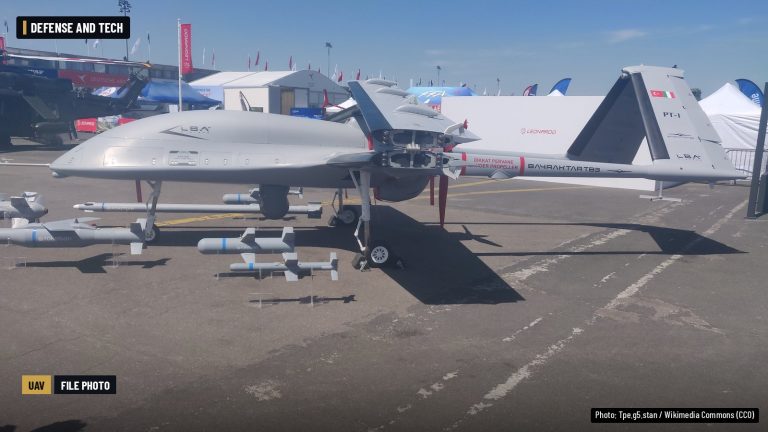
IRIFI enters a crowded category of low-cost, long-range one-way-attack drones that has expanded rapidly since Russia’s war in Ukraine. Established or widely exported systems include Iran’s Shahed-136 (and its Russian-built derivative, the Geran-2), Israel’s Harpy and Harop loitering munitions, Turkey’s Bayraktar family including the newly disclosed Kemankeş cruise missile, and China’s CH-series strike drones marketed across Africa and the Middle East. Harmattan AI’s pitch rests on two differentiators: a stated range roughly double that of the Shahed-136, and GNSS-independent navigation intended to keep the drone accurate under electronic warfare — a problem that has degraded satellite-guided munitions on several recent battlefields. Neither claim has been tested publicly or independently verified.
Why It Matters
For Morocco, the IRIFI letter of intent is less about a single weapon than about a template: pairing a Western-aligned AI startup’s technology with a declared policy of building “strategic autonomy and technological sovereignty,” as Harmattan AI’s M’Ghari put it, by locating production, research and training on Moroccan soil rather than simply importing finished systems. That mirrors moves Rabat has made with India’s MKU on armor and optics, and it would give Morocco an offensive long-range strike option to go with the air-defense and fighter upgrades it has pursued through 2026, in a region where Algeria has been pursuing its own high-end acquisitions, including a reported Su-57E program.
For Harmattan AI and Dassault Aviation, a Moroccan production and development partnership extends the company’s footprint beyond Europe and Ukraine and tests whether a venture-backed European defense-AI firm can translate a large funding round into an actual overseas manufacturing and export relationship, rather than software integration work alone.
What Happens Next
Because the October agreement is a letter of intent rather than a signed contract, the next concrete markers to watch are whether Morocco and Harmattan AI announce firm order numbers, a program value, or a production start date, and whether Rabat selects a location for the promised manufacturing and R&D facilities. Independent confirmation of IRIFI’s claimed one-meter accuracy and jam-resistance, and any demonstration or test-flight footage, have not yet been published by either party.
Frequently Asked Questions
What is the IRIFI drone?
IRIFI is a long-range, one-way strike drone developed by French company Harmattan AI, intended to deliver precision strikes without relying on GPS or other satellite navigation during most of its flight.
How far can the IRIFI drone fly?
Harmattan AI states a maximum range of up to 2,000 kilometers, though this figure comes from the manufacturer and has not been independently verified.
Has Morocco actually bought the IRIFI drone?
No. As of early November 2026, Morocco and Harmattan AI have signed only a letter of intent covering joint development and local production, not a binding purchase contract with disclosed quantities or pricing.
Who funds Harmattan AI?
Harmattan AI’s largest known backer is French aerospace manufacturer Dassault Aviation, which led a $200 million Series B investment in January 2026 at a reported $1.4 billion valuation. Earlier investors included Atlantic.vc and FirstMark.
Why is Morocco building drones with a French company instead of buying them ready-made?
Moroccan officials have framed the partnership as part of a push for “strategic autonomy and technological sovereignty,” aiming to build local manufacturing, an AI research center and university partnerships rather than simply importing a finished weapon.
Sources
- Militarnyi, “France Develops IRIFI Strike Drone With Range Of 2,000 km — Morocco to Be First Customer,” October 8, 2026 — primary source for IRIFI specifications and the October 7 letter of intent. militarnyi.com
- Harmattan AI, “Harmattan AI and the Kingdom of Morocco Sign Major Strategic Partnership for National Defense,” June 17, 2026 — primary source for the June partnership and CEO quotes. harmattan.ai
- DroneXL, “Harmattan AI’s 2,000 km Drone Doesn’t Need GPS, and Morocco Wants It,” October 12, 2026 — used for additional detail on navigation and launch concept. dronexl.co
- Le360 (English), “Defense: What we know about IRIFI, the long-range strike drone Harmattan AI plans to develop with Morocco’s Royal Armed Forces,” October 2026 — used for context on program status. en.le360.ma
- SiliconAngle, “French fighter company Dassault invests $200M in autonomous drone startup Harmattan AI,” January 12, 2026 — primary source for Harmattan AI’s funding and Dassault partnership. siliconangle.com
- 7News.ma, “Morocco moves to build its own AI-powered anti-drone interceptors” — single-source reference for the unconfirmed Gobi VSHORAD claim, flagged as preliminary. en.7news.ma