
IRAN SHOOTS DOWN F-35: THE FALL OF THE STEALTH THRONE

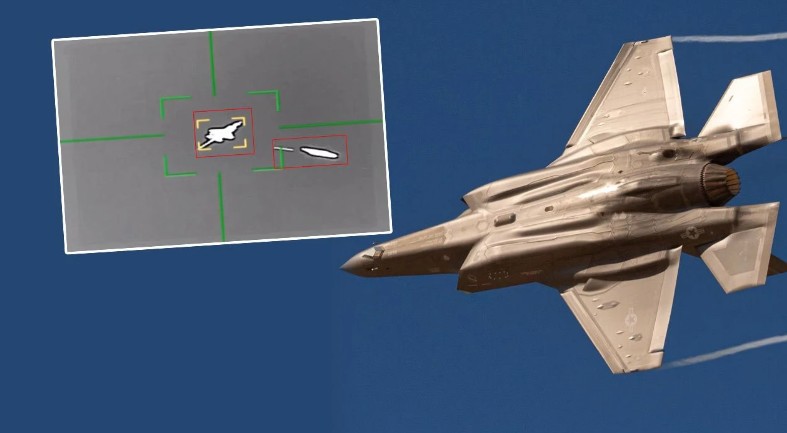

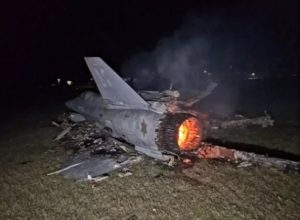
STRATEGIC AVIATION ANALYSIS — The geopolitical landscape of April 2026 has been permanently altered by a singular, catastrophic event for Western air power: the confirmed kinetic interception of an F-35 Lightning II over the Iranian theater. While the “Ghost of the Skies” was marketed as the ultimate predator of the 21st century, the sight of a 5th-generation stealth airframe falling in flames after a missile strike has ended the era of “Stealth Absolute.”
The F-35 is no longer just a shaking throne; it is a platform whose fundamental promise of invincibility has been breached.
1. The Kinetic Intercept: How the “Invisible” was Struck
The most significant blow to the F-35’s reputation is not a software glitch, but its vulnerability to high-end Integrated Air Defense Systems (IADS). Reports indicate that Iranian long-range surface-to-air missile (SAM) batteries—utilizing advanced Bavar-373 or localized S-400 logic—successfully achieved a “hard kill” on a maneuvering F-35.
Technical analysts point to a “Multi-Static Radar” approach. By using multiple low-frequency transmitters and receivers spread across a vast area, the Iranian network was able to detect the turbulence caused by the F-35’s airframe, bypassing the stealth coating optimized for higher frequencies. Once the general location was locked, a high-velocity interceptor with an Infra-Red Search and Track (IRST) seeker finished the job, tracking the jet’s thermal signature rather than its radar return.
2. The Double Disaster: Missile Strikes and “Ghost” Crashes
The F-35 program is currently fighting a two-front war for its survival. On one side, the kinetic loss over Iran proves that stealth is a “delaying tactic,” not a “vanishing act.” On the other side, the reported loss of an Israeli F-35 “Adir” that crashed without a missile impact—likely due to Electronic Attrition or a catastrophic system loop—suggests a deep-seated fragility in the aircraft’s “brain.”
This combination of a “Kinetic Kill” and a “Non-Kinetic Crash” paints a grim picture:
-
The Physical Barrier: Adversaries have cracked the radar code.
-
The Digital Barrier: The jet’s internal software is vulnerable to the intense electromagnetic chaos of 2026 warfare.
3. The Financial and Psychological Fallout
The F-35 is more than a weapon; it is an industrial titan costing over $1.7 trillion across its lifecycle. When an F-35 is confirmed as “downed by a missile,” the cost-exchange ratio becomes a strategic nightmare.
Strategic Insight: A single Iranian interceptor costing $200,000 has successfully neutralized a $120 million 5th-generation asset. For defense ministries worldwide, this “asymmetric victory” is forcing a radical reassessment of future procurement. If stealth cannot guarantee survival, the justification for the F-35’s exorbitant price tag vanishes.
4. The RCS Paradox: Why Stealth Failed
In the physics of stealth, Radar Cross Section ($RCS$) is highly dependent on the “aspect angle.” While the F-35 is remarkably “quiet” from the front, it is significantly more visible from the sides and rear.
In the saturated environment of the 2026 conflict, Iranian “passive sensors” and wide-angle radar arrays likely caught the F-35 as it turned, exposing its larger $RCS$ profile. Once the “stealth window” was breached for even a few seconds, the high-speed processing of modern SAM systems made the intercept inevitable.
Verdict: The End of the Stealth Monopoly
The downing of an F-35 in 2026 marks the end of the “Stealth Monopoly” held by the US and its allies. The myth of the “Untouchable Ghost” has been shattered by the reality of advanced sensors and high-velocity kinetics. As Lockheed Martin and the Pentagon scramble to assess the damage, the focus is rapidly shifting toward 6th-generation designs that prioritize Directed Energy Weapons and Electronic Stealth, because in the skies of today, traditional “geometry-based stealth” is no longer enough to stay alive.