

Jet Trainer / Light Attack
Leonardo M-346 Master / Fighting Master
The Leonardo M-346 Master is an Italian twin-engine advanced jet trainer built by Leonardo at Venegono Superiore, in service since about 2012. Its M-346FA Fighting Master version adds radar and weapons, and the type is operated by Italy, Israel, Singapore, Poland and Greece.
 Italy|Leonardo (Alenia Aermacchi) & Yakovlev design origin
What Is the Leonardo M-346 Master? Overview, History and Development
The M-346 was developed jointly by Aermacchi and Yakovlev from the late 1990s, before the partners split in 2000, and the Italian aircraft flew on 15 July 2004. It has fly-by-wire controls and two Honeywell F124 turbofans of about 28 kN each. It reaches about Mach 1.15, has a ferry range of about 2,722 km and can simulate fighters such as the F-35 and Eurofighter.
Italy’s first aircraft entered service around 2012–2013. Operators include Italy, Israel with 30 aircraft, Singapore with 12 based in France, Poland with about 16 and Greece with 10. The M-346FA has about 3,000 kg of weapons capacity on its hardpoints. No combat use is known, and the Israeli aircraft are used purely for training. Rivals include the T-50, Yak-130, Hawk, Hürjet and T-7A.
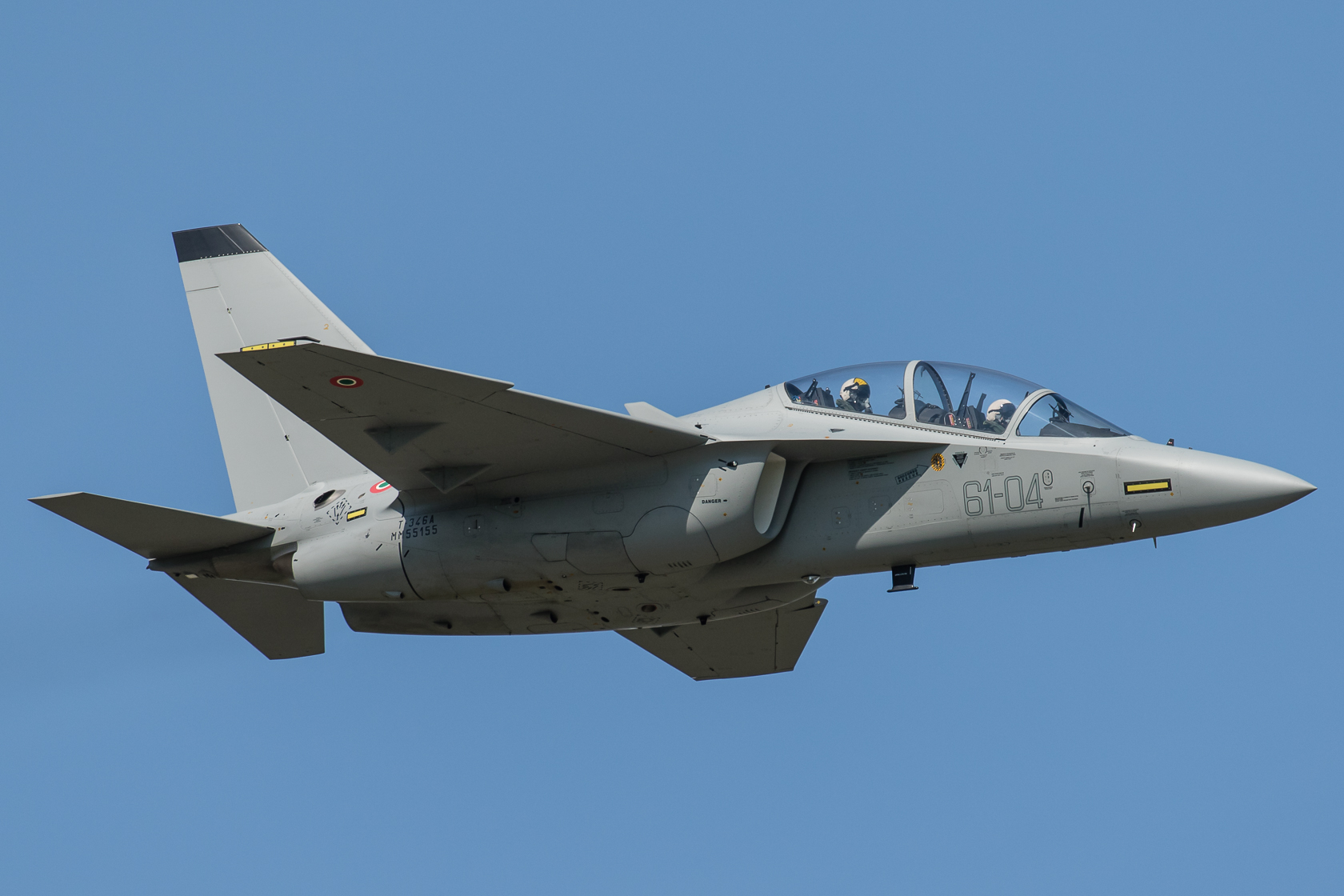
Leonardo M-346 Master Specifications: Speed, Range, Engines and Armament
Leonardo M-346 Master Variants and Versions Compared
The standard advanced trainer with embedded tactical training simulation, used to prepare pilots for modern fighters.
A fighter-trainer version with an optional radar for lead-in fighter training.
The light attack version with the Grifo-346 radar and about 3,000 kg of weapons, marketed as the Fighting Master.
Which Countries Use the Leonardo M-346 Master? Operators and Users
Italy Israel
 Singapore
 Poland
 Greece
Leonardo M-346 Master FAQ: Price, Range, Operators and Most Asked Questions
How much does the M-346 cost?
The Leonardo M-346 costs roughly US$20–40 million per aircraft depending on configuration. Israel’s 30-aircraft deal was valued at about US$1 billion including training packages, according to reports, so package prices run higher than flyaway cost.
How fast is the M-346 Master?
The M-346 Master reaches a top speed of about Mach 1.15, which makes it transonic or lightly supersonic. It has a ferry range of about 2,722 km and a service ceiling of around 13,700 m, powered by two F124 turbofans.
Which countries use the M-346?
The M-346 is operated by Italy, Israel, Singapore, Poland and Greece. Israel flies 30 for its flight academy, Singapore 12 from France, Poland about 16, Greece 10, while other reported customers remain unverified.
M-346 vs T-50: which is better?
The M-346 is a twin-engine trainer with a slightly lower top speed, while the T-50 is a single-engine design reaching about Mach 1.5. The T-50 family is a more established light fighter, but the M-346 is praised as a trainer.
Does Israel use the M-346?
Israel does use the M-346, which the Israeli Air Force calls Lavi, with 30 aircraft ordered in 2012 for its flight academy. They are used for pilot training only and there is no known combat use.
Is the M-346 related to the Yak-130?
The M-346 and Yak-130 share a common origin, as Aermacchi and Yakovlev developed the design together in the late 1990s before splitting in 2000. The M-346 then evolved with Western avionics and engines, while the Yak-130 stayed subsonic.