

Utility Helicopter
Kamov Ka-226
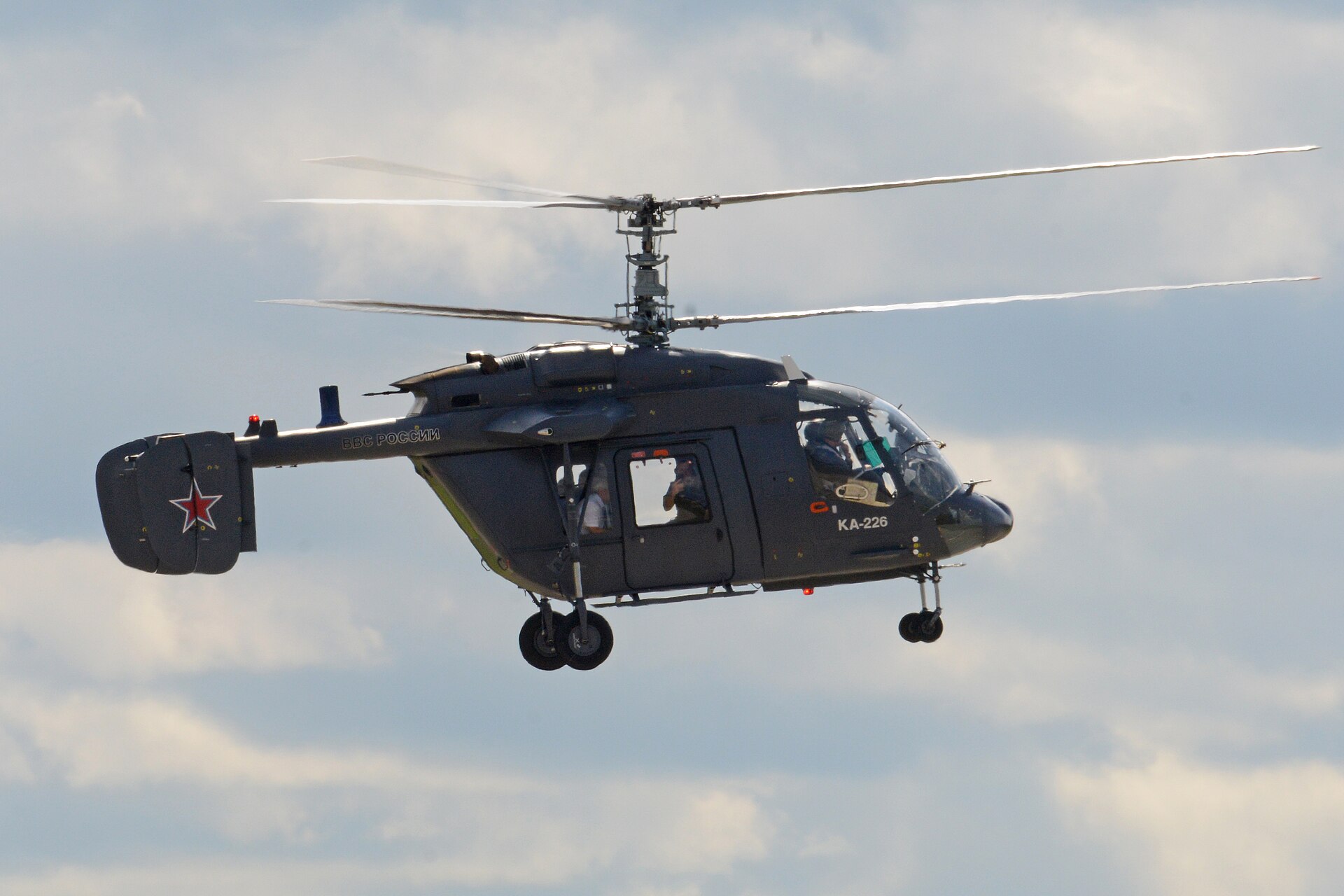
The Kamov Ka-226 is a Russian coaxial-rotor light utility helicopter made by Kamov, part of Russian Helicopters, and certified in 2003. A development of the Ka-26, it has a removable cargo or passenger pod and is built at Kumertau.
 Russia|Kamov / Russian Helicopters
Overview
The Ka-226 grew out of the Ka-26 and first flew on 4 September 1997, with certification following in 2003. Its coaxial rotors need no tail rotor, and the cabin pod can be detached so the helicopter carries external loads, or up to six passengers or one tonne of payload. Early models used Rolls-Royce 250-C20R engines, and the Ka-226T has Turbomeca Arrius 2G1 engines for high-altitude work. Maximum speed is about 210 km/h and range about 600 km, rising to roughly 1,000 km with auxiliary fuel.
Production is at the Kumertau Aviation Production Enterprise in Bashkortostan. Russian users include police, rescue services, state companies and a limited number with the Ministry of Defence. India selected the Ka-226T in 2015 for 200 helicopters, 60 delivered and 140 to be built by HAL, but the programme stalled amid sanctions and engine questions. Western engine supply has been limited since 2022, so Russia is introducing PD-1V engines. There are no verified military export operators; earlier contracts suggested about 3–4 million USD each.
Key Specifications
Variants
The Ka-226 is the base light utility model with a modular passenger or cargo pod.
The Ka-226T uses Turbomeca Arrius 2G1 engines for high-altitude performance and is the version selected by India.
The Ka-226.50 is a Russian-engined development aimed at import substitution.
Operators
RussiaFrequently Asked Questions
How much does a Ka-226 cost?
A Kamov Ka-226 cost about 3–4 million USD per aircraft in earlier quoted contracts (hedged). Final prices depend on the configuration and engine fit. The price depends on the configuration, the engines fitted and the buyer.
How fast is the Ka-226?
The Kamov Ka-226 has a maximum speed of about 210 km/h and a cruise speed near 190 km/h. Its range is around 600 km, up to roughly 1,000 km with auxiliary fuel.
Which countries use the Ka-226?
The Kamov Ka-226 is operated mainly in Russia by police, rescue services, state companies and a limited number of military units. No verified military export operators exist outside Russia, and India’s planned purchase is stalled.
What happened to the Ka-226 deal with India?
The Ka-226T was selected by India in 2015 under an agreement for 200 helicopters, 60 delivered and 140 built by HAL. The programme has stalled over sanctions and engine questions, and no definitive deliveries have been confirmed.
Ka-226 vs Ansat: which is better?
The Kamov Ka-226 uses coaxial rotors and a removable pod, while the Kazan Ansat has a conventional main and tail rotor layout. Both are Russian light helicopters, and the choice depends on whether cargo flexibility or conventional handling matters more.
Why does the Ka-226 have no tail rotor?
The Kamov Ka-226 has two coaxial counter-rotating main rotors that cancel each other’s torque, so no tail rotor is needed. This also makes the helicopter compact for confined landing sites.