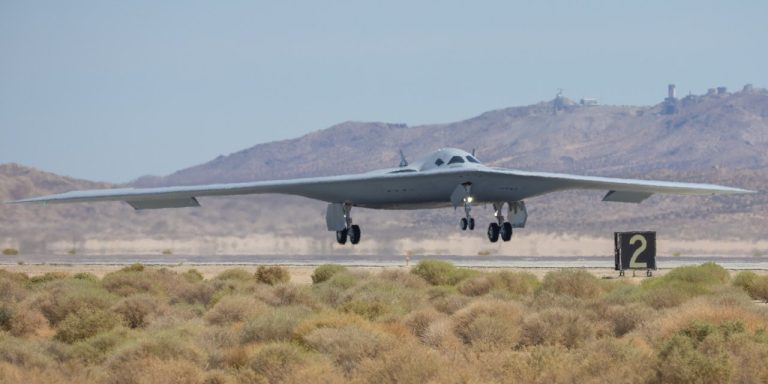
Stealth Bomber
Rockwell B-1B Lancer
The B-1B Lancer is a four-engine supersonic variable-sweep-wing strategic bomber made by Rockwell (now Boeing) in the United States, in service since 1986. Nicknamed the Bone, it carries the largest conventional payload in the USAF inventory.
 United States|Rockwell International (now Boeing)
What Is the Rockwell B-1B Lancer? Overview, History and Development
The B-1A first flew on 23 December 1974 and was cancelled by President Carter in 1977. Reagan revived it as the B-1B, which flew on 18 October 1984 and entered service on 1 October 1986 at Dyess Air Force Base. Four F101-GE-102 engines of about 137 kN each push it to about Mach 1.25, with wings that sweep from 15 to 67.5 degrees. It carries up to about 34,000 kg internally, including JDAM, JASSM-ER and LRASM missiles. After START it was converted to a conventional-only role.
A total of 100 B-1Bs were built, plus four B-1A prototypes. About 45 are in USAF service as of 2025, at Dyess and Ellsworth air force bases, after 17 were retired in 2021. The B-21 Raider is to replace it, with the type withdrawn in the 2030s, around 2038 according to some sources. Combat use includes Desert Fox in 1998, Kosovo, Afghanistan, Iraq, Libya and the April 2018 Syria strikes. The B-1B was never exported, and Russia’s Tu-160 is its closest equivalent.

Rockwell B-1B Lancer Specifications: Speed, Range, Engines and Armament
Rockwell B-1B Lancer Variants and Versions Compared
The original 1970s prototype bomber, cancelled in 1977.
The production bomber with reduced radar signature, updated avionics and a conventional-only role.
The conventional-upgrade standard with improved weapons integration and networking.
Which Countries Use the Rockwell B-1B Lancer? Operators and Users
United StatesRockwell B-1B Lancer FAQ: Price, Range, Operators and Most Asked Questions
How much does a B-1B cost?
A B-1B cost roughly 283 million US dollars per aircraft in 1998 dollars, according to the USAF fact sheet, though programme figures differ by definition. The 100 aircraft cost about 2.2 billion dollars in 1982 dollars.
How fast is the B-1B Lancer?
The B-1B Lancer has a top speed of about Mach 1.25, or roughly 1,325 km/h, at altitude. Low-level penetration speed is about Mach 0.92.
How many B-1Bs does the US have?
The US Air Force has about 45 B-1Bs in service as of 2025. It built 100 in total, and 17 were retired in 2021.
B-1B vs Tu-160: which is better?
The B-1B and the Tu-160 are the closest equivalents as swing-wing supersonic bombers, but the Tu-160 is larger and faster at about Mach 2. The B-1B is conventional-only and has a much longer service record with the USAF.
Is the B-1B stealth?
The B-1B Lancer is not a stealth aircraft. It has a radar cross-section roughly one-hundredth of a B-52’s, but it is not stealthy like the B-2 or B-21.
Is the B-1B being retired?
The B-1B Lancer is being replaced by the B-21 Raider, with the type to be withdrawn in the 2030s, around 2038 according to some sources. The USAF still operates about 45 of them.