
F-35A vs F-35B vs F-35C: What Is the Difference?
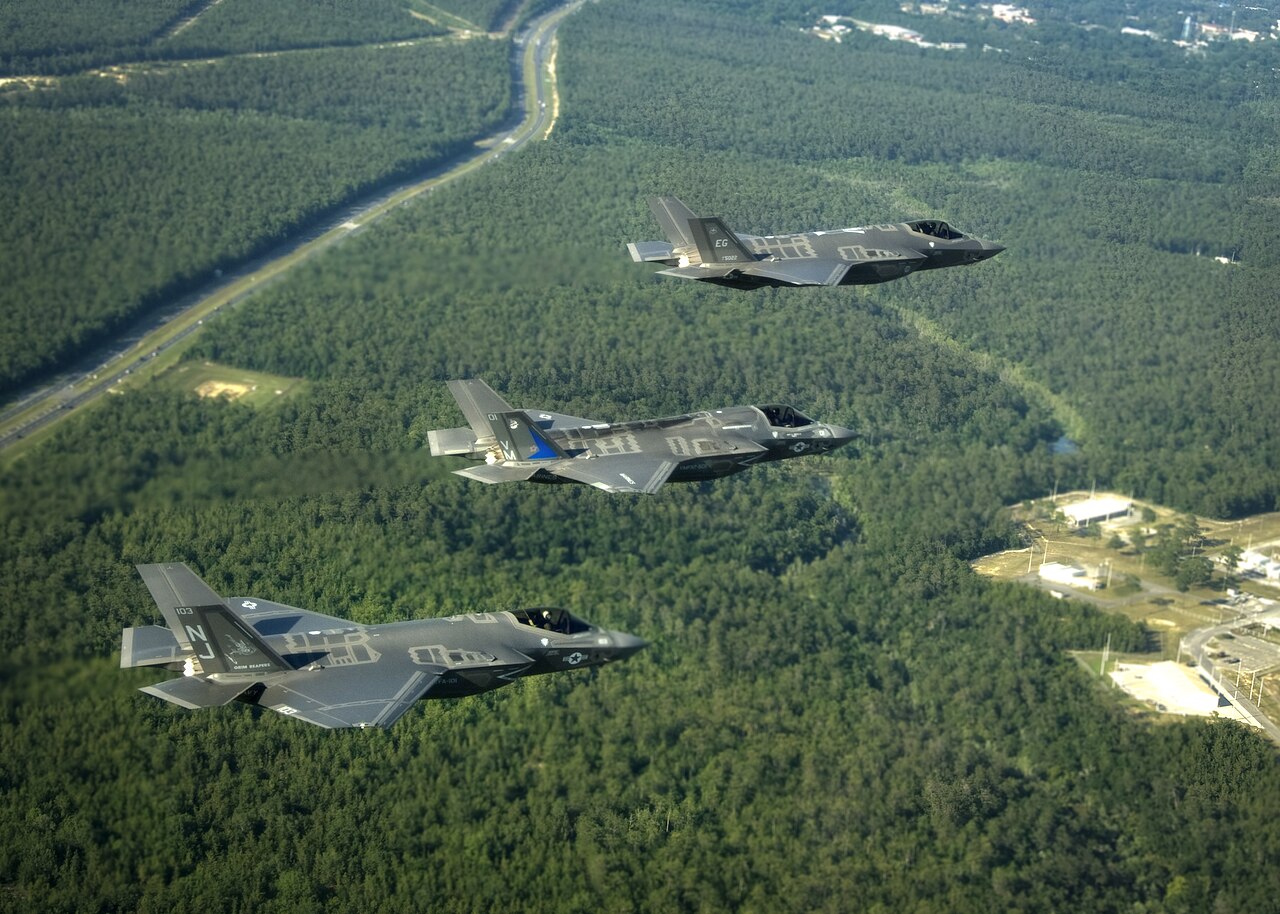
The F-35A takes off from ordinary runways, the F-35B can take off in a short distance and land vertically, and the F-35C is built for catapult launches and arrested landings on aircraft carriers. Everything else that separates them, from fuel load to price, follows from that one difference.
All three share the same radar, sensors, software and basic engine, and look alike at a glance. Under the skin they have drifted apart: the programme office has said only 20 to 25% of parts are common, far below the original goal. This F-35A vs F-35B vs F-35C comparison sets out what each variant gives up and gains.
F-35A vs F-35B vs F-35C at a glance
| Feature | F-35A | F-35B | F-35C |
|---|---|---|---|
| Takeoff and landing | Conventional runway | Short takeoff, vertical landing | Catapult launch, arrested landing |
| Length | 51.4 ft (15.7 m) | 51.2 ft (15.6 m) | 51.5 ft (15.7 m) |
| Wingspan | 35 ft (10.7 m) | 35 ft (10.7 m) | 43 ft (13.1 m), folding |
| Wing area | 460 sq ft | 460 sq ft | 668 sq ft |
| Empty weight | 29,300 lb | 32,472 lb | 34,581 lb |
| Internal fuel | 18,250 lb | 13,500 lb | 19,750 lb |
| Combat radius | 669 nm | 505 nm | 670 nm |
| Load limit | 9 g | 7 g | 7.5 g |
| Weapons load | 18,000 lb | 15,000 lb | 18,000 lb |
| Gun | Internal 25 mm | External pod | External pod |
| Aerial refuelling | Boom | Probe and drogue | Probe and drogue |
| Flyaway cost, Lots 18-19 | $92.0M | $121.4M | $110.8M |
| Entered service | August 2016 | July 2015 | February 2019 |
F-35A: the air force version
The F-35A is the baseline and by far the most numerous. It is the lightest of the three, the only one rated to 9 g and the only one with a gun inside the airframe. It refuels from a boom, the system the US Air Force uses.
It is also the cheapest, which is why almost every export customer buys it. The US Air Force plans 1,763, and the A is the only variant certified to carry the B61-12 nuclear bomb. Cost details are in our guide to how much an F-35 costs.
F-35B: short takeoff and vertical landing
The F-35B replaces the Harrier. A lift fan behind the cockpit, driven by a shaft from the engine, and a tail nozzle that swivels downward let it take off in a few hundred feet and land vertically. That allows it to fly from amphibious assault ships, small carriers without catapults and short stretches of road.
The lift system takes the space where the A carries fuel and makes the jet heavier. The result is about a quarter less fuel, a shorter radius, smaller weapons bays limited to 1,000 lb class bombs and a 7 g limit. It is the most complex and the most expensive variant. The US Marine Corps, the United Kingdom, Italy and Japan fly it, and Singapore has ordered it.
F-35C: the carrier version
The F-35C is built for the US Navy’s large carriers. Its wing is 45% larger than the A’s, which lowers the approach speed for carrier landings and makes room for more fuel. The wingtips fold to save deck space. It has a stronger structure, a twin-wheel nose gear with a catapult launch bar and a heavier arresting hook.
The bigger wing gives the C the most fuel and the longest reach of the three, but also the highest empty weight and slower acceleration. Only the US Navy and Marine Corps operate it.
What do all three share?
The mission systems are the same: the APG-81 radar, the infrared camera system, the electro-optical targeting system, the electronic warfare suite and the helmet. So is the software, which means a pilot sees the same displays in any variant. All three reach Mach 1.6, as covered in how fast the F-35 is.
The engine is the F135 in each case, with a different version for the B to drive the lift fan. Stealth shaping and coatings are common. The weapons differ mainly in what fits the smaller bays of the B, which we list in F-35 weapons.
Which F-35 variant is best?
It depends on where the aircraft has to operate from. For an air force with long runways the A is the obvious choice: cheapest, most agile and with good range. The B is for navies and marine forces without catapult carriers, or for countries that expect their runways to be attacked. The C is for a navy with catapults, which today means the United States.
Several countries buy two. Italy and Japan operate both the A and the B, and Britain decided in 2025 to add 12 F-35As to its F-35B fleet, in part for NATO’s nuclear mission. Range differences are explained in how long an F-35 can stay in the air, and the aircraft itself in what the F-35 is.
Frequently asked questions
What is the difference between the F-35A, B and C?
The A uses conventional runways, the B takes off in a short distance and lands vertically, and the C operates from aircraft carriers with catapults and arresting wires.
Which F-35 variant can land vertically?
Only the F-35B.
Which F-35 has the longest range?
The F-35C carries the most fuel. Its combat radius of about 670 nm is roughly equal to the F-35A’s and well ahead of the F-35B’s 505 nm.
Which F-35 is the most expensive?
The F-35B, at about $121.4 million in Lots 18 and 19.
Do all F-35 variants have a gun?
Only the F-35A has an internal gun. The B and C can carry the same 25 mm cannon in an external pod.
Which variant do most countries buy?
The F-35A. It is the cheapest and suits air forces that operate from normal runways.
- Lockheed Martin – F-35 Lightning II programme site: f35.com
- Air & Space Forces Magazine – What an F-35 costs right now (3 September 2026): airandspaceforces.com
- Wikipedia – Lockheed Martin F-35 Lightning II: en.wikipedia.org
- Wikipedia – Lockheed Martin F-35 Lightning II operators: en.wikipedia.org