

Attack Aircraft
Su-25
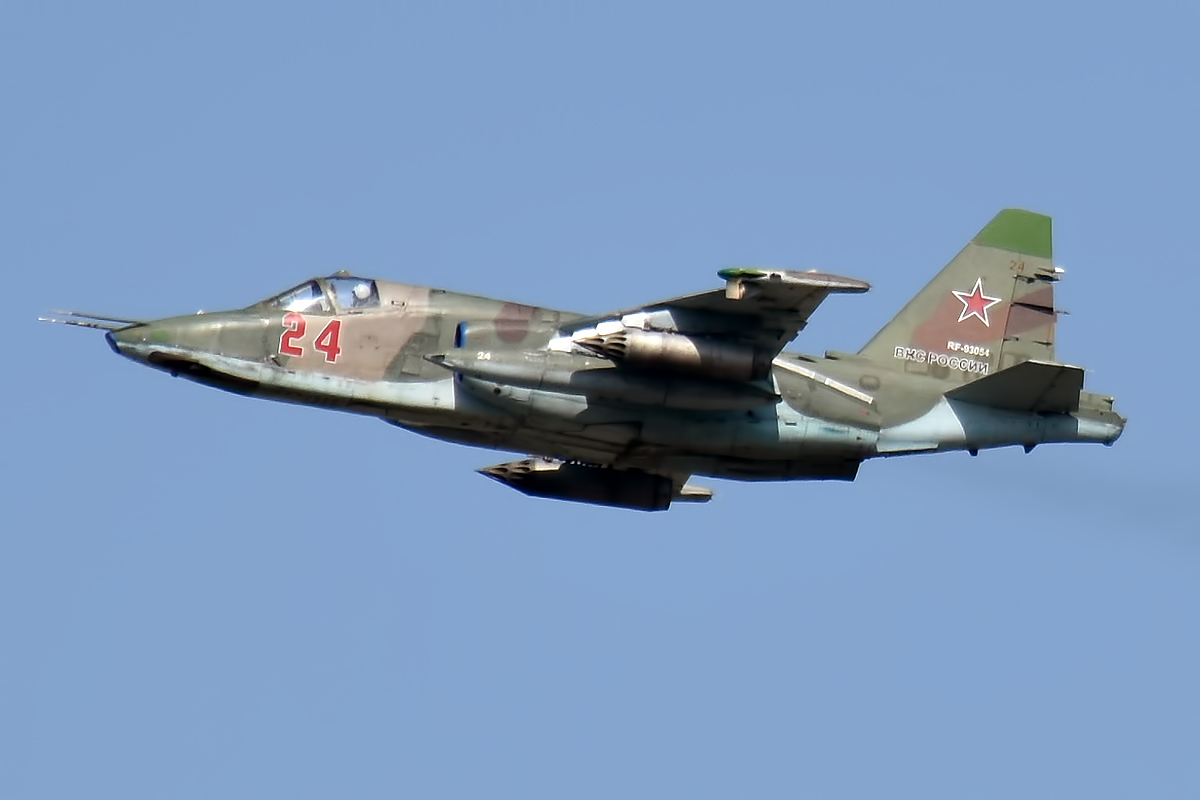
The Su-25, known to NATO as the Frogfoot and in Russia as Grach (Rook), is a single-seat, twin-engine close air support jet designed by Sukhoi. More than 1,000 were built, and it has seen combat from Afghanistan in the 1980s to the Russia–Ukraine war.
 Russia|Sukhoi
Overview
The Su-25 first flew on 22 February 1975 and entered service on 19 July 1981. More than 1,000 were built up to 2017, mostly at Tbilisi and Ulan-Ude. It was designed to survive ground fire, with a titanium armoured cockpit, redundant controls and rugged systems that can work from rough forward airstrips. A built-in GSh-30-2 30 mm cannon is backed by 11 hardpoints for up to 4,400 kg of rockets, bombs and Kh-25/Kh-29 missiles. Top speed is about 975 km/h at sea level.
Russia flies the largest fleet, estimated at around 183 aircraft, and has modernised many to Su-25SM/SM3 standard with new avionics and the Vitebsk-25 self-protection suite. About 20 countries operate it, including Belarus, North Korea, Iraq, Sudan and Ukraine. Both sides have used it heavily in Ukraine, where many were lost to air defences and MANPADS and Russian pilots often loft unguided rockets from long range. Earlier combat includes Afghanistan, Chechnya, Georgia, Syria and Iraq’s fight against ISIS.
Key Specifications
Variants
Export version of the single-seat attack jet, supplied to Warsaw Pact and other foreign customers.
Two-seat combat trainer built at Ulan-Ude that keeps most of the single-seater’s attack capability.
Latest Russian modernisation, with updated avionics and the Vitebsk-25 self-protection suite.
Operators
Russia Armenia
 Azerbaijan
 Belarus
 Bulgaria
 Chad
 Congo – Kinshasa
 Equatorial Guinea
 Ethiopia
 Georgia
 Iraq
 Kazakhstan
 Mali
 Niger
 North Korea
 Peru
 Sudan
 Turkmenistan
 Ukraine
 Uzbekistan
Frequently Asked Questions
Su-25 vs A-10: which is better?
Neither is simply better; they tackle the same close-support job in different ways. The A-10 is larger, with a heavier gun and payload, while the Su-25 is faster, lighter and designed to fly from rough forward airstrips.
How many Su-25 does Russia have?
Russia is estimated to have about 183 Su-25s in 2026, which makes it the largest operator, although no official figure exists. Losses in Ukraine have reduced the fleet, and many remaining aircraft have been upgraded to Su-25SM/SM3 standard.
How fast is the Su-25?
The Su-25 has a top speed of about 975 km/h at sea level. It is subsonic by design, trading speed for armour, low-level agility and the ability to carry up to 4,400 kg of weapons on 11 hardpoints.
Which countries use the Su-25?
About 20 countries use the Su-25, including Russia, Belarus, Ukraine, Kazakhstan, Armenia, Azerbaijan, Georgia, Iraq, Sudan, North Korea, Peru and African states such as Chad, Ethiopia and Mali. Iran’s IRGC has also received a small number.
Is the Su-25 armored?
Yes. The Su-25 pilot sits in a welded titanium armoured ‘bathtub’, and the aircraft has redundant flight controls and simple, rugged systems meant to keep it flying after hits from small arms and shell fragments.
Did Türkiye shoot down an Armenian Su-25?
Türkiye denied it. Armenia claimed that a Turkish F-16 shot down an Armenian Su-25 on 29 September 2020 during the Karabakh war, but the allegation has never been independently verified. Azerbaijan also lost Su-25s in that conflict.