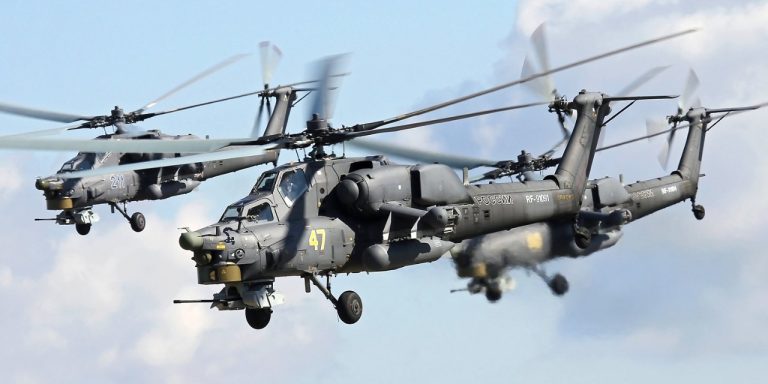
Attack Helicopter
Mi-24 / Mi-35 Hind
The Mi-24, exported as the Mi-35 and known to NATO as ‘Hind’, is a Soviet-designed attack helicopter that can also carry up to eight troops. In service since 1972, it is one of the most widely produced and most combat-tested attack helicopters in the world.
 Russia|Mil / Rostvertol & Arsenyev Progress
Overview
The Mi-24 first flew on 19 September 1969 and entered Soviet service in 1972. From the Mi-24D onwards it has a stepped tandem ‘double-bubble’ cockpit, stub wings with six weapon stations and a rear cabin for eight soldiers. Two TV3-117 engines give a top speed of about 320–335 km/h, and a modified Mi-24 set helicopter speed records in the 1970s. Versions mount a 12.7 mm, 23 mm or 30 mm gun alongside Shturm or Ataka missiles.
More than 2,600 have been built, and the modernised Mi-35M, with the Mi-28’s rotor system and fixed landing gear, has remained in production mainly for export. The Hind fought in Afghanistan, the Iran–Iraq War, Chechnya, Africa, Syria and Nagorno-Karabakh, and both sides use it in the Russia–Ukraine war. Several NATO members passed their fleets to Ukraine after 2022. In Russian service it is gradually giving way to the Mi-28 and Ka-52.

Key Specifications
Variants
The main Soviet-era production version with a chin turret carrying a 12.7 mm YakB-12.7 machine gun, exported as the Mi-35.
A version armed with a fixed twin-barrel 30 mm GSh-30K cannon in place of the turret, exported as the Mi-35P.
A modernised export model with the Mi-28 rotor system, fixed landing gear and a 23 mm GSh-23L turret.
Operators
Russia Algeria
 Armenia
 Azerbaijan
 Belarus
 Bulgaria
 Chad
 Cuba
 Ethiopia
 Indonesia
 Iraq
 Kazakhstan
 Kyrgyzstan
 Mali
 Nigeria
 Peru
 Poland
 Serbia
 Sudan
 Tajikistan
 Turkmenistan
 Uganda
 Ukraine
 Uzbekistan
 Venezuela
 Vietnam
Frequently Asked Questions
How many troops can a Mi-24 carry?
The Mi-24 can carry up to eight troops in its rear cabin. That makes it unusual among attack helicopters, since Western types such as the AH-64 Apache and AH-1 Cobra have no passenger compartment.
How fast is the Mi-24?
The Mi-24 has a maximum speed of about 320–335 km/h and a range of roughly 450 km. A specially modified Mi-24, designated A-10, set several helicopter speed records between 1975 and 1978.
Which countries use the Mi-24?
More than 25 countries fly the Mi-24 or Mi-35, including Russia, Algeria, Armenia, Azerbaijan, Iraq, Indonesia, Nigeria, Poland, Serbia, Ukraine, Venezuela and Vietnam. Several NATO members have retired theirs and transferred many to Ukraine.
Mi-24 vs Apache: which is better?
The AH-64 Apache is the more capable dedicated tank hunter, with better sensors and precision weapons. The Mi-24 is a larger, heavily armed design that can also carry eight troops, but its basic layout dates back to the late 1960s.
What is the difference between Mi-24 and Mi-35?
Mi-35 is the export designation for the Mi-24. Earlier Mi-35s match Soviet Mi-24 variants, while the newer Mi-35M is a modernised model with the Mi-28’s rotor system, fixed landing gear and updated avionics.
How much does a Mi-24 cost?
There is no official price for the Mi-24, and most of the world’s fleet consists of decades-old airframes. The cost of new Mi-35M helicopters depends on each export contract’s weapons, training and support, so published figures are only estimates.