Angola Receives Six HT-100 Naval Drone Helicopters From UAE
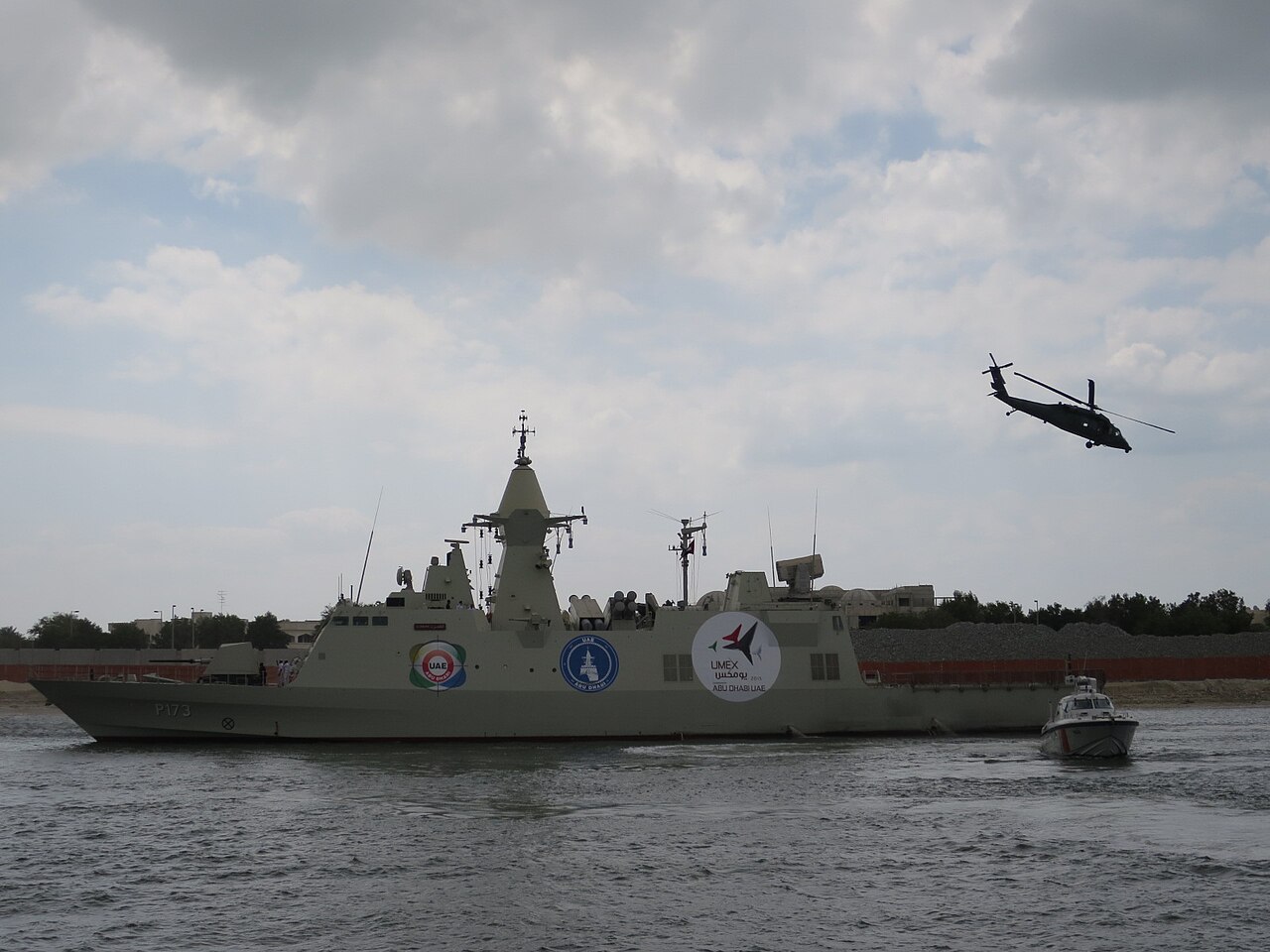
Angola’s navy has taken delivery of six ANAVIA HT-100 Naval unmanned helicopters from the United Arab Emirates’ EDGE Group, giving the West African state a shipborne surveillance capability that few of its regional neighbours can match.
The delivery, announced on 14 September, covers six rotary-wing systems that will be distributed two per ship across three Baynunah-class corvettes Angola has on order. The aircraft completed acceptance testing at ANAVIA’s facility in Bilten, Switzerland, before handover.
“This milestone demonstrates our ability to deliver a complete, fully autonomous system for shipborne operations,” said Ishan Sahgal, ANAVIA’s founder and co-chief executive.
An Unusual Aircraft
The HT-100 is not a conventional helicopter drone. It uses a Flettner-type intermeshing twin-rotor configuration — two rotors angled outward and geared to pass between each other — which eliminates the tail rotor entirely. The arrangement is rare in modern aviation but has a specific virtue at sea: a shorter overall footprint and no tail rotor to strike a hangar door or superstructure in a rolling deck.
The aircraft is three metres long with a four-metre rotor diameter, a maximum take-off weight of 120 kilograms and a payload capacity of 60 kilograms — half its own weight, an unusually high fraction. A shaft turbine burning jet fuel gives it six hours of endurance on up to 60 litres, a top speed of 65 knots and a service ceiling of 4,000 metres.
Running on jet fuel rather than avgas or batteries matters operationally. It means the drone draws from the same fuel stock as the ship’s own helicopter and gas turbines, removing a separate logistics chain from an already small corvette.
The airframe is corrosion-resistant carbon composite, rated for launch and recovery up to sea state 3 — waves of roughly half a metre to 1.25 metres. Sensors include electro-optical and infrared cameras plus FPV cameras, and the system is designed to keep flying in GNSS-denied conditions, a capability that has moved from niche to mandatory across the drone market over the past three years.
The Corvettes Behind the Drones
The HT-100s are one element of a much larger package. Angola contracted in 2023 for three Baynunah-class corvettes in a deal worth roughly €1 billion ($1.1 billion), one of the largest naval orders ever placed by a sub-Saharan African state.
The Baynunah class was designed for the UAE Navy — a 70-metre, roughly 900-tonne combatant carrying anti-ship missiles, a point-defence missile system, a 76mm gun and a flight deck. For Angola it represents a step change. The Angolan navy has operated largely patrol craft and ageing Soviet-era vessels, with limited ability to sustain presence beyond coastal waters.
Pairing each corvette with two unmanned helicopters multiplies what those hulls can see. A ship’s radar horizon against a small surface contact is a matter of kilometres; an aircraft at altitude extends that by an order of magnitude, and two airframes allow one to be airborne while the other is serviced.
What Angola Is Watching
Angola’s maritime problem is economic before it is military. The country’s offshore oil fields account for the overwhelming majority of export revenue, and the platforms, pipelines and tanker traffic that serve them sit in an exclusive economic zone of roughly 500,000 square kilometres.
The Gulf of Guinea to the north has for years been among the world’s worst regions for piracy and crew kidnapping, and while reported incidents have fallen from their 2020 peak, the underlying capacity has not gone away. Illegal, unreported and unregulated fishing is a more constant drain, with foreign trawlers operating in West African waters at a scale regional navies have struggled to police.
None of that requires a warship to shoot at anything. It requires knowing what is in the water. That is the specific gap an endurance-optimised shipborne drone fills.
EDGE Pushes Into Africa
For EDGE Group, the delivery extends a pattern. The Abu Dhabi state-owned conglomerate has spent the past five years consolidating Emirati defence firms and buying stakes abroad — ANAVIA among them — and has been unusually aggressive in marketing to African and Asian customers that Western suppliers have been slow to court or unwilling to arm.
The commercial proposition is straightforward: complete packages, fewer political conditions, and faster delivery than the multi-year queues that now characterise European and American order books. It is the same opening Turkish manufacturers exploited across Africa with armed drones, and EDGE has been studying that playbook closely.
Angola, for its part, has diversified deliberately. Luanda’s traditional supplier was Russia, and the collapse of Russian export capacity after 2022 forced a search for alternatives. The Emirati route offers modern equipment without the political entanglements of a Western package — and without waiting behind NATO members in line.
Sources
- The Defense Post, “Angola Takes Delivery of HT-100 Naval Helicopter Drones From UAE,” 14 September 2026
- EDGE Group and ANAVIA statements, including remarks by ANAVIA founder and co-CEO Ishan Sahgal
- ANAVIA HT-100 Naval technical specifications, manufacturer data
- Angola–EDGE Group Baynunah-class corvette contract announcement, 2023
- International Maritime Bureau piracy reporting, Gulf of Guinea