China’s GJ-11 Stealth Drone Reveals Weapons Bay in New PLA Air Force Footage
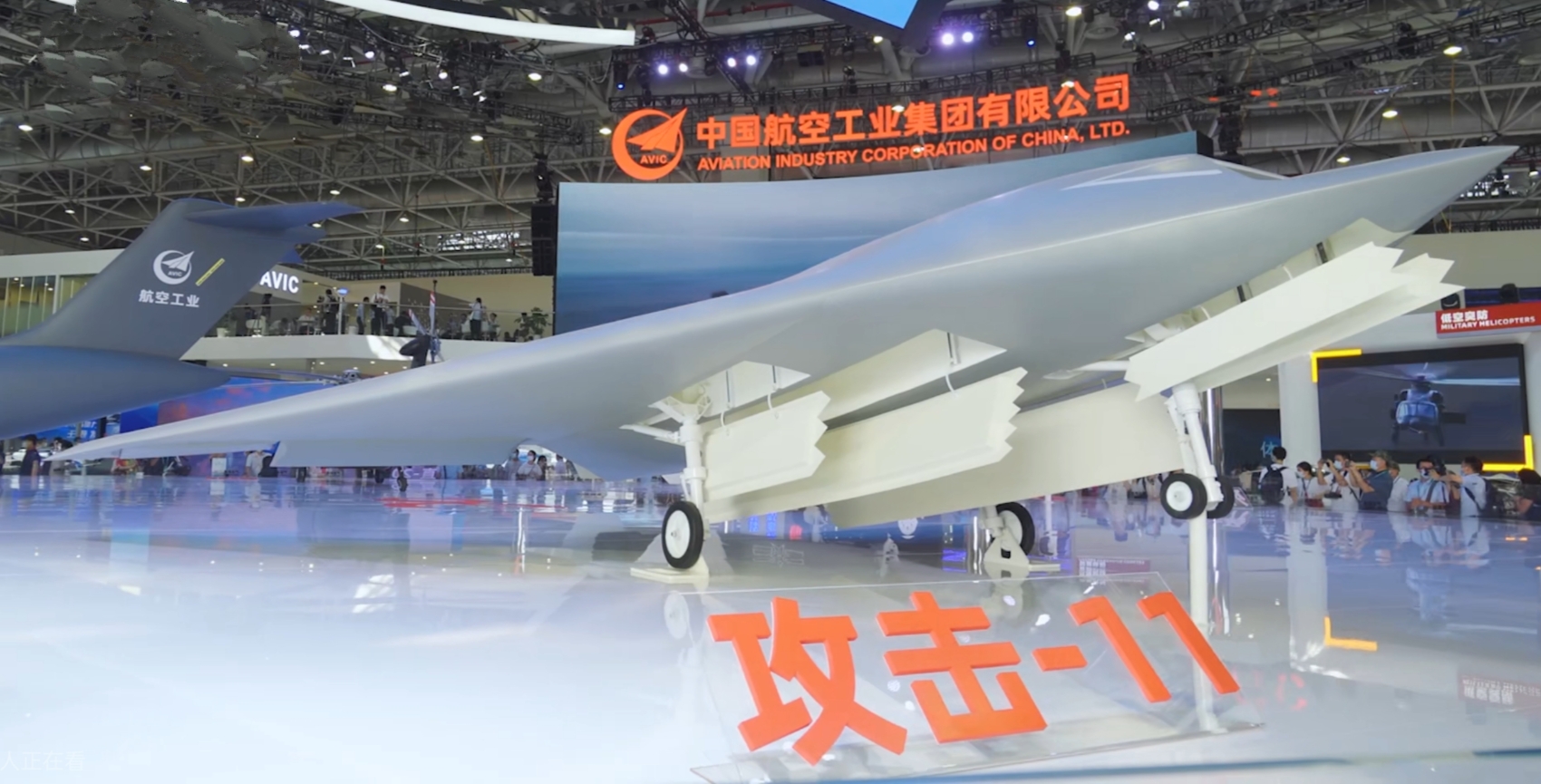
China’s air force has released its clearest look yet at the internal weapons bays of the GJ-11 stealth attack drone, publishing new footage two days ahead of the People’s Liberation Army Air Force’s (PLAAF) 77th anniversary on November 11. State broadcaster CCTV paired the release with a claim that the flying-wing unmanned combat air vehicle (UCAV) has flown its first live-fire strike mission, though it disclosed no date, location, target or weapon used. The footage is the most detailed public material yet on a program China has spent more than a decade keeping largely out of view.
What Happened
On November 9, 2026, the PLAAF released roughly 20 seconds of new footage of the GJ-11, which Chinese state media refer to by the official designation Xuanlong, rendered in English as “Mysterious Dragon.” CCTV’s coverage, tied to the PLAAF’s founding anniversary, showed the aircraft from angles that had not previously been made public, according to specialist outlet The Aviationist, which reviewed the clip frame by frame.
The new shots reveal two internal weapons bays on the underside of the fuselage, positioned between the GJ-11’s main landing gear, each covered by its own set of doors. In one hangar shot, a bay door is seen partly open, its serrated edge visible — a stealth-shaping detail intended to scatter radar returns rather than reflect them back to a receiver. Other frames show the landing gear retracting after takeoff and a trapezoidal fairing under the nose that analysts assess as housing an electro-optical/infrared sensor, though its exact function has not been confirmed. Foreign object debris covers visible in earlier 2025 footage are absent from the new shots.
CGTN, the PLAAF’s officially sanctioned outlet for the release, described the aircraft as a tailless flying-wing stealth UCAV “developed independently by China,” built for strike missions and suppression of enemy air defenses, with internal bays sized for “several types of precision air-to-surface munitions.” Song Zhongping, a military commentator cited by Global Times, said the airframe uses radar-absorbent coatings and that its exhaust has received additional stealth treatment, without giving further technical detail.
The Product/System
The GJ-11 traces back to a technology demonstrator that first flew in 2013 in a markedly less stealthy configuration, built under the earlier unofficial name “Sharp Sword.” A redesigned, more stealth-optimized airframe appeared as a mockup at China’s 2019 National Day parade, with a reshaped rear fuselage and a shielded exhaust. Its internal weapons bays were first shown publicly as a static display model at Airshow China in Zhuhai in 2021, where Aviation Industry Corporation of China (AVIC) exhibited the aircraft with its bay doors open.
Open-source and specialist reporting attributes manufacture of the GJ-11 to Hongdu Aviation Industry Group, an AVIC subsidiary, with design input credited to the Shenyang Aircraft Design Institute; the PLAAF itself has not named a manufacturer in its public releases. The airframe is a tailless flying wing with dorsal, shielded air intakes and no exposed exhaust nozzle — a configuration optimized to reduce radar cross-section from multiple aspects rather than to maximize speed or payload.
Satellite imagery reviewed by Western analysts placed at least three GJ-11 airframes at Shigatse Air Base in Tibet between August and September 2025, which independent observers read as evidence of operational testing rather than confirmed combat service. In November 2025 the PLAAF released footage showing a GJ-11 flying in formation with a J-20 stealth fighter and a J-16D electronic-warfare aircraft — the first public indication of the manned-unmanned teaming role China envisions for the drone, with the two-seat J-20S variant widely assessed as a candidate controller platform.
Who Uses It
The PLAAF is the only confirmed operator. State media reported in November 2025 that the GJ-11 had formally entered service, though independent verification of squadron-level deployment remains limited to the satellite and video evidence described above. A related navalized derivative, unofficially tracked by analysts under designations including GJ-11H and GJ-21, has been associated with China’s growing fleet of large-deck amphibious assault ships; Chinese state media said a GJ-21 flew from the Type 076 amphibious assault ship Sichuan in reporting published this month, distinct from the land-based GJ-11 footage released on November 9. There is no evidence to date of a carrier-qualified, combat-ready naval squadron.
Export/Procurement History
Unlike China’s Wing Loong and CH-series armed drones, which Chinese manufacturers actively market and have exported to operators across Africa, the Middle East and Asia, the GJ-11 has not been offered for export and no foreign customer has been reported. The program appears to remain, for now, dedicated exclusively to PLA requirements, consistent with its classification as a higher-end stealth strike asset rather than an export-oriented attritable system.
Global Competitors
The GJ-11 is most often compared to Russia’s Sukhoi S-70 Okhotnik-B, a similarly sized flying-wing stealth UCAV intended to operate alongside the Su-57, and to the retired Northrop Grumman X-47B carrier demonstrator that the United States flew more than a decade ago but did not take into production. It is frequently described as broadly analogous in role to the U.S. Air Force’s Collaborative Combat Aircraft (CCA) program, whose first increment — General Atomics’ YFQ-42A and Anduril’s YFQ-44A — is explicitly designed around low per-unit cost and attrition tolerance. Analysts note the GJ-11’s design emphasis on stealth shaping and internal carriage points to a more expensive, survivability-focused aircraft closer in philosophy to Lockheed Martin’s newly disclosed Vectis concept than to the CCA program’s attritable drones. India’s DRDO is pursuing a comparable stealthy UCAV under its Ghatak/SWiFT program, though that effort remains in earlier development stages, and Turkey’s Baykar is advancing its own Kizilelma flying-wing combat drone.
Why It Matters
The weapons-bay footage and the unverified live-fire claim, taken together, are the strongest public signal yet that China intends the GJ-11 for genuine strike missions rather than reconnaissance alone. A stealthy, internally armed UCAV capable of operating alongside crewed fighters would give the PLAAF a tool for suppressing air defenses and striking hardened targets while keeping a human pilot out of the most contested airspace — a capability set the U.S. and Russia are also racing to field, but which neither has yet shown in a comparably mature, internally armed configuration alongside a fifth-generation fighter in public footage.
What Happens Next
None of the core performance claims — munition types carried, strike accuracy, or the specifics of the reported live-fire mission — have been independently verified, and PLAAF releases of this kind are produced for domestic anniversary messaging as much as for technical disclosure. Analysts will be watching for further satellite imagery of basing patterns, any additional footage clarifying whether the airframe shown is a production-standard aircraft or a continuing prototype variant, and whether China discloses details of the naval GJ-21/GJ-11H derivative’s integration with its amphibious assault ship fleet.
FAQ
What is the GJ-11?
The GJ-11, officially designated Xuanlong by the PLAAF, is a tailless, flying-wing stealth unmanned combat air vehicle developed for China’s air force, built to carry precision munitions internally for strike and air-defense-suppression missions.
Is the GJ-11 in active service?
Chinese state media reported in November 2025 that the GJ-11 had entered service, and CCTV’s November 2026 anniversary coverage referenced a first live-fire strike mission. Neither claim has been independently verified in detail.
What weapons does the GJ-11 carry?
The aircraft has two internal weapons bays between its main landing gear. Chinese state media describe them as sized for multiple types of precision-guided, air-to-surface munitions, but specific weapons have not been officially disclosed.
Who manufactures the GJ-11?
Open-source reporting attributes the aircraft to Hongdu Aviation Industry Group, a subsidiary of the state-owned Aviation Industry Corporation of China (AVIC), though the PLAAF’s own releases have not named a manufacturer.
How does the GJ-11 compare to the U.S. CCA program?
The GJ-11 is often described as roughly analogous in role to the U.S. Air Force’s Collaborative Combat Aircraft program, but its stealth-focused, more expensive design philosophy is seen as closer to a survivable penetrating strike platform than to the CCA program’s low-cost, attritable drones.
Sources
- CGTN, “Chinese Air Force releases latest footage of the GJ-11 stealth UAV,” November 9, 2026 — official PLAAF-sanctioned description of the aircraft and its mission set. Link
- The Aviationist, “Our Best Look Yet at China’s GJ-11 UCAV,” November 9, 2026 — detailed frame-by-frame analysis of the new footage, weapons bay and sensor fairing, and the live-fire claim. Link
- Defence Blog, “New footage shows China’s stealth combat drone in active use” — corroborating reporting on the November 2025 service announcement and official Xuanlong designation. Link
- South China Morning Post, “Fresh GJ-11 footage gives glimpse of weapon bay in China’s next-gen drone” — independent confirmation of the weapons-bay imagery. Link
- Wikimedia Commons, “GJ-11 at Airshow China Zhuhai 2021” (Infinty 0, CC BY-SA 4.0) — source of the featured image showing the aircraft’s weapons bay configuration as first publicly displayed. Link