Uzbekistan Unveils FN-X Long-Range Strike Drone at AAD 2026
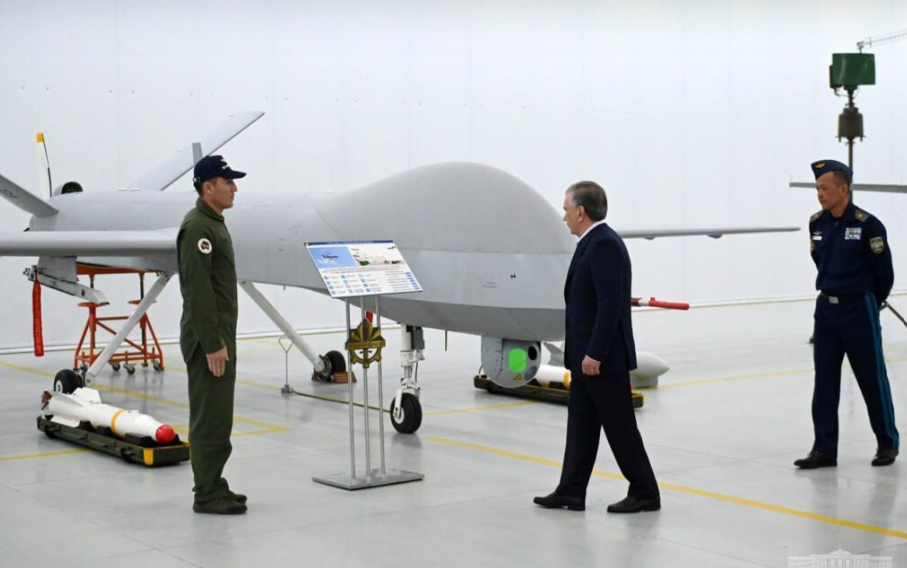
Uzbekistan’s Electronic Autonomous Solutions (EAS) unveiled a new long-range strike drone, the FN-X, at the Africa Aerospace and Defence (AAD) exhibition in South Africa in September, marking the Central Asian country’s first public push into offensive unmanned systems after years of focusing almost entirely on counter-drone technology. The flying-wing aircraft was shown at Uzbekistan’s national pavilion, where it drew visits from the Democratic Republic of the Congo’s chief of the general staff and South African defense officials, according to Uzbek outlet Daryo. No contract, foreign customer, or operational deployment has been confirmed, and the manufacturer’s performance claims have not been independently verified.
What Happened
AAD 2026 ran from September 16 to 20 at Air Force Base Waterkloof in Centurion, near Pretoria. Among the exhibitors was EAS, a private Uzbek firm that had built its reputation almost exclusively on counter-unmanned-aircraft-systems (C-UAS) products. At the show, the company introduced the FN-X, described in Daryo’s English-language report as a long-range strike drone with a flying-wing airframe, an internal combustion engine, and a reported range of up to 1,500 kilometers.
The figure is not consistent across the company’s own disclosures. Daryo’s Russian- and Uzbek-language coverage of the same unveiling cited only “over 1,000 kilometers,” without giving the higher number. Until EAS or Uzbekistan’s Ministry of Defense publishes a technical data sheet or the aircraft completes a publicly documented test flight, the 1,500-kilometer figure should be treated as a manufacturer claim made at a trade show, not a verified specification.
The Product/System
According to Daryo’s reporting, the FN-X is a flying-wing unmanned aircraft powered by a piston engine rather than the jet or electric propulsion used on some rival designs. Reported figures include a cruising speed of around 200 kilometers per hour, an endurance of roughly six hours, a maximum payload of 30 kilograms, and a high-explosive fragmentation warhead. That combination places the FN-X in the same broad category as other long-range, propeller-driven one-way-attack drones fielded elsewhere, such as Iran’s Shahed-136 and Russia’s locally built Geran-2 derivative, though none of the FN-X’s figures have been confirmed by independent flight testing or released in a formal specification sheet.
EAS itself is a young company. Uzbek and regional trade press describe it as founded around 2022–2023 and built its initial business around detection-and-defeat systems rather than strike weapons: the handheld EAS Fowler jammer, reportedly used by Uzbekistan’s presidential guard; the vehicle-mounted AirShield 1MS and boat-mounted AirShield 1N jamming systems; and the EAS Dome, an integrated radar-and-jamming complex that the company has said it plans to equip with interceptor drones from 2027. A company representative described EAS to South African trade outlet DefenceWeb as licensed and accredited by Uzbekistan’s Ministry of Defense, a claim that rests on the company’s own statements rather than a published government record. The FN-X represents the firm’s first publicized move from defensive counter-drone work into an offensive strike platform.
Who Uses It
No operator has been confirmed. Uzbekistan’s armed forces have not announced an order, and no foreign military has been named as a customer or evaluator. The only documented interest so far is diplomatic rather than contractual: Daryo reported that the Congolese Chief of the General Staff and South African defense officials visited the Uzbek pavilion where the FN-X was displayed, which indicates attention from potential buyers but not a transaction.
Export/Procurement History
EAS has an established domestic customer base for its counter-drone line — the company says its detection systems already protect airports, border posts, and other sensitive sites inside Uzbekistan, and training mock-ups of its anti-drone equipment have been handed to a Ground Forces training institute. None of that history extends to the FN-X, which has no known export record, no publicized domestic order, and no price disclosed. Its AAD 2026 debut functioned as an introduction to international buyers rather than the announcement of a completed sale.
Global Competitors
Long-range, propeller-driven one-way-attack drones have become a crowded category since 2022. Iran’s Shahed-136 and its Russian-built derivative, the Geran-2, are produced in the thousands and have reported ranges that, in extended variants, reach well beyond 1,000 kilometers. Ukraine’s Fire Point FP-1 is cited with an effective range near 1,600 kilometers. Regionally, Turkey remains the dominant outside drone supplier across Central Asia — Kazakhstan has a production agreement with Turkish Aerospace for the Anka, and Kyrgyzstan operates Bayraktar TB2s and Aksungur aircraft — while China and Russia continue to offer competing systems. Against that field, the FN-X is a late and unproven entrant, and EAS has not disclosed a unit cost that would let buyers compare it on price.
Why It Matters
The FN-X is a small data point, but it fits a broader pattern of Central Asian states moving from buying drones to building them. Kazakhstan’s Air Assault Forces have stood up in-house FPV drone production, and Uzbekistan’s own State Defense Industry Committee has for several years produced the Lochin and Shahin UAV lines without a confirmed export market. EAS’s pivot from jamming systems to a long-range strike airframe suggests Uzbekistan’s private defense sector, not just its state industry, now sees a market for offensive unmanned systems, following a path that private loitering-munition makers elsewhere — such as Poland’s WB Group, maker of the Warmate — have already taken. Showing the aircraft in South Africa rather than at a Central Asian or Gulf exhibition also signals that EAS is explicitly courting African buyers, a market where Turkish, Chinese and Iranian-origin drones have already found steady demand.
What Happens Next
There is no public timeline for a first flight, a government order, or an export certification process, and Uzbekistan’s Ministry of Defense has not issued its own statement on the FN-X. The next meaningful signal would be an independently verifiable test — video, telemetry, or a government acknowledgment — that confirms or revises the performance figures EAS gave at AAD 2026, or a disclosed order from either Tashkent or a foreign buyer.
FAQ
What is the FN-X drone?
The FN-X is a flying-wing, piston-engine strike drone unveiled by Uzbek company Electronic Autonomous Solutions (EAS) at AAD 2026 in South Africa. It is reported to carry a 30-kilogram high-explosive fragmentation warhead.
Who makes the FN-X drone?
Electronic Autonomous Solutions (EAS), a private Uzbek company previously known for counter-drone jamming and detection systems rather than strike weapons.
What is the FN-X’s range?
EAS’s English-language disclosure cites up to 1,500 kilometers, while the company’s Russian- and Uzbek-language statements say only “over 1,000 kilometers.” Neither figure has been independently verified.
Has any country ordered the FN-X?
No. No government has confirmed an order, and the drone has no known operator. Officials from the Democratic Republic of the Congo and South Africa visited the display, but no deal has been announced.
Is Uzbekistan a drone exporter?
Not yet in a confirmed way. Uzbekistan’s state industry has produced the Lochin and Shahin UAVs for several years without a verified export market, and EAS’s counter-drone systems have so far been sold domestically.
Sources
- Daryo.uz, “Uzbekistan unveils FN-X strike drone with up to 1,500 km range at AAD 2026,” September 18, 2026 — primary report on the FN-X unveiling, specifications and AAD 2026 context.
- DefenceWeb, “Counter-UAS solutions take centre stage for EAS,” 2026 — background on EAS’s counter-drone product line and its Ministry of Defense licensing claim.
- EAS Company official site (eascompany.uz) — company background on the EAS Fowler, AirShield and EAS Dome counter-drone systems.
- Caspian Policy Center / Observer Research Foundation analyses on Central Asian drone and counter-drone development — regional context on Uzbekistan’s Lochin/Shahin UAV programs and Kazakhstan’s Turkish-built Anka cooperation.