

What is a Kalashnikov? An In-Depth Analysis of the World’s Leading Assault Rifle



STRATEGIC ANALYSIS — No single object in the history of modern warfare has shaped geopolitics, revolutionized infantry tactics, or appeared on more national flags than the Kalashnikov. Known formally as the AK-47 (Avtomat Kalashnikova 1947), this weapon has transcended its role as a simple tool of war to become a global cultural and military icon.
Designed by Mikhail Kalashnikov in the aftermath of World War II, the rifle was built on a singular philosophy: absolute reliability through simplicity.
1. From Prototype to Global Standard: The Evolution
The development of the Kalashnikov was a response to the Soviet Union’s need for a versatile, mid-range weapon that could survive the harshest environments on Earth.
-
The AK-47 (1947): The original version featured a milled steel receiver, making it heavy but incredibly durable. It utilized the 7.62x39mm intermediate cartridge, offering a perfect balance between recoil and stopping power.
-
The AKM (1959): The “Modernized” variant introduced the stamped steel receiver, which significantly reduced weight and manufacturing costs, allowing for mass production on a global scale.
-
The AK-74 (1974): A major shift in doctrine. Moving to a smaller, high-velocity 5.45x39mm round, the AK-74 offered better accuracy and allowed soldiers to carry more ammunition.
-
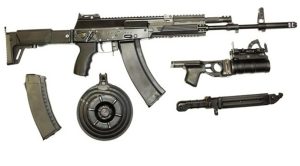
The AK-100 Series & AK-12 (Modern Era): Today, the AK-12 and AK-15 represent the pinnacle of the platform, featuring Picatinny rails, improved ergonomics, and modularity for 21st-century “Ratnik” gear sets.
2. Technical Superiority: Why It Never Jams
The Kalashnikov is legendary for its ability to fire in mud, sand, and sub-zero temperatures. This is due to its long-stroke gas piston system. Unlike the tight tolerances of Western rifles like the M4, the AK is designed with “loose” tolerances. This extra space allows the moving parts to cycle even when the rifle is filled with carbon buildup or debris.
3. The Prolific Giant: By The Numbers
The scale of the Kalashnikov’s reach is staggering. It is widely considered the most manufactured firearm in human history.
-
Total Units: Estimates suggest there are over 100 million Kalashnikov-style rifles in circulation worldwide.
-
Global Usage: The AK and its variants are officially used by the armed forces of over 100 nations.
-
Non-State Use: Beyond sovereign armies, it remains the primary choice for thousands of paramilitary groups and insurgents due to its low maintenance and ease of use.
4. Global Manufacturing: Who Builds the AK Today?
While the Kalashnikov Concern in Izhevsk, Russia, remains the spiritual home of the weapon, the rifle is produced—both licensed and unlicensed—across the globe.
-
Russia: The primary innovator, currently producing the AK-12, AK-15, and the export-focused AK-19.
-
China: Norinco produces the Type 56, one of the most widely exported variants in history.
-
Eastern Europe: Bulgaria (Arsenal), Romania (ROMARM), and Serbia (Zastava) remain major hubs for high-quality AK variants.
-
USA: In recent years, companies like Kalashnikov USA and Palmetto State Armory have begun domestic production to satisfy a massive civilian and tactical market.
